
Cillian Murphy and Antony Genn on ‘Peaky Blinders: The Immortal Man’ soundtrack: ‘Leave your ego at the door, the music’s in charge’
“It's a terrible affliction that we're both deeply afflicted with, this obsession with music,” the pair say as they release the brooding, atmospheric soundtrack to the iconic TV show's debut on the big screen
In Celtic folklore, the wren – though small – is titled ‘the king of all birds’ for outwitting the eagle by hiding on its back in order to fly higher than all other birds. Despite its royal title, the wren was symbolically hunted and its death emblematic of the end of the year and the start of the new. The significance of the bird varies between stories, decades and cultures, from resourcefulness and intelligence to treachery.
With qualities not unlike our protagonist, it’s a symbolism which Cillian Murphy and composer Antony Genn say they got “for free” when reimagining Lankum’s ‘Hunting the Wren’, featuring Fontaines D.C. vocalist Grian Chatten, as the track to play out Tommy Shelby’s final chapter in the upcoming feature length film, Peaky Blinders: The Immortal Man.
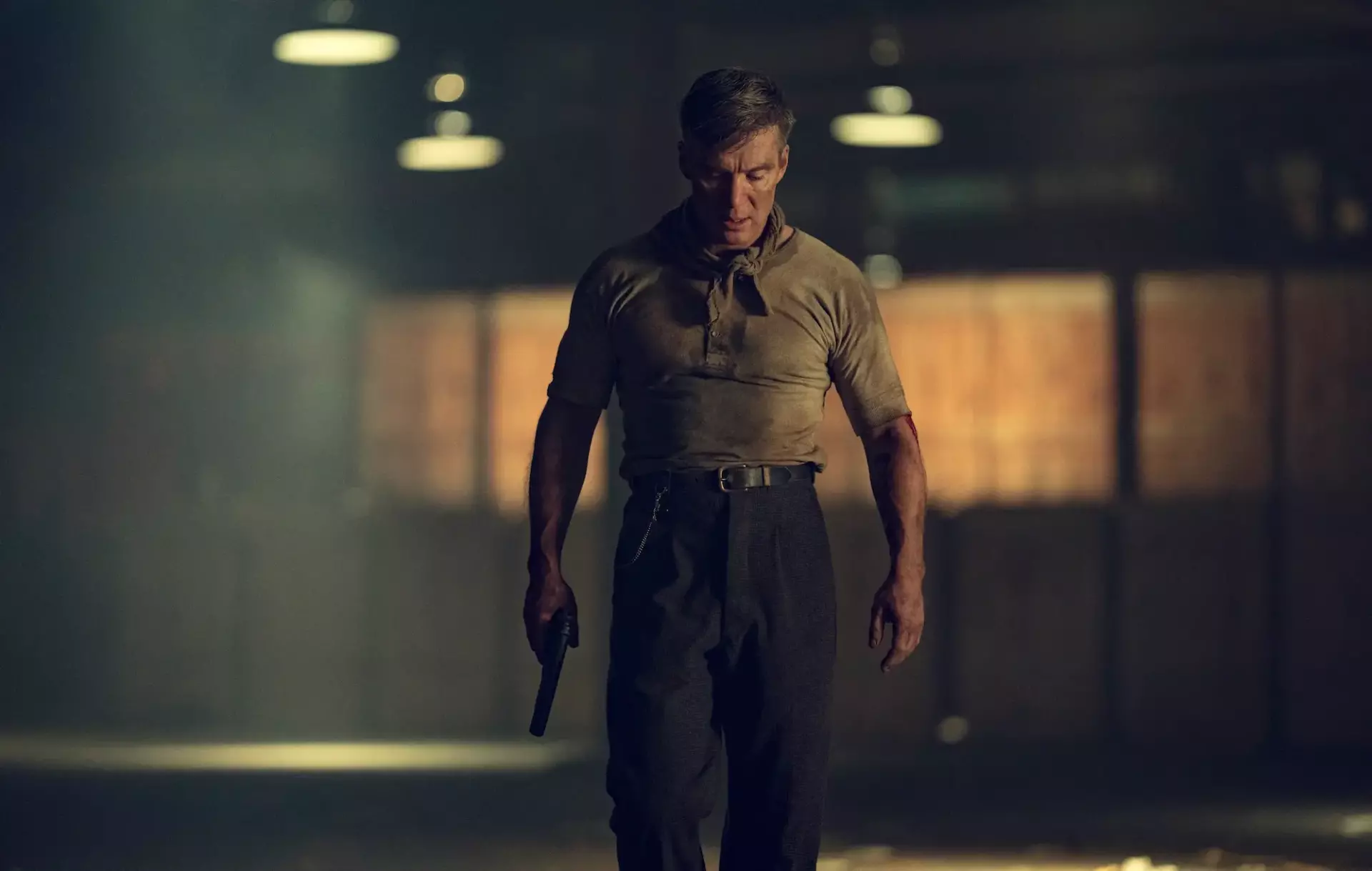
The new film from series creator Steven Knight, directed by Tom Harper, picks back up with Birmingham’s notorious crime family, the Shelby’s, in 1940s Britain. Set against the backdrop of WWII, Tommy Shelby emerges from a self-imposed exile to “face his most destructive reckoning yet.” The synopsis continues: “With the future of the family and the country at stake, Tommy must face his own demons, and choose whether to confront his legacy, or burn it to the ground. By order of the Peaky Blinders…”
Alongside Lankum, the new film makes way for a set of fresh voices, marking a powerful new chapter in Peaky’s iconic music legacy. Featuring 36 tracks total, the score, composed by long-time Peaky Blinders collaborators Genn and Martin Slattery, is bolstered with brand new original recordings from Amyl and the Sniffers’ Amy Taylor, and Fontaines D.C’s Chatten, Carlos O’Connell and Tom Coll.
Elsewhere, a curated selection of needle-drops includes a reimagining of Nick Cave’s ‘Red Right Hand’, an album track from 90s post-hardcore underground heroes, mclusky, and two Massive Attack covers, ‘Angel’ from Chatten and ‘Teardrop’ from Cornish/Irish newcomers Girl in the Year Above, described by Robert Del Naja as the most “sublime” interpretation he’s ever heard.
A masterclass in collaboration, the diverse, brooding new soundtrack is, as Genn describes, driven by the arc and emotion of the story resulting in what Murphy says is the one he is “particularly proud of.”
Read and watch our exclusive interview with Cillian Murphy and Antony Genn below, in which the two music enthusiasts discuss collaboration, storytelling, and when music in pubs is a bad idea…
Thinking about the legacy of the show and reflecting on the last 13 years, what is it about Steven Knight’s writing that you think lends itself so well to music?
Cillian: That’s a good question. I don’t really know. [Ant] might have a better theory than me.
Ant: I don’t know if it’s down to Steven. Steven’s writing is brilliant, but the great thing about film and television is it’s a collaborative thing. With Peaky Blinders, there was the writing of the first season, and then it was Otto Bathurst – wasn’t it? – who came in, and he had ideas. The great thing about collaboration is that there’s always surprises. Steve writes Peaky Blinders, I don’t know if Steve thought, “Yeah, let’s have…[this particular song].” I don’t think he did, I think it was Otto Bathurst who came in and said, “What about ‘Red Right Hand’, Nick Cave?” That kind of plants a flagpole somewhere that then lets you come off and shoot off in other areas and sparks other things. That’s the great thing about collaborative art forms, I think, where the sum of the whole is greater than the sum of its parts, so to speak.
Speaking about collaboration, I know in another interview recently with yourself and Martin Slattery, Ant, you said that the first time you heard ‘Puppets’ with Grian Chatten it gave you the shivers. Cillian, was there a particular scene that, when you saw it for the first time with the music, it did the same thing for you?
Cillian: Because I was producing [the film], I was lucky enough to see every version of it and hear every version of the song and the lads were working on it. The riff arrived first, right, and then it began to evolve. And then the lyrics came in later. We always knew it was going to be this piece of music that was written bespoke to picture, to that sequence, and then to see it evolve, it was electrifying. The song-to-picture is mindblowingly good. You get inside the whole world of Peaky through the sound of it and Grian’s lyrics, but then, I was on the radio today playing it and everyone loves the tune. It’s a banging tune just on its own. It’s been a privilege to be involved, all the way along, with the quality of music on the show, but this soundtrack I’m particularly proud of.
And the Lankum song [‘Hunting the Wren’]. It’s beautiful, it gives you goosebumps. With this film being the final chapter [for Tommy Shelby], how soon did you arrive at that as being one of the last things that we hear?
Cillian: That was pretty early, wasn’t it?
Ant: Yeah, and it was when we first had a meeting, before me and Martin had got the job. It was the first one with Tom. I did say in that first meeting, because me and Cillian had also already spoken about Fontaines and we’d already talked about Lankum. In that meeting I mentioned Lankum as well and fair play to Tom, I don’t think he was aware of Lankum, and he went and absorbed all their music, consumed all their music, and he’s the person that put ‘Hunting the Wren’ in the scene. It just worked so well for the scene.
Cillian: That never moved.
Ant: No, that never moved. That was one of those things. Apart from the fact that that I said to Tom, “I want to rerecord that song.” And I think at first Tom was like, “Are you sure about that, mate?” And I was like, “I just think we can get more. I think I think there’s more to be had by really tailoring it, crafting it and bringing it out,” because [in] the scene, you go out into the land and I just heard uilleann pipes, the sound of the land, you know what I mean? In this particular scene, it goes into these photographs and this goes to historical things. And I just thought we could, you know…
Cillian: …go deeper.
Ant: I was about to say milk it, but just go deeper. Exactly. That’s a better way to put it. Thanks, Cill. To go deeper into it and see if we can get more. And then when it comes out grander, and [adding] the orchestra and stuff like that. We were very lucky to get Lankum to agree to come and re=record it with us. It was a couple of the most magical days of my life, being in the studio working with those guys.
You touched on lyrics and the importance of lyrics. I wondered how important the symbolism of the wren, especially in folklore and in terms of the land, was to that scene?
Cillian: It’s a great point. I think that you kind of get that for free, don’t you?
Ant: Yeah, I just think sometimes you just put a song on and it works.
Cillian: It’s like magic.
Ant: Often not, you know, and in the process there’s a lot of trial and error. As Cillian says, every single scene that we did in the process, which was a long process, I would send to Tom and Cillian all the way down so we all had opinions on it. Fortunately, we’ve all got a great working relationship and understanding where if it’s not right, there’s no pussyfooting around it, I’ll tell you that. Sometimes you have to travel through things to get there, and sometimes you have to try things that don’t quite work. But you’re going in the right direction, or this part of it, this emotion works, but that this is not working in this context. Is there somewhere else we can go? That’s the process, and I’ll be honest with you, I love the process. So if I’m playing something to him or Tom and you [Cillian] turn around and go, “It’s not quite right,” that just raises questions. I’m all about the questions. I’m not sure about the answers. We come to the answers together, but you’ve got to keep asking questions.
Cillian: I think it’s the fact that myself and Ant have known each other for 20 years, myself and Tom have known each other since season one of Peaky, so there’s an awful lot of trust and you can speak your mind very, very openly and say, “Look, it’s not working for me” and no one gets offended. Everyone is there to make the best film. Everyone is there to make the best score possible. It’s really, really open, honest, interaction and sharing of opinions, which is the way it should be.
Ant: We have a motto – well, not really a motto, it sounds so cheesy, but a vibe with myself and Martin. We’ve worked together for 30 years. It’s like: you just leave your ego at the door, the music’s in charge. In this scenario, the story is in charge. We’re not in charge, the story’s in charge, and we are but mere servants of the story. Together, usually we can get there together. And that’s the brilliant thing about collaboration. That’s why I love collaborating with people because the sum of the whole is greater than the sum of its parts.
One of my favourite parts of the new film is when Tommy has a disagreement with a record player in the pub. What are your thoughts on his opinion that music in pubs is a bad idea?
Cillian: So, I agree with his sentiment. Music like ambient noise in the background is a bad idea. Live music in a pub is a great idea. But then, it’s very complicated because I love a jukebox too. So, I guess I don’t like a detuned radio. Muzak is a terrible idea. But a really well-chosen coin jukebox – who does that anymore? – or live music. I like [Tommy’s] sentiment, which is that pubs are for drinking and for chatting.
You’ve both got enough change in your pocket for one song on the jukebox, what are you picking?
Ant: Depends what day is. Depends what you’re doing. Are you celebrating a birthday? Commiserating?
You’ve just finished all your junkets…
Ant: “Celebrate good times, come on!” Maybe that.
It depends. The beautiful thing about music is [that] throughout history, there’s music for everything. You have music at a funeral, you have a music at a wedding, and every single thing in between. There’s music for birth, there’s music for death. That’s the beautiful thing about music. That’s why I’m so into it, because there isn’t a moment in the day that a certain song can’t soundtrack what I’m feeling or take me to feel something else.
I live in a flat, and sometimes nowadays with Bluetooth speakers, you just leave it on knowing that it’ll disconnect from your phone as you walk out. But then I shut my door of my flat and I think, “God, this is actually pretty loud” and I just leave it playing. I’m thinking the neighbours must think, “Is this geezer ever going to stop listening to music?”
Cillian: Sometimes I have one tune playing in one part of the house and you walk in and there’s another tune playing in the other part. I just love it so much.
Ant: It’s a terrible affliction that we’re both deeply afflicted with, this obsession with music.
Is there a running link or thread that weaves this collection of songs and the score together?
Ant: It’s always just about the story of the film, the arc of the story. We’ve been very, very lucky to work on a film that’s got such an arc where the opportunity to do such diverse music was right there in front of our eyes, and that’s why we were able to work with all these people as well. Bringing these great storytellers, from Lankum and Grian and Amy Taylor, and the teardrop cover [by] Girl in the Year Above. When we were watching [the film] the other night, just watching all these things and somehow it all works, even though it’s very different. But it’s all about the story, really. I just feel very lucky to have been involved in something that’s that gives you the opportunity to one minute to do something really delicate and beautiful, and then to absolutely take your head off. For me, personally, that’s great fun, because some days I’m in the studio tinkling on a little guitar and Martin’s putting a delicate piano thing down and then I’ve got bass with a distortion pedal.
It’s a cracking bass tone...
Ant: Fender Precision, man, through an Ampeg.
Ah, I’m a big fan of the sound of a RAT pedal.
Cillian: Oh, I like a RAT pedal.
Ant: RAT pedals are very good but the real trick is, in this hand, no pedal can do it. I’m obsessed with The Stranglers. They were the first band I ever saw, and JJ Burnel, who is one of the greatest bass players of all time, you’re thinking, “What pedal is he using?” If you ever watch him play, which I did, it’s this hand that’s doing it. That fierce tone is coming from this geezer, so you can have all the pedals in the world but [your hand] is the only pedal you need.
The official soundtrack to ‘Peaky Blinders: The Immortal Man’ is available to stream now, with physical formats arriving in May. The film is in cinemas now and streams on Netflix from March 20.