
Andrea Bocelli launches “Believe. Further” with Philip Morris International in Venice
The multi-year platform was unveiled during a Venice media weekend, culminating in a 30th anniversary performance of Romanza in Piazza San Marco
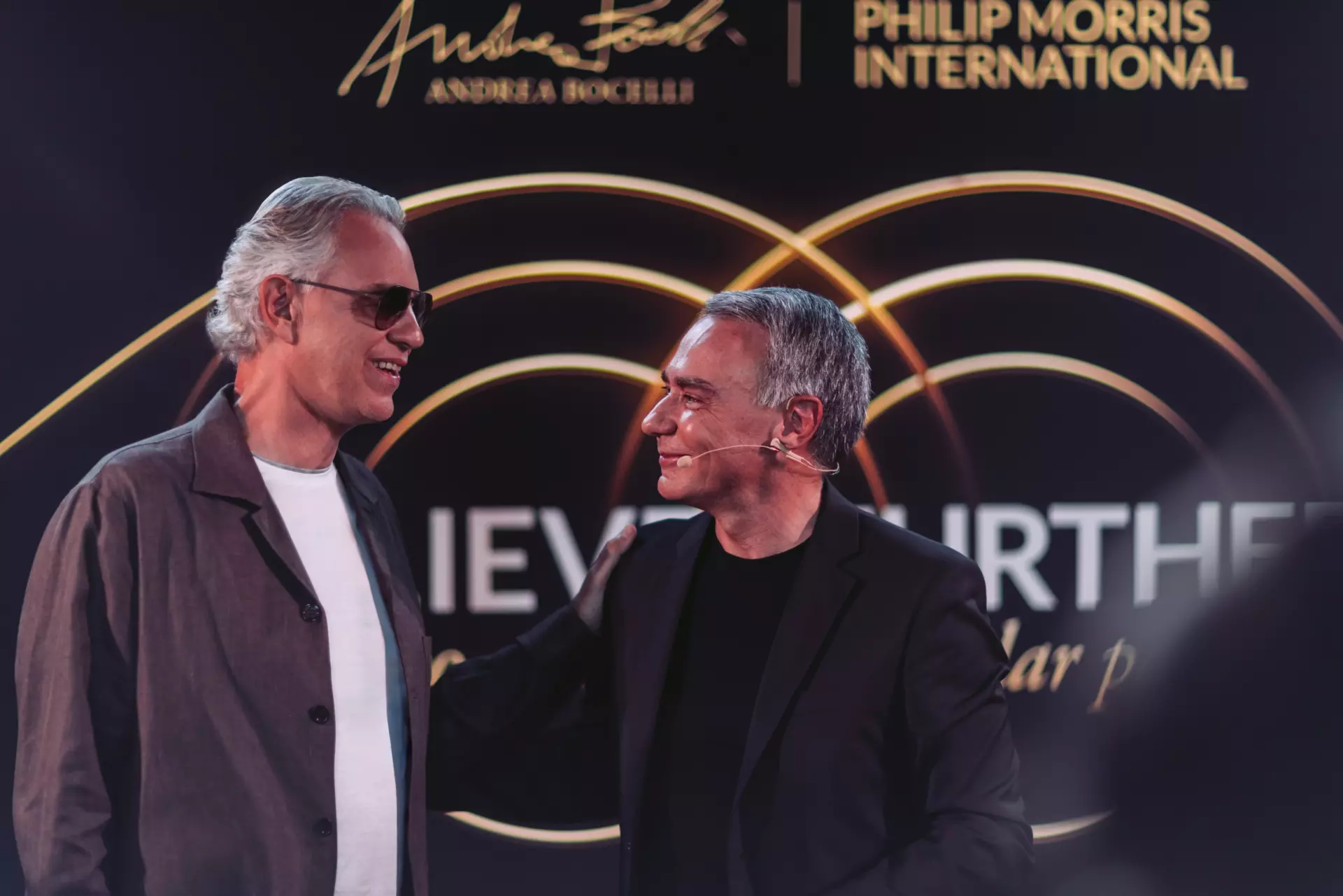
Piazza San Marco on a hot evening in June is one of those spaces that operates on an entirely different frequency versus the rest of the word. As a music venue, it imposes reverence before a note vibrates into existence.
With an audience of this size, you might expect noisy anticipation, the restless shuffling and relentless fanning of a sweaty crowd waiting to be entertained, fuelled by earlier canal-side Campari Spritz. Instead, the sound pre-performance was inexplicably soft, a low murmur moving through the square like a yielding drum roll. Part of that hush belonged to the setting. Part of it belonged to Andrea Bocelli. And part of it, perhaps, belonged to the collective awareness that to be seated in Venice, in that square, waiting for that voice, was kind of a big deal.
The occasion was the Venice launch of “Believe. Further”, a new multi-year platform from Philip Morris International and Maestro Andrea Bocelli, designed, according to PMI, to engage audiences in a wider conversation about progress, transformation and positive change.
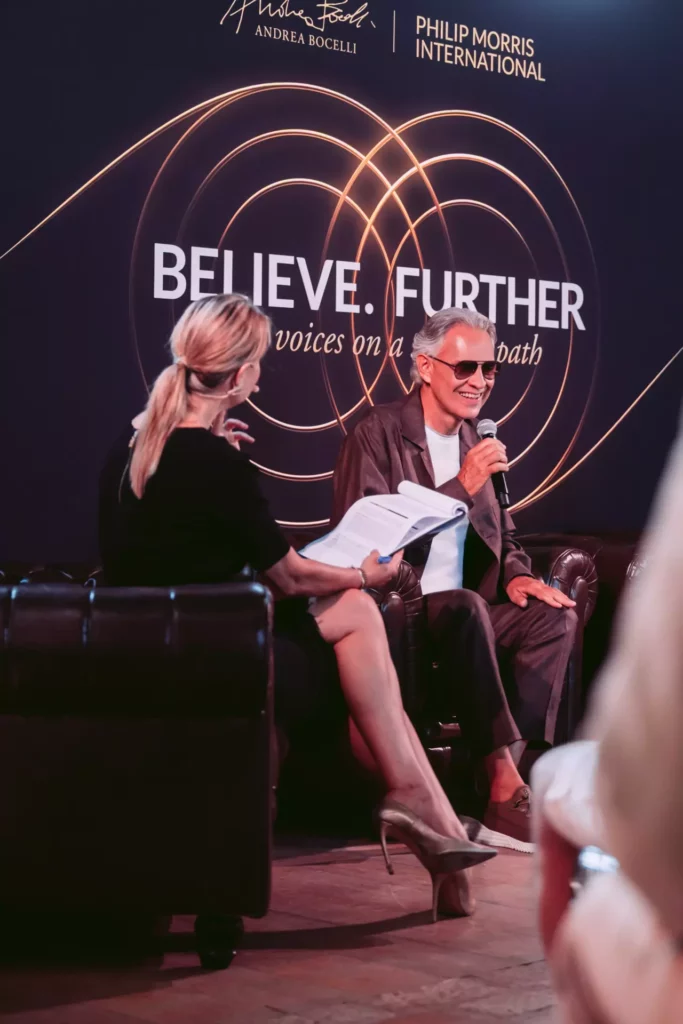
The launch formed part of a two-day media event in Venice, where European press gathered for a programme that included the city’s cultural landmarks, an intimate fireside conversation with Bocelli, and a concert in Piazza San Marco marking the 30th anniversary of Romanza, the 1997 album that helped turn the Tuscan tenor into one of the world’s most recognisable voices.
Around the square, PMI’s invited press wore lanyards naming their country of provenance, lending the evening the air of an elevated Eurovision gathering. Rolling Stone UK as the single UK media presence bonded intimately with PMI Germany and German National Geographic Traveller over humour drier than Knäckbrot, flirting with Euronews and their superhuman capacity for gin and tonic, collectively observing Slovakia that seemed to have sent their most glamorous TV personalities for the occasion. Douze points pour la Slovaquie! But as the lights came up, all fell into the kind of collective stillness that only a historically significant live performance can really command.
The programme itself moved with intention. Its first half honoured the operatic tradition, with works from Verdi, Puccini, Bizet and Orff, including “La donna è mobile”, “Brindisi” and “O Fortuna”. Its second half shifted towards the repertoire that millions associate most closely with Bocelli’s crossover career: “Caruso”, “Romanza”, “Il mare calmo della sera”, “Vivere”, “Vivo per lei” and “Canto della terra”.
Roberto de Candia brought delicious grandeur to “Largo al factotum”, resisting neither the humour nor the majesty of Rossini’s famous showpiece. For those unfamiliar, if you’ve heard an advert for Filippo Berrio olive oil recently – that’s the one.
Rusanda Panfili, the Moldovan-born violinist, composer and arranger, delivered the evening’s most electrifying instrumental moment during the “Cinema Medley”, her harmonics landing with such precision they felt like sorcery. Andrea Lykke, the Danish singer whose career moves between musical theatre, Disney voice work and classical performance, added seismic shockwaves of emotion to the second half. A notable quake came with “Vivo per lei”, as Bocelli and Lykke’s voices found each other and seemed, for a few minutes, to occupy the same breath.
Bocelli’s voice remains instantly recognisable: golden at the centre, a broad vibrato that ripples outwards like light on a Venice canal. There is an easy temptation, with artists of his stature, to reach for the familiar shorthand: legend, icon, still got it, Italian stallion. All true, perhaps, but too reductive. To watch Bocelli in Piazza San Marco was to understand something more specific about cultural pride at its most generous. Not nationalism as border or barricade, but heritage as offering: the beauty of the human delivered directly from the soul.
That idea of transformation – personal, artistic, cultural and corporate – sits at the centre of “Believe. Further”. The platform begins with the question: what do you do when the world has already decided what you are? For this journalist however, the more pressing thought is what on earth do you do when the world hasn’t decided what it is or where it’s going.
For Bocelli however, that question has shaped a career built on crossing borders: between opera and popular music, classical discipline and mass emotion, Italian tradition and global reach. Born in Lajatico, Tuscany, Bocelli studied law before fully committing to music. Over a career spanning more than three decades, he has sold more than 90 million records and generated more than 16 billion streams, according to materials shared around the launch.
For PMI, the same question is being applied to its own corporate evolution. The company, historically associated with cigarettes, says it is pursuing a long-term transformation towards smoke-free products for adults who would otherwise continue to smoke. According to PMI, smoke-free products account for 43% of its net revenues and reach consumers in over 105 markets worldwide as of first-quarter 2026.
“We committed to transform our business, replacing cigarettes with better alternatives because it was the right thing to do and because we could. There was no plan B,” said Massimo Andolina, President Europe at Philip Morris International, in remarks shared as part of the launch.
Bocelli, meanwhile, framed the platform through the language of values and possibility. “We must consider possible even what may seem impossible,” he said, “when it helps improve lives and advance human progress.”
The sensitivity of that conversation is obvious. PMI remains one of the world’s most scrutinised companies, operating in a category shaped by deep public health concerns and complex regulation. Any discussion of transformation in this space demands a tightrope walk of corporate positioning, science, public health debate and cultural storytelling.
What “Believe. Further” appears to be attempting is not a product launch, but a reputational and cultural platform: a way of placing PMI’s transformation narrative alongside a figure whose own career has been defined by belief, endurance and reinvention. Whether audiences accept that parallel will depend on to what extent they understand the principles responsible market development and how the platform evolves beyond its Venetian opening,
As a setting, Venice did much of the emotional heavy lifting. The city has always understood reinvention. It’s a potent spritz of history, theatre and spectacle. During the day, the Biennale offered its own reminder that culture is never still. By night, Piazza San Marco became something closer to an open-air cathedral, hosting voices conspiring to make even the most familiar songs feel newly charged.
In the concert programme, Bocelli described bringing Romanza to Piazza San Marco as a privilege that filled him with “excitement and emotion”. He also reflected that beauty asks to be recognised, cherished, defended and served.
That line lingered well into the early hours after the final notes.
Because for all the messaging around ‘believing further’ (clumsy in its construction, sorry PMI), the clearest argument of the weekend came not from a press release, a platform statement or a corporate statistic. It came from the music itself: from Panfili’s violin, from Lykke’s voice, from the hush of the square, and from Bocelli standing before Venice with a sound the world recognised instantly.
In that moment, belief did not need much explaining. It vibrated.
Disclosure: Vincent Jaskowski attended the Venice launch of “Believe. Further” as a guest of Philip Morris International. Philip Morris International is the parent company of Swedish Match, maker of ZYN, headline sponsor of the Rolling Stone UK Awards.