
Inside the Rise of Corporate Wellness and Conscious Design: Super Buddha, SuperSure, Wells Fargo Center
In partnership with Jordan Finkle
By Kyle Russell

The modern workplace is undergoing a quiet revolution shaped not by square footage or skyline views, but by physiology, psychology, and experience. The traditional office, once a temple to efficiency and fluorescent-lit productivity, has become an unlikely laboratory for ideas once reserved for longevity clinics, boutique hospitality, and elite athletic programs. What began as nap pods in Silicon Valley and kombucha taps in start-up lofts has matured into something more intentional and far more consequential: evidence-led wellness architecture, sensory programming, and bio-responsive space design.
The New Workplace: From Aesthetic Design to Cognitive Engineering
The shift is not aesthetic, it is physiological. Companies are no longer merely decorating; they are engineering environments calibrated to reduce cognitive friction, regulate stress hormones, support circadian biology, and cultivate states of flow. The workplace is becoming a performance ecosystem, informed by neuroscience research on attention and mood regulation, the rise of somatic therapy and mindfulness, and new biometrics-driven understandings of human energy cycles.
It is a response to a cultural inflection point. Hybrid work fractured the tether between employee and office, forcing organizations to re-justify the value of presence. Retention has become a measure of experience. Talent flight has become a proxy for cultural credibility. In this post-WFH era, the office must earn the commute by providing something irreplaceable at home: coherence, clarity, connection, and cognitive uplift.
Across sectors leaders are internalizing an emerging truth: burnout is not a personal failing; it is an architectural one. The cost of distraction, dysregulation, and emotional fatigue is measurable, not metaphysical, and the environments that once accelerated cognitive output are now understood to erode it.
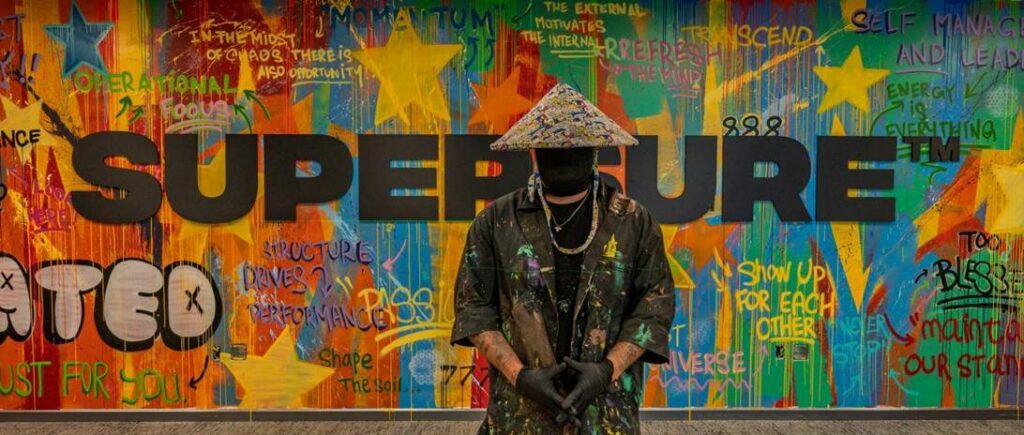
Super Buddha, SuperSure, and Spatial Language for Emotional Regulation in the Wells Fargo Center
In Miami, on the penthouse level of the Wells Fargo Center, this movement has taken on one of its most vivid expressions: a 25,000-square-foot corporate sanctuary designed by the artist known as Super Buddha for SuperSure, an AI-driven insurance technology firm. Here, corporate space is reimagined not simply as a workplace, but as a cognitive and emotional environment engineered to elevate mood, deepen presence, and anchor human performance. This is not perk-culture 2.0. It is the institutionalization of wellbeing as competitive infrastructure.
The vision has been entrusted to the artist known as Super Buddha, whose work blends contemporary Asian symbolism, color psychology, numerology, and meditative cultural motifs. Rather than hanging art on walls, he treats art as architecture, atmosphere, and subconscious programming. He is creating a spatial language designed to influence internal state.
Visitors enter a sculpted environment where spaces are sequenced like emotional chambers: a Zen meditation suite, a vitality room for acupuncture and chiropractic wellness, hospitality lounges influenced by Tulum’s biophilic serenity, and circulation paths that function as mindful corridors rather than functional hallways. The design operates like a nervous-system circuit — a choreography of focus, recovery, creativity, and grounded energy.
Employees do not merely occupy the environment, they are regulated by it.
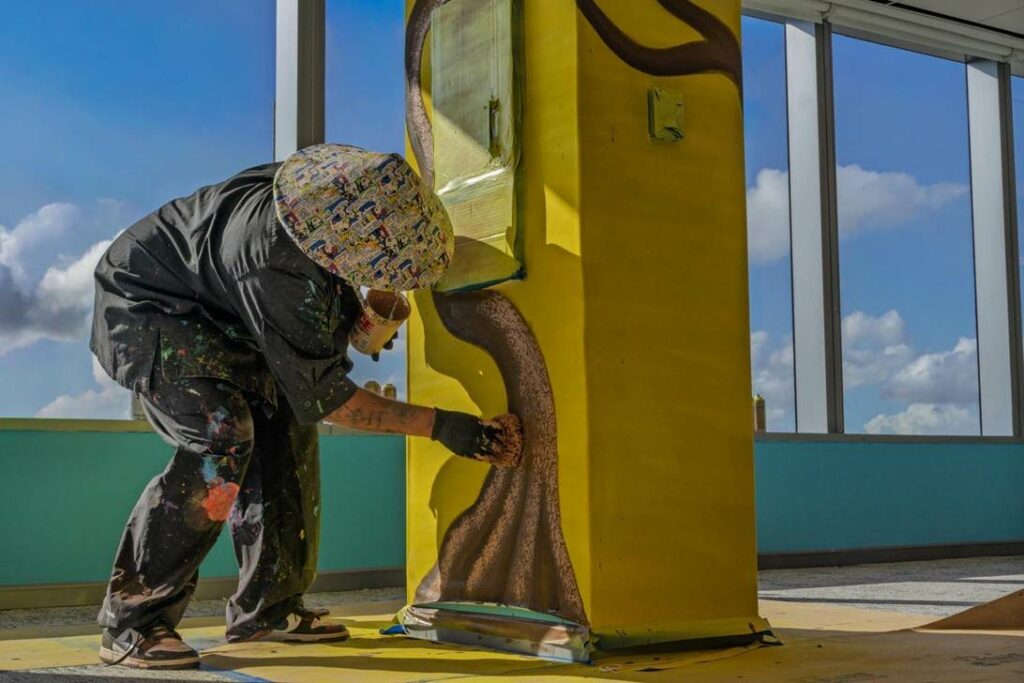
Wellness as Corporate Infrastructure
What once lived at the fringes of “biohacking culture” now sits quietly inside corporate planning decks. It signals a new era: the physiology of work becomes part of the economics of work.
Super Buddha’s work aligns with this logic. His spaces are not escapist—they are functional cognitive tools. Everything, from pastel gradients to numerological placements to koi and blossom iconography, carries intention: to uplift mood, widen emotional bandwidth, and remind the mind of serenity, not urgency.
This philosophy mirrors the evolution of wellness from consumer trend to corporate necessity. As high-performing companies embrace longevity thinking and human-systems design, the office is becoming not a container for work, but a platform for human optimization.
This article is for informational purposes only and does not substitute for professional medical advice. If you are seeking medical advice, diagnosis or treatment, please consult a medical professional or healthcare provider.