
Larissa Lowthorp and Miss Pluke: The Genre-Defying, Era-Defining Cultural Icons Whose Unorthodox Approach is Transforming Pop Culture
In partnership with Capitol Records
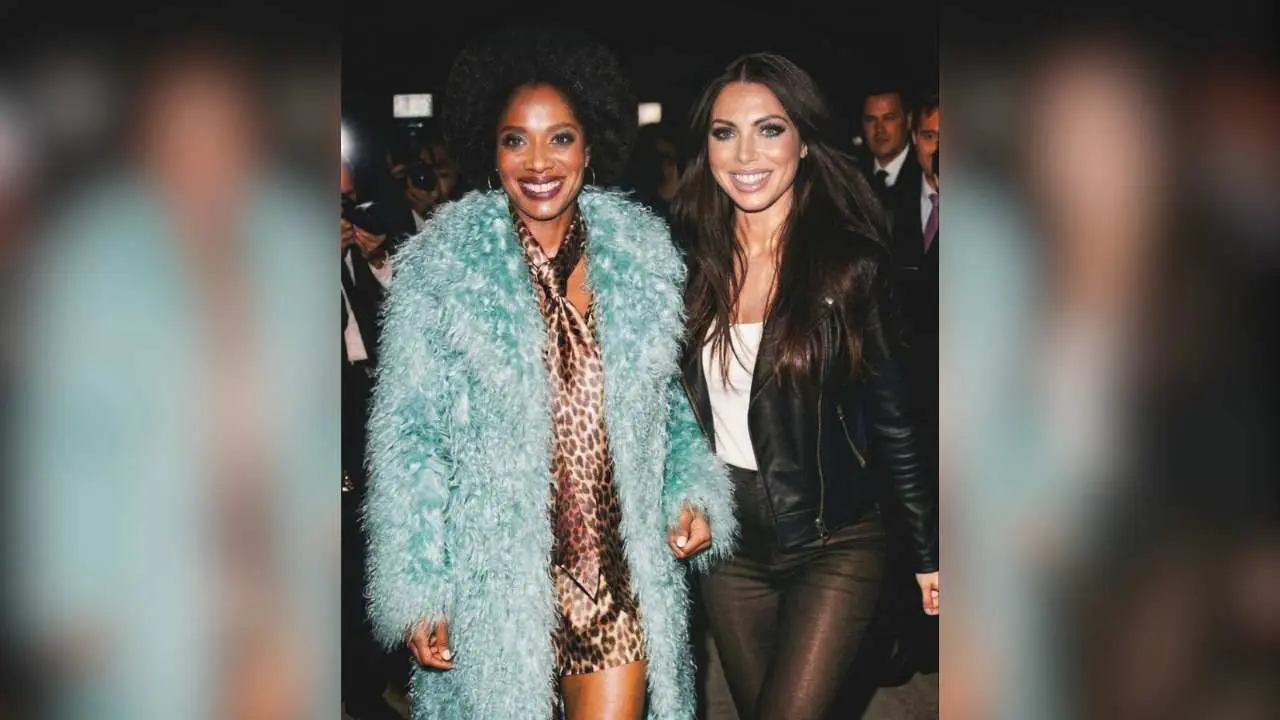
From the dawn of hip-hop and New Jack Swing to the trenches of Paisley Park and the Minneapolis underground, this pair has emerged from the shadows to dismantle the old guard. Now, they hold the keys to the kingdom—and they’re teaching the next generation how to unlock the gate.
At sunrise on Monday mornings, a gleaming white Mercedes pulls into a low-slung concrete sanctuary at the base of the Malibu hills. Out step two who clock the room before the room clocks them: Larissa Lowthorp and Marzella ‘Miss Pluke’ Marzelle. To the public, they’re the industry’s best-kept secret. To insiders, they’re the kind of “if you know, you know” force label and studio execs keep on speed dial. They move through the industry the way a grandmaster plays chess—nothing rushed, nothing wasted. In a cutthroat business, there isn’t another option.
Inside, the air is thick with Thai coffee and the sound of unreleased tracks tied to names you’d recognize—but likely won’t be credited. Then again, they aren’t here for the credits; they’re here for the conversation. Musicians, producers, composers, and a colorful cacophony of wandering scions filter through the room. Lowthorp and Marzelle work the crowd with casual ease, the kind of people who make you feel like they’ve known you forever—or at least since your last flat-lined release (too bad you didn’t call them first).
By mid-morning, the Malibu venue clears out. The pair heads deep into the winding, eucalyptus-scented shadows of Topanga Canyon for the rest of the day. This is where the real work happens. They spend the afternoon in a tucked-away private studio, lost in a haze of impromptu songwriting and building out a new sound with a small, hand-picked circle. It’s a raw, ego-free environment where they can be themselves. They write verses over the steady pulse of 800-year-old Himalayan drums and Tibetan bells salvaged from last year’s fires, a tragedy that’s served to draw this tightly-knit community closer together.
Watching her, it’s evident that Lowthorp isn’t interested in the tidy, soul-crushing boxes the industry uses to shelve talent. She’s the person producers call when the politics start to choke the art, or when a rollout flatlines. She’s the strategist, the closer, the one who takes a raw idea and makes it move. Her origin story reads like a series of unpaved switchbacks.
Raised in an artsy pocket of rural Minnesota, she was often pulled out of the classroom to travel with her parents. Her real education happened on the move—partially as a Guthrie-trained child actress in a traveling troupe of performers, and partially homeschooled during weeks-long stretches at the Mayo Clinic while her father dealt with chronic health issues from his time as a nuclear engineer. Between subjects, she’d find her way to the common-room piano, playing for patients and their guests.
But there was no piano in the house growing up. Instead, Lowthorp translated professional lessons onto an antique two-manual organ inherited from her grandma, composing her own ditties to bridge the assigned scales. Her father applied his atomic logic to his later work as a trombonist and inventor, treating music and math as the same thing: patterns to decode. Also a war-history obsessive and amateur radio operator, he ran the home like a laboratory where weekend movie nights were for compositional autopsy. Film scores and cinematography was picked apart until the bones showed. With a family tree tracing to the Churchill, Habsburg, Spencer, and Hanover lines, there was an unspoken order to the household. Lowthorp absorbed it early, spending parts of her childhood decoding WWII-era audio and firing off bursts of Morse code, training her ear to hear patterns everyone else missed.
That technical mind took her to Toronto as a financial research consultant for Intuit. Later, she was tapped to join Gunnar Wiedenfels’ team at Warner Bros. in Burbank, where she led creative direction on the studio’s tentpole franchises. Her physical training was equally rigorous. Prior to leaving Minnesota, she spent years mastering the undulating isolations of Middle Eastern movement with the venerable Jawaahir Dance Company, and later in private apprenticeship under Brazilian star Ana Cristina Oliveira, studying the faster, more intricate footwork of samba. This is the precision that now drives her intuitive approach to luxury fashion and entertainment.
This ear for hidden signals serves her well today; in the studio, she listens to a track as if she’s cracking a cipher, looking for the buried pulse that needs to be amplified. “You can feel when a track is lying to you,” Lowthorp says. “The industry wants everything polished until it’s unrecognizable, but the real power is in the friction. I’m looking for that one raw nerve everyone else is trying to smooth over. That’s where the emotion is.”
Her music pedigree is pure Twin Cities grit. Lowthorp ran the gauntlet handling the front lines of concert promotions at First Avenue, a protégé to legendary promoter Sue McLean. Together, they worked to keep the scene’s heart beating during its most volatile years. A turn with Ticketmaster rounded out her perspective, but it was alongside indie pioneers like Laurie Lindeen—the Zuzu’s Petals frontwoman and voice of the era’s DIY rebellion—where she learned to navigate a business rarely kind to women.
It became one of her signature moves. Lowthorp built a reputation guiding veterans through the slow, delicate work of reclaiming their narrative, while helping those earlier in their careers to differentiate their artistic identities from the start. She worked with Lindeen during her transition into life as a writer and speaker, helping her branch out and find her own voice while still leaning into her deep musical roots. Lowthorp applies that same strategy to others who had been written off, boxed in, or cut out of their own catalogs.
She and Marzelle mentor the emerging artists in their orbit to define their brand and sharpen their voices early, ensuring their identity is too distinct to be diluted by label mandates.
“I refuse to be a passenger in my own career, and I won’t let my artists be either,” Lowthorp says. “In this business, if you don’t define the space you own, someone will design a cage for you and call it a brand. I’m here to make sure you keep the keys to your kingdom.”
It’s about teaching the next generation to own their narrative before someone else tries to write it for them. Lowthorp saw the cost of that struggle firsthand behind the purple curtain. After years under an NDA, she’s finally able to acknowledge the work that led to her running creative direction on projects for The Artist during his war with the majors—tactics she now anchors into every undertaking. Lowthorp, who started as a college intern at a publishing house, was pulled into a clandestine request that demanded the kind of lock-and-key discretion that defined the entire operation. Her experience orchestrating fast-moving, immersive activations earned her the respect of the inner circle and paved the way for the unorthodox, highly effective concepts she brings to the studio and her work in luxury fashion today.
The exacting instincts she honed at Paisley Park are what led Lowthorp to a tucked-away Mediterranean estate hidden by an iron gate on a palm-lined boulevard in the Hills half a decade ago. She’d caught whispers of a New Edition Vegas residency and tour prep for a NKOTB opening act—and decided to show up at rehearsal.
Behind the mansion sits a converted guesthouse vibrating with high-decibel hip-hop. Inside is a floor-to-ceiling collage of mirrors and racks of glittery stage armor—prototypes from The Good Girls, Michael Jackson and Boyz II Men tours, half-sewn ghosts of pop history. In the center of the din is Lowthorp’s first glimpse of Marzelle.
Once the music hits, she glides across the floor, commanding the mic with a lethal, fluid grace. Her performance reveals the born entertainer who has spent a lifetime captivating sold-out stadium crowds.
When the music cuts, the room goes silent. Marzelle speaks in a low, velvet hush, though a jagged rasp sits just beneath the surface. This dual timbre lets her slip from a sharp, rapid-fire flow to the soulful weight of her gospel roots. Shunning the industry’s Autotune crutch, she’s back to the work of raw invention, ignoring the trend of vibe over structure.
Hollywood-born Marzelle was raised among the entertainment elite in the heart of LA. Dancing before she walked, she is the daughter of a train conductor with a “metaphoric poetic flow” and a mother who designed her own clothes, a blueprint for Marzelle’s own lyricism and work ethic. Her work with Bell Biv DeVoe established her as a primary force behind the New Jack Swing aesthetic; she co-choreographed and style-directed their “Poison” video before steering generations of R&B royalty. Whether working as the style director for Montell Jordan or serving the looks that inspired early identities of Truth Hurts, Missy Elliott, and OutKast, Marzelle was the “ghost in the machine” shaping the era’s definitive voices.
By her late teens, she had carved out a reputation that—alongside her Paradigm-signed dance quartet, Str8 Ahead—would lead to an induction into the Hip Hop Museum Hall of Fame. It is a long-overdue nod to a career spent defining the culture’s visual and sonic shorthand, but the credits only tell half the story.
A conservatory-trained actress and former financial executive who was a credited percussionist on a gospel album by age 13, Marzelle saw her work break on world tours and national television while the rest of the culture was still catching up. She prototyped the draped silhouettes that became the visual shorthand for the neo-soul movement, often pushing against label heads who wanted to play it safe. Now, she is weaving those threads together for a completely original sound on the record Lowthorp is producing under their newly-formed joint record label.
Today, the Lowthorp-Marzelle alliance serves as a survival guide for the next generation. It is a translation of the high-stakes machinery they’ve operated from the inside—a history spent maneuvering through the gears of Warner Bros. and Universal, and the heavyweights of Def Jam, MCA, and Motown. Through the partnership of Lowthorp’s production company, AllSight Studios, and Marzelle’s Stingh Management Group, they prepare new talent for the global stage. Their white-glove service teaches the oft-gatekept art of holding onto your rights and keeping your head under pressure, using a curriculum built on the battle-scars of their own careers.
That focus extends to Pluketacular, a capsule offering from Lowthorp’s luxury fashion house, Lunescape. Under the creative direction of Marzelle, the line pulls from a vault of concert and music-video prototypes she has held in her private collection since the early aughts. In a long-overdue resurrection of fashion history, Marzelle—who once skipped her college graduation to hop a tour bus—is finally cutting from her original patterns again. This time, there’s no middleman. The silhouettes that defined an era are being resurrected on her own terms.
The two are also working on a fictional series based on Marzelle’s life—a ground-level look at the seismic shift into next-era hip hop, told by someone who stood at the frontier of the genre’s most defining moments. She’s interested in the truth behind the tabloids.
As Marzelle puts it, “We’re focused on each small detail being satisfying to the psyche. We want you to miss a memory of something you didn’t get to experience. And I’m going to tell the real story, not the version the media groomed you to accept. I saw everything. You hear? Everything.”
Together, they move as a single, fluid whole. Lowthorp and Marzelle built the house, wired the sound, and they decide who stays for the afterparty. It’s going to be one hell of a ride.