
Libya’s Rising Generation Is Rallying Behind a Future They Believe Only Crown Prince Mohammed el-Senussi Can Deliver
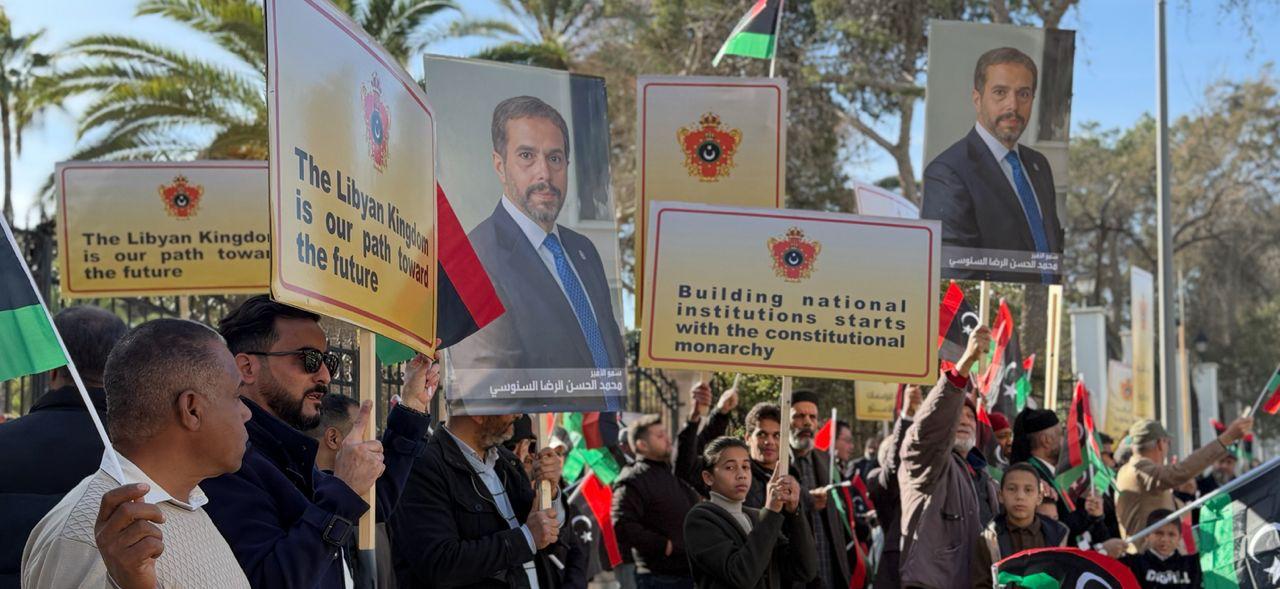
For most young Libyans, instability is not a chapter in their country’s history. It is the only reality they have ever known. Born into a Libya fractured by rival governments, corruption, armed groups and endless “transitional” arrangements, an entire generation has grown up without reliable electricity, meaningful employment or a political system that speaks to their future. What has begun to change, however, is their willingness to accept that reality.
Over the past two months, Libya’s youth have emerged as a visible and organised force in the country’s civic life, publicly backing an idea many of them never expected to embrace: the restoration of the constitutional monarchy established under the 1951 Independence Constitution, with Crown Prince Mohammed El Senussi as its constitutional head. It is a striking development precisely because this generation has no lived memory of monarchy at all. Yet for many, it now represents the only framework they believe can unify the country and give them a future worth staying for.
The shift did not happen overnight. In mid-November, nearly one thousand Libyans gathered in Tripoli for the National Meeting for Unity and Peace, the largest public mobilisation in support of constitutional legitimacy in decades. A week later, women from across the country convened to press for inclusion, stability and constitutional clarity. Then, on 4 December, young Libyans took centre stage themselves, organising a national youth conference that made explicit what had been building beneath the surface: deep frustration with the political class and a growing belief that Libya must return to its original constitutional foundations.

What makes these gatherings significant is not only their size, but who was leading them. Libya is one of the youngest countries in the world. Based on United Nations Population Division data, more than half of Libyans are under the age of 30, making youth the country’s largest demographic group. For years, this majority was treated as a problem to be managed or a risk to be contained. Increasingly, it is asserting itself as a political and cultural force, even as the space for public expression remains uneven and tightly regulated.
For Libya’s youth, daily life is defined by blocked horizons. University degrees often lead nowhere. Merit is overshadowed by patronage. Corruption is not an abstract concept but something encountered at ministries, banks and job interviews. Many young people describe feeling trapped between a desire to contribute and a system that offers no pathways forward.
“We were promised a future after 2011, but instead we inherited chaos,” said Ahmed Bayoud, a youth organiser involved in the December conference. “Every transitional authority told us to wait. Wait for elections. Wait for reform. Meanwhile, our lives were put on hold.”
Against this backdrop, the appeal of the 1951 Independence Constitution is rooted less in nostalgia than in pragmatism. Drafted under United Nations supervision and adopted at independence, it established Libya as a parliamentary state with a constitutional monarchy that stood above factional politics. It enshrined civil and political rights, introduced an independent judiciary, and granted women political rights earlier than several European countries, including Switzerland. It also provided legal safeguards for religious and ethnic minorities.
Crucially, many young Libyans argue that the constitution was never lawfully abrogated. Though suspended following the 1969 coup, it was never replaced through a legitimate constitutional process. Legal scholars, including those consulted in the United States, have noted that this leaves the 1951 Constitution as Libya’s only valid constitutional reference point.
To understand why this matters to a generation born decades later, it helps to look back. During the monarchy era, Libya transitioned from one of the poorest countries in the world into a functioning state with unified institutions, growing educational access and an emerging national economy. Stability allowed for long-term planning. Oil revenues were channelled through national institutions rather than captured by rival power centres. For young Libyans raised amid paralysis and fragmentation, that period represents proof that Libya once worked — and could again.
Crown Prince Mohammed El Senussi has been central to this renewed constitutional discussion. Over the past eighteen months, he has convened a National Dialogue with Libyans from across regions and backgrounds, holding sessions in Istanbul, London, Rome, Paris and Madrid. What began as conversations among diaspora communities and civil society figures has now translated into momentum on the ground inside Libya itself. For many youth participants, the Crown Prince is not seen as a political contender but as a constitutional figure whose role is defined by the framework established in 1951.

“The monarchy and the constitution cannot be separated,” said Ahmed Nbia, a youth organiser involved in outreach efforts. “When we studied our history honestly, the only time Libya had unity, legality and functioning institutions was under the 1951 Constitution.”
This sentiment became impossible to ignore after Libya’s Independence Day. On 3 January, young Libyans took to the streets in a public march expressing support for the constitutional monarchy and for Crown Prince Mohammed El Senussi’s call for national unity. The mobilisation unfolded within clear constraints on public assembly, yet it carried a weight that extended well beyond the streets themselves, resonating across social media, private networks, and youth forums nationwide. Banners appeared alongside chants emphasising unity and a future built by Libyans themselves.
“We are not marching for the past,” said Abdulrazag Henshir, one of the participants. “We are marching because we want a future that works. The monarchy represents unity, not division. It represents a state, not chaos.”
Beyond Libya’s borders, the movement is being closely followed across the region. In the Gulf, particularly in Saudi Arabia, observers view the emergence of a youth-driven constitutional movement as a potentially stabilising development, while recognising that visible mobilisation does not always capture the full depth of public sentiment under current conditions.
What is emerging is not a protest, but a reassertion of national purpose. Culture, history and political aspiration are converging around a shared belief that Libya’s future must be grounded in legitimacy, continuity and unity.
For the first time in years, Libya’s youth are not merely reacting to events. They are insisting on being seen, heard, and taken seriously — and are rallying around a constitutional framework they believe can finally make that future possible.
Rolling Stone UK publishes articles from a variety of contributors which express a wide range of viewpoints. The positions taken in these articles are not necessarily those of Rolling Stone UK.