
Tel Aviv’s New Architects: Inside Israel’s Tech Reinvention
Spend enough time in Tel Aviv’s cafés, labs, or meeting rooms and you start to notice a rhythm. Ideas move fast here, as founders scribble on napkins, engineers whisper about breakthroughs that have not yet been announced, and researchers pull apart problems as casually as if they were talking about the weather.
There are global tech hubs with bigger buildings, flashier events, and better coffee. But there are not many places where innovation feels this natural, this lived-in, or this relentless.
For years, the story was simple. Israel produced an improbable number of startups for a country its size. Scrappy founders, military tech expertise, venture capital flowing in. The “startup nation” label stuck because it was mostly true. But that story is becoming outdated, and fast.
Something fundamental has shifted. Israel is no longer producing startups in the way it once did. It is now producing the infrastructure that produces startups. Venture studios that treat company creation like an engineering problem. Hospital innovation centres that turn clinical frustrations into real products. VCs who no longer wait for entrepreneurs to show up because they are already designing the companies the world needs and then finding the people to run them.
It has been a quiet but defining change. The country now operates as one of the most effective startup creation engines on the planet, particularly in fields where breakthroughs are genuinely difficult, including computational biology, AI infrastructure, medical devices, and health tech.
While global tech investment contracted, for example, Israeli life sciences attracted more than two billion dollars in 2024. The Israel Innovation Authority reports roughly 1,800 active health-tech and life-science companies, with more than 90 per cent still registered in Israel.
Dror Bin, CEO of the Israel Innovation Authority, recently announced a major applied research consortium worth around NIS 180 million. He framed the moment with characteristic restraint. “This is the unique combination of science, industry, and vision that sets Israel apart, turning it from a startup nation into a global deep-tech powerhouse.”
For Bin, the “real challenge today is to continue creating innovation based on real value… moving from speed to depth, from standalone products to infrastructures that shape the future.”
AI companies like ThetaRay and Quali represent this shift. ThetaRay’s autonomous AI helps global banks detect financial-crime networks that traditional systems miss entirely. Quali builds platforms that allow companies to orchestrate sprawling multi-cloud AI environments, a problem that has quietly become one of the central engineering challenges of the era.
Both firms are flagship investments of Jerusalem Venture Partners, one of Israel’s most established venture capital firms. Its founder, Dr Erel Margalit, has watched this evolution across multiple generations of companies. He put it simply. “Israeli companies have traditionally combined their local heritage with an international strategy, a dual model that ensured business continuity. Overcoming hardship and achieving the impossible goes with us throughout our journey.”

But the biggest transformation in Israeli tech is not coming only from VCs or accelerators. It is emerging from venture studios purpose-built to take on scientific and technical challenges that are too big for conventional startups.
AION Labs is one of the clearest examples. Founded with AstraZeneca, Pfizer, Merck, Teva, and Amazon Web Services, AION begins with scientific problems that even the largest pharmaceutical companies cannot solve, then constructs companies specifically designed to tackle them. Since late 2023, it has launched five startups, secured follow-on rounds for two more, and has several others on the way.
CEO Mati Gill says that “Israel’s ingenuity, innovative DNA, and advanced science did not slow down due to the recent geopolitical situation. In fact, it flourished even more, and now there is a real opportunity to turn the ripe science into value.”
His calm confidence reflects a broader sentiment in the sector. Even in uncertainty, the machinery of innovation never stalled.
One of AION’s ventures, Promise Bio, is tackling a question that has frustrated medicine for decades. Why do patients with the same disease respond so differently to the same treatment? By using epiproteomics and AI to map patterns that influence therapeutic outcomes, the company is working to turn personalised medicine from an aspiration into a clinical reality.
Medtech is undergoing a parallel transformation. Edge Medical, a venture studio focused on medical devices, begins not with business plans but with actual clinical frustrations. The studio partners directly with specialists and builds companies that can move from prototype to regulatory clearance far faster than traditional medical-device pathways allow.
One of its strongest examples is Synchrony Medical, which developed the LibAirty airway-clearance device alongside pulmonary experts at Sheba Medical Center. Clinicians shaped every design decision, compressing what is usually a slow and bureaucratic pathway into a rapid cycle of development, clinical studies, FDA clearance, and US commercialisation.
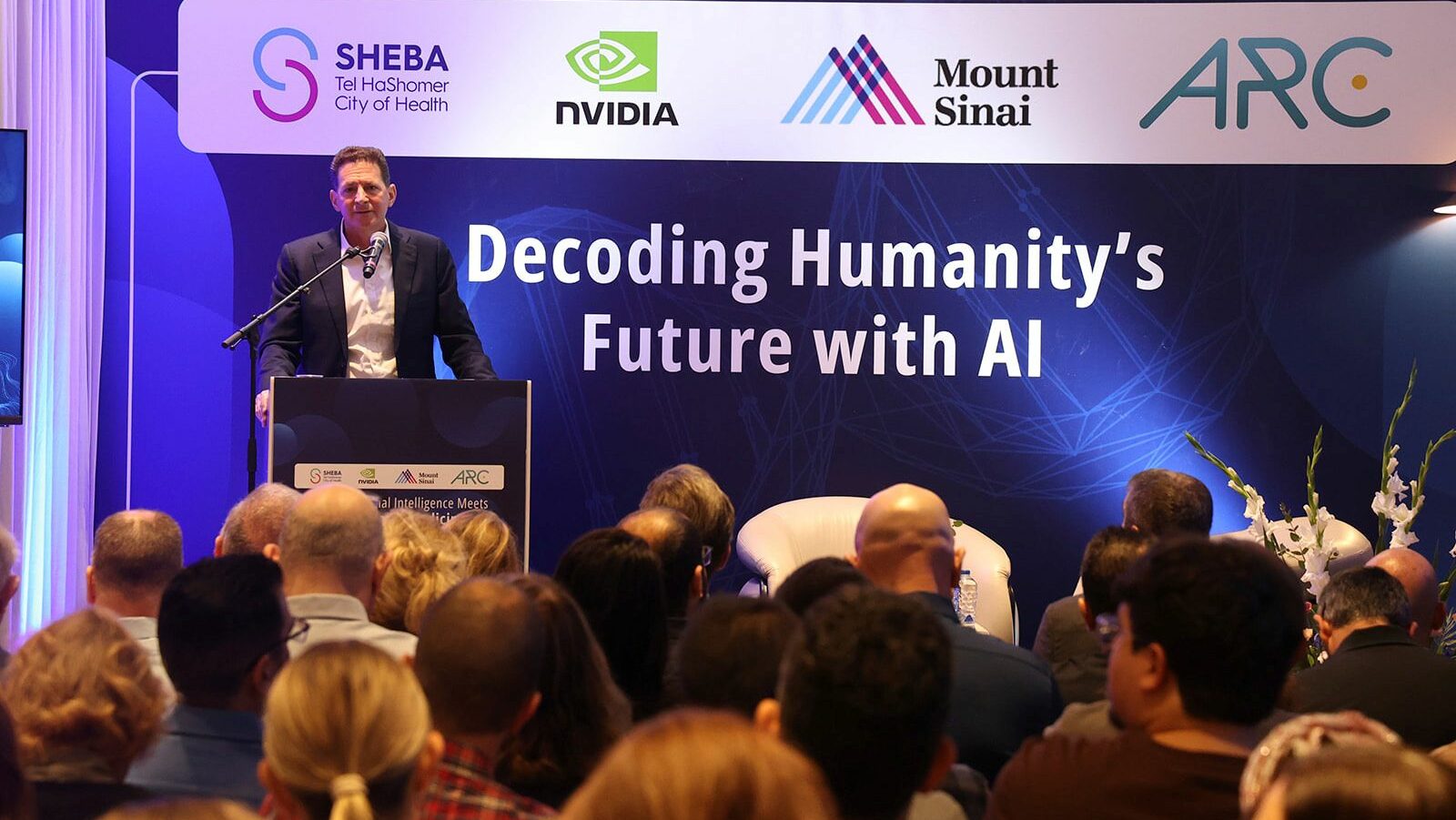
This tight connection between clinical practice and innovation also defines ARC Innovation at Sheba, one of the world’s largest hospital-based innovation ecosystems. ARC does not feel like a conventional hospital department. It feels like a studio where clinicians, engineers, data scientists, and entrepreneurs work in constant proximity, creating a feedback loop between medical need and technological response.
Its director, Prof Eyal Zimlichman, says the past two years forced ARC to accelerate dramatically. “Crisis is a catalyst for innovation. The war presented us with an opportunity to move faster. As we found out during Covid, crisis enables us to solve problems that otherwise would have taken us much longer to address.”
Zimlichman explained how the hospital adapted under pressure. “Alongside expanding rehabilitation services, which included piloting new health tech solutions, we accelerated mental health support technologies and created new frontline systems for our staff, finally getting rid of the only remaining paper trail in the hospital that was still existent in our emergency department.”
ARC embodies Israel’s broader innovation philosophy. What matters is not only talent or urgency or technology, but the architecture. It is a deliberately designed ecosystem that brings multiple disciplines into the same room and treats innovation as a system rather than luck.
Other countries are studying that system closely. London, Berlin, Boston, Singapore. Each is trying to understand how a country this small built a machine that produces not only startups but the frameworks for creating startups.
Israel earned its reputation by launching companies incredibly fast. The next chapter is more ambitious. It is about exporting the blueprint for how to build an innovation ecosystem itself.
As Dr Erel Margalit puts it, “Israel’s strength has never been about size. It is about building ecosystems that bring science, creativity and industry together with purpose. The next chapter is not just Israeli companies going global, it is global innovation hubs adopting the frameworks Israel has pioneered.”
Rolling Stone UK publishes articles from a variety of contributors which express a wide range of viewpoints. The positions taken in these articles are not necessarily those of Rolling Stone UK