
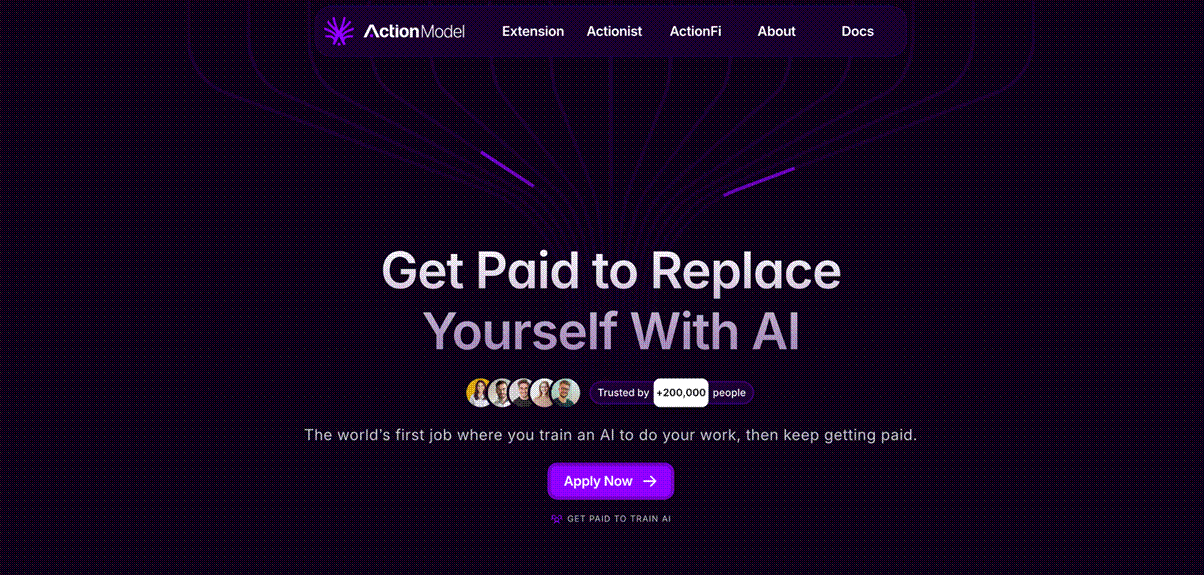
A startup is offering workers compensation to teach artificial intelligence how to do their jobs. Depending on how you look at it, that idea is either pragmatic preparation for the future — or one of the more unusual job postings circulating online.
The Laptop Economy Meets AI
For years, the internet promised a different kind of career path. Anyone with a laptop could carve out a living online. Writing. Designing. Coding. Editing videos. Managing communities. The so-called creator economy told a generation that if you had talent and enough hustle, you could build something of your own.
Now artificial intelligence is starting to do that work.
And according to Sina Yamani, most people still haven’t grasped how quickly the shift is coming.
“Many people around the world work in computer-based roles,” Yamani says. “Some analysts expect AI to automate a portion of these tasks in the coming years, and 80% of it within the next few years. People simply don’t realise what’s coming yet.”
A Job Posting With a Twist
Yamani isn’t trying to stop that future. Instead, he’s proposing something stranger: helping people prepare for it by teaching the machines how their jobs work.
His company, Action Model, recently posted a role called “Replace Yourself.” The job pays £80 an hour for participants willing to document how they perform their work and help train an AI system to replicate those tasks.
In other words, workers are being asked to help automate themselves.
At first glance, the concept might initially sound unconventional. For decades, technology companies have insisted that automation would free people from repetitive labor. What they rarely mentioned was that someone might eventually be asked to show the machines exactly how to do it.
The Argument for Opting In
Yamani argues the alternative is worse.
“We’re hiring people to teach AI exactly what they do for their jobs, essentially replacing themselves,” he says. “Whilst this may seem scary at first, they need to understand that it is an inevitability. Instead of sitting and waiting for BigTech to do it, you can do it yourself and earn an income from your AI replication when others use it.”
The pitch taps into a growing frustration with the way artificial intelligence is currently being built. Most powerful AI models are trained on enormous amounts of data scraped from across the internet. The writers, designers, programmers, and artists whose work helped train those systems rarely see any of the profits.
Action Model claims to be trying something different.
Ownership, Not Just Automation
“We believe that AI should be owned by the people,” Yamani says. “Action Model was recently introduced.”
The platform invites users to build automated agents and workflows that businesses can use. When those tools are used, the creator receives a share of that usage.
“Collectively, all of these people own a stake in the Action Model together,” Yamani says. “The bigger the community grows, the more valuable it is for everyone involved.”
For Yamani, the idea is simple. If artificial intelligence is going to learn how to perform digital work, the people who teach those systems should have a stake in the outcome.
From Doing the Work to Training the Machine
“Some computer-based tasks may increasingly be automated,” he says. “As for the person automating themselves, not only will it free up their time to do more important tasks, letting the AI take on the burden of work, with the possibility of earning income from the AI when other people use it to automate their work as well.”
For decades, the internet promised that anyone with a laptop could build something of their own. Write. Design. Code. Create. The work was the point; the thing that turned talent into a living.
But in this vision of the future, the work is no longer the point. The point is teaching the machine to do it for you, then collecting a fee when it does the same for someone else.
Empowerment or Surrender?
“Instead of concentrating value within a small number of large AI platforms,” Yamani says, “we’re allowing normal people to have a stake in AI as well.”
Whether that feels like empowerment or surrender probably depends on how you feel about the future that’s already arriving.
Either way, the laptop isn’t going anywhere. The hands typing on it might just belong to someone, or something else.
The information provided in this article is for general informational and educational purposes only. It is not intended as financial advice. Readers should not rely solely on the content of this article and are encouraged to seek professional advice tailored to their specific circumstances. We disclaim any liability for any loss or damage arising directly or indirectly from the use of, or reliance on, the information presented.