
‘Backrooms’ director Kane Parsons: ‘I plan on continuing it – Backrooms is not done’
The horror genre may never be the same again: at the age of 20, Kane Parsons has directed a masterwork for A24. Backrooms, based on internet lore around liminal spaces, looks set to be a critical and commercial smash. Here, Rolling Stone UK meets an exciting new voice in moviemaking.
Two real-world, mind-bending buildings evoke the same sense of unease as the endless liminal spaces featured in the new A24 horror film Backrooms, directed by 20-year-old Kane Parsons. Holy Trinity Cathedral in Tbilisi (monumental, and when this writer visited, virtually empty) and the inexplicably trippy, Lego-like Habitat 67 in Montreal.
“There’s a photo of that in the film!” Parsons enthuses of the latter, our mutual appreciation of improbable architecture swiftly opening up the conversation with Rolling Stone UK.
“We’ve still got everything in a storage container – I’m gonna probably try and poach a whole bunch of it!” he jokes when we ask if he managed to take any of the vast, maze-like set design home. “I’ve got the sun paintings and stuff in my apartment in Vancouver. I’ve got a handful of things!”
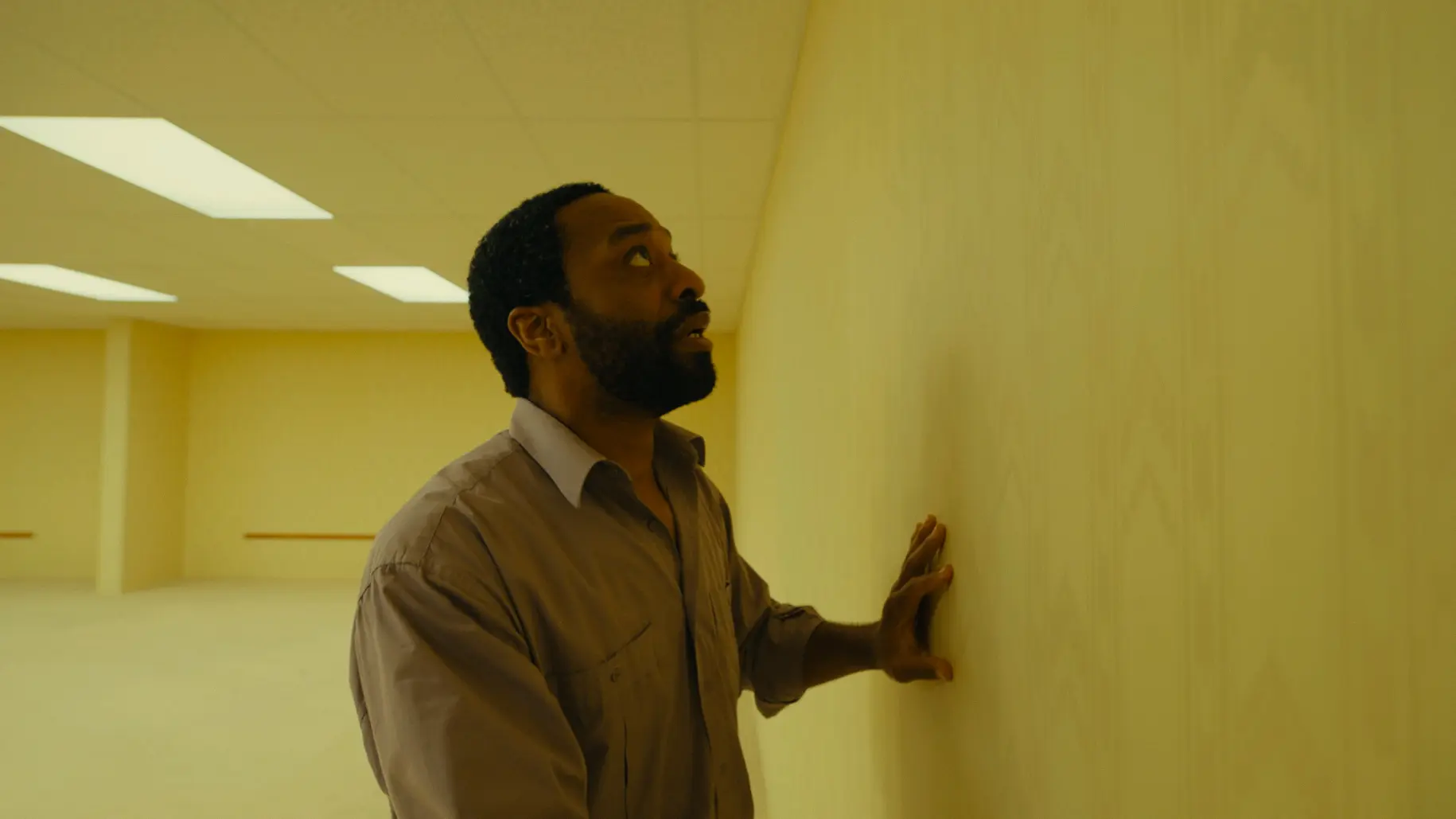
In this one-of-a-kind psychological thriller, Chiwetel Ejiofor’s besieged furniture store owner Clark approaches mental breakdown – and enters another dimension. One seemingly informed by his own mind, to boot. Inside, he finds an apparently never-ending series of spatially incoherent rooms, many of them sickly yellow in colour, full of distorted memories of his past. (Ejiofor’s fellow Oscar-nominee Renate Reinsve plays Clark’s therapist, Mary, who goes in after him.)
The Backrooms’ origin story is as fascinating as the film itself: it started with an eerie photo of a fluorescent-lit furniture store taken in 2002, shared online on a renovation blog in 2003, and reposted on 4chan in 2019 with the prompt for users to “post disquieting images that just feel ‘off’,” before blazing a trail across the internet from Reddit to YouTube and beyond.
Parsons is just one of millions who have contributed to this ‘creepypasta’ (a pun on copy and paste, and the user-generated nature of these stories) after he, at 16, made a hit found-footage horror web series out of it. A24 came calling in 2023. The now-film is written by Will Soodik and based on the aforementioned series by Parsons.
“I continually maintain that I did not create The Backrooms,” he says, stressing the universal nature of the story. “I don’t want to be the creator of it. This is an interpretation. Anyone can go and do anything with it, really.”
Here, this rising force in filmmaking talks about the messiness of the human mind and where the pull of world-building will take him next.
I have had some mental health issues in the past, and it can be so difficult to describe the experience of any sort of messiness of the mind. Stories and especially films that give you some witness-bearing and something to relate to can be quite helpful. Do you hope the film is received that way by people out there who are feeling something similar?
Yeah. I think that, for me, it’s been helpful for everything I’ve dealt with in the past. It’s been through the lens of – I get comfort from finding the sort of evolutionary or cognitive biological sort of imperative for where behaviours come from, where the messiness comes from.
I think the film, and any psychology, and any piece of work I do usually comes from, I think I like to have a… to the best I can; I’m not a neurologist, and I’m certainly not a trained psychologist, so these are all armchair perspectives and whatnot. Of course it is. But I think the film is very much dealing with the messiness of the fact that we as humans are not built to have a perfectly clear head, with, like, a perfect understanding of reality and perfect memory.
Everything we feel and think is built around a system that has evolved for a very long time just for the purpose of being a successful organism that can spread all over the planet and spread anywhere, really.
So, you know, there’s information everywhere and we only see a small sliver. Our memories are just an imprint left in our brain that is fleeting and designed to help us prepare for the future better. So, there are so many ways in which sometimes the systems that are in place just don’t mesh properly. Things can get wrenched in there. Things can get stuck. Like a broken little mechanism, clicking at the same thing over and over again like a fly against glass being able to see its own construction.
I find a lot of sympathy in all of that. I find it to be immensely neutralising. It puts me at peace, personally. I know that’s not the case for everyone. It’s at least the case with this hard sci-fi approach. I like to go into Backrooms and look at the psychology.
The horror genre is very youth orientated. I know some people have been a bit over-interested in your age, but one of the things I loved about the film is that the main characters are middle-aged. Which I feel is perhaps not what people were expecting. Can you talk about how the decision came to be that the characters would be that age?
Yeah, well, certainly, I think it’s just I have a bad time writing people my age, on the younger side. For whatever reason – maybe it’s because I’m only working around people who are much older, because of the necessity of how busy things have been. But I think in general you just have a chance to challenge more longstanding lifelong beliefs at a certain point that have had time to grow and develop. When looking at young people, there is a such a richness; there’s a reason why youth is used so much as a lever in film, I’d say.
But I think I am more interested in the challenging of institutions from an actual honest perspective that’s not so… a heated element coming in and slamming into a new, older system. You’re very malleable when you’re young. You can adapt with a much greater level of ease. I find trying to look at, with more honesty, what it is like, needing to commit to certain ways of life and mental patterns at a certain point that feel done and feel complete and feel final. Where else is there to go at that point? It just feels a little more challenging and therefore more interesting to me.
Have you had any contact with the person who took the original photo, or the person who made the original post?
I’ve not. I believe we know who took the original photo. Haven’t had contact with them. The original author – we don’t have a good way of confirming that. I’ve been messaged by well into the… at least a thousand people over the years claiming to be the original. Usually, it’s two camps. Either someone filing a cease and desist very aggressively, or it’s someone who is overwhelmingly calm and zen about it, and just being positive, which is, like, ‘great, if that is truthful, in either case, I wish I could have a coherent conversation.’ But when it’s so many people, it really promotes a sort of scepticism and an inability to be trusting of it. So, I continually maintain that I did not create The Backrooms. I don’t want to be the creator of it. This is an interpretation. Anyone can go and do anything with it, really.
Is there a director’s cut?
No. I don’t think so. There’s nothing in the film I’d want to bring back. You know, we cut things, things change. But this is the version I’ve advised people watch.
What is it about being scared that you enjoy the most?
There’s the cheap scare aspect of obviously adrenaline – I forget the exact psychology, but there’s a reason people are thrill seekers. That’s a big part of it for a lot of us. I’ve become a lot more appreciative with slow-burn… not slow-burn necessarily, but outside the context of immediately scary, adrenaline, heart going. Broader, more slowed down and more discussion-based horror. I think it just gives me a greater appreciation for most of life. I appreciate how it usually tends to give me a focus on challenging core beliefs that I’m uncomfortable with. It doesn’t pull a lot of punches, typically.
Did making the film affect any dreams you had?
No. Probably not. There are some dreams that affected the set design a little. But other than that, no. Usually pretty unrelated.
Have you detected a difference in how the film is being received comparing those that are digital natives, and those that aren’t?
Oh yeah, definitely. What can I say about that? I think there are too many different subcategories to summarise it properly right now, in the time we have, but I think that generally speaking … I know certainly people who are not feeling familiar with [The Backrooms], coming to it having a false grasp or typically coming into contact with false answers for the sake of having answers about the thing. So typically, there’s questions or feelings or at least an assumption that this was a video game that got adapted or something and whatnot. So, there are technicalities that are not true to what the situation really is. I think it’s like… I don’t know, I’m struggling with that right now! The distinction between those two groups. I think I could probably tell you in a couple of weeks when we’ve had a proper discourse. People are coming in here, and people like you have done their research, so I’ve not had to face it too much!
Are you excited at the prospect of world-building?
I mean, I love it, yeah. It’s one of the things I’ve been doing my whole life, pretty much.
But in terms of future feature films?
Oh, yeah. I think this is a world-building exercise on top of what I’ve already done. I’m well into it, and plan on certainly continuing it. Backrooms is not done.
Backrooms hits cinemas today (29 May).