
‘California Schemin’: How James McAvoy brought the Great Hip Hop Hoax to the big screen
James McAvoy talks opportunities for Scottish talent as he brings the incredible true story of Silibil N’ Brains, who pulled off Scotland’s great “hip-hop hoax”, to the silver screen.
By Nick Reilly
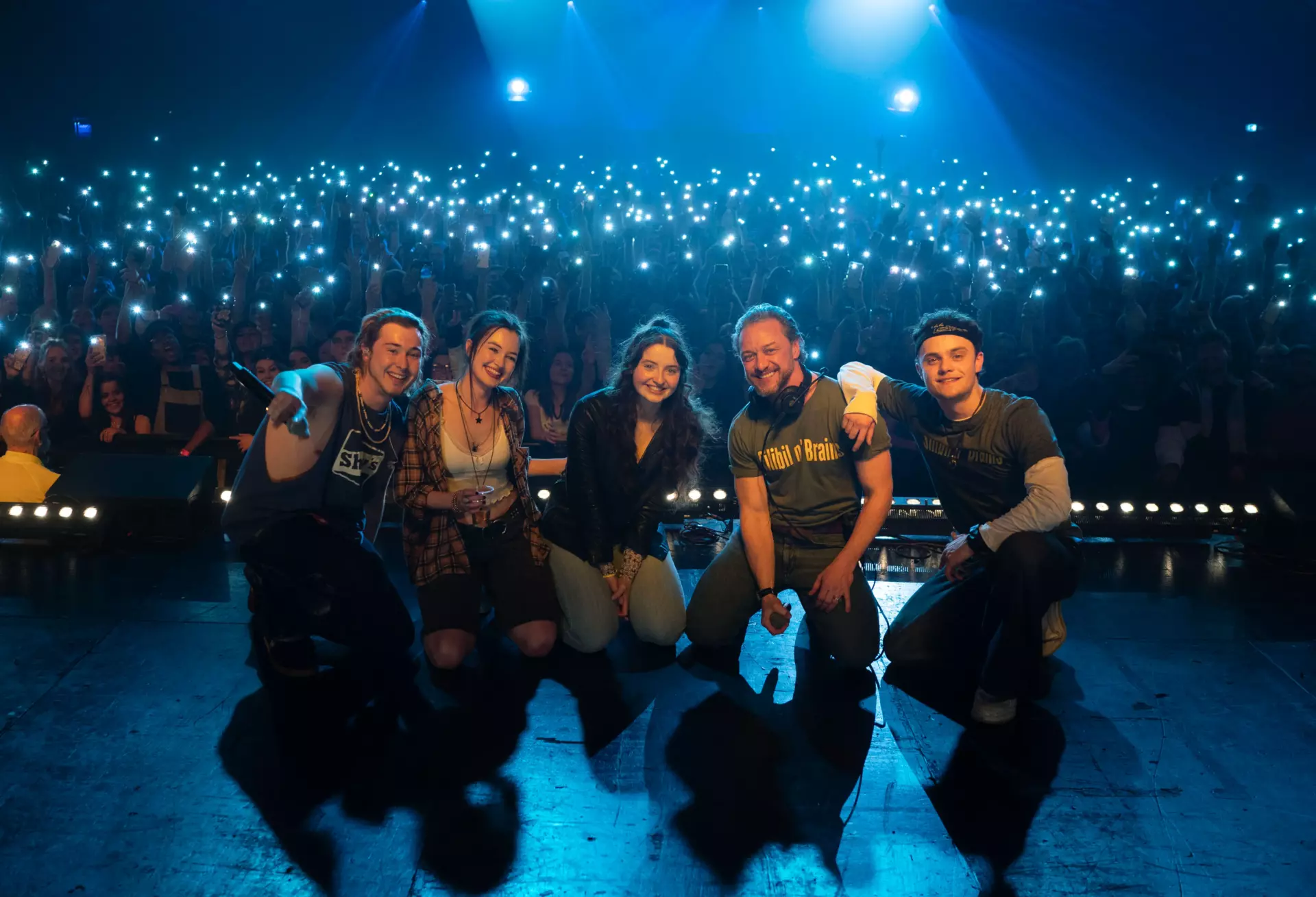
Eminem cut his teeth on the mean streets of Detroit. Kendrick Lamar found his Pulitzer Prize-winning prowess in Compton. Rappers from the fourth largest city in Scotland, however? Less of an established prospect altogether…
This was the situation faced by Dundee-born friends and rap lovers Gavin Bain and Billy Boyd when they answered the call for rappers from a major label in 2000s London. The pair were almost immediately and unfairly knocked back at an audition on account of their accents, derided as the “Scottish Proclaimers”. But as the old saying goes, if you can’t beat ’em, join ’em. The pair adopted the fake personas of West Coast rappers Silibil (Boyd) and Brains McLoud (Bain) and found that the industry was suddenly, and gallingly, a lot more receptive. MTV appearances soon followed, along with a Sony record deal and even a support slot with Eminem.
The personal cost, however, was huge, and the pressure of the lies, paired with some serious partying, began to have a monumental impact on the pair’s mental health, leading to the duo’s eventual decline.
It’s an irresistible Hollywood story now brought to the big screen in new film California Schemin’ by one of Scotland’s finest exports, James McAvoy, in a thrilling directorial debut.
“I’m always getting sent stuff, but along came this story that was entertaining in a way that movies made in Scotland aren’t always,” says McAvoy. “Or, accurately, the movies we’re allowed to make. We get trapped sometimes into making gritty drama, or things like Outlander that don’t come along too often. So, this story felt like the perfect opportunity to do something that was about being trapped and some of the reasons why that happens,” he tells Rolling Stone UK.
That, and the prospect of telling a truly irresistible tale, as McAvoy reveals in our full Q&A…
The idea of two Dundee rappers pretending to be American to hoodwink the record industry is an incredible conceit. What attracted you to this particular story?
There aren’t a lot of films that seem to break out of the gritty drama bracket that are made in Scotland. This isn’t just a Scottish issue, but it’s one I’ve seen in my part of the world.
And that sense of barriers translates to the film, too.
Whatever the barrier, the ceiling, the closed door, is, I think that wherever you are in the world, this is quite a universal thing, and there’s certain people who are allowed to do things, and there are certain people who are not allowed to do things, and that was key to this story. But also, I was just attracted by the opportunity to entertain. This movie has a heavy and dark part to it, but it’s also a true story which is quite audacious, and when Scottish people hear about it, we tend to go, “Fucking brilliant, man.” Because even if the boys ultimately failed and walked away with nothing, we all go, “Fucking brilliant, man,” as if they won.
That’s a comment upon the Scottish psyche; we love this almost Robin Hood story of gaming the system, sticking it to the man. I didn’t know what I was looking for when I wanted to direct, but when I read it, I knew it was this.
It’s a really exciting story – that’s the thing that shines through.
Yeah, and I got the chance to talk about what it means to be Scottish, what it is to try and perform as an artist and tell quite a universally entertaining story at the same time. That was all really important to me.
Did being Scottish yourself help to bring the story to life?
No, not really. I’ve been working for 30 years as an actor, and I think I’ve played five Scottish people. I’ve lived in London longer than I’ve lived in Scotland, and for that reason, I really wasn’t specifically looking for a Scottish thing to begin with.
What attracted me to this project as well was that it was about two young people in the sort of neighbourhood where I grew up. And these sorts of places exist all around the world, but there’s definitely a council estate mentality and a frame of mind that translates. Because when you don’t have money or electricity, you can still sing and have a party. It’s a story of ambition and creative desire, being faced with how much you’re willing to sacrifice, not just in terms of blood, sweat and tears, but of your own integrity and of your own identity and your own self to get it.
Can you relate to that idea of sacrifice?
Well, in a much less sensational fashion, I’ve walked that path my entire career as a guy from a place like Billy and Gavin came from, and my job is about pretending to be other people, of course. But there’s definitely been an internal conversation about my life, my career and how best to get there. And yeah, I’ve been there and that was the most important thing in telling that particular story.
With this being your directorial debut, was there anyone you looked to for advice?
Certainly, in post-production I took a lot of advice from Jon S. Baird, who directed me in Filth and is about to do so again in the adaptation of Frankie Boyle’s Meantime. I did ask James Watkins, who I worked with on Speak No Evil too, and he really helped.
But one of the only things I took was something I learned from Joe Wright on Atonement. And that was making a point every single time we shoot a scene of rehearsing with the actors and the director of photography. Lining it up, figuring [out] what shots you need if you haven’t already, and then bringing the whole crew in.
I’ve worked with Jamie Lloyd in theatre too, and he recently seems to be much more interested in the person than the actor. And I was all about that because it allowed the whole thing to be open and vulnerable.
You’re in the film too, though, as an all-out bastard A&R man. A fun part?
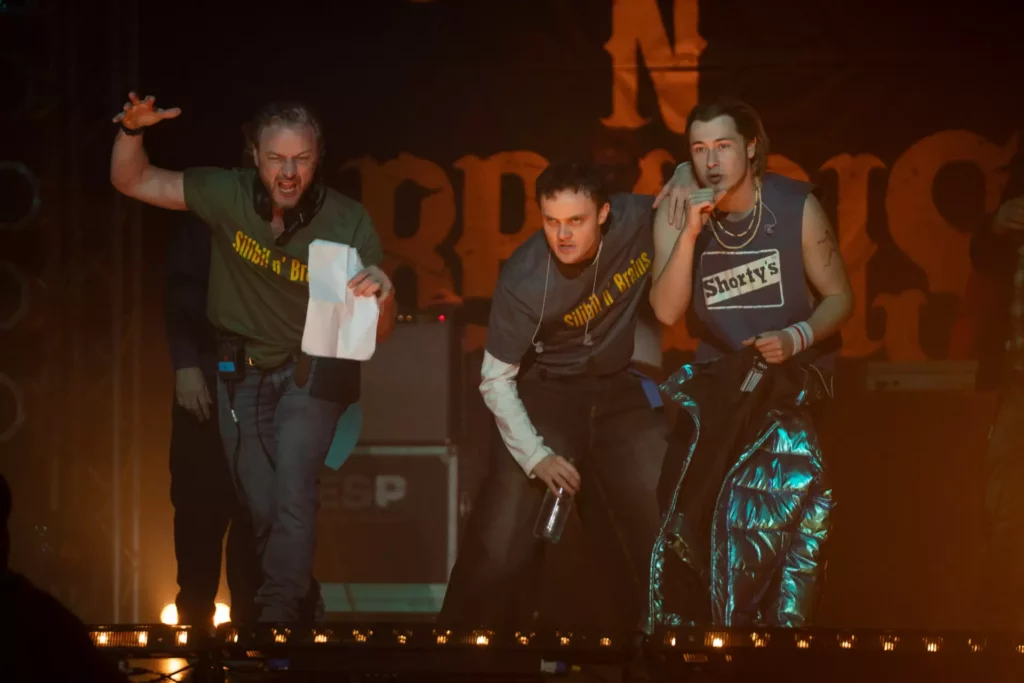
Oh, man, I could’ve done without it, and that’s probably why my character seemed so grumpy! It’s a lot on your plate when you’re directing; you’re spinning, like, 20 plates. I can’t remember who said it, but someone once described the process of acting and directing at the same time and explained how you’re behind your monitor but then you have to walk to your mark.
And then on the way to the mark, someone is telling you about casting decisions for the next day, telling you someone’s not available or you can’t get Portaloos to set and you need to change the location. And if it isn’t that, you’ll be walking back to the monitor to review your performance, and on the way back somebody’s going, “Listen, the lights haven’t come in for tomorrow.” So yeah, it’s stressful, and I think the grumpiness of my character was well served by that!
A baptism by fire then?
Oh, no, I knew it was gonna be a nightmare in that regard, to be honest. If you’re making a story about two Scottish guys who are 19 or 20, there’s not that many people who can be in it if you really want to finance your movie. That’s the state of our industry. So just having me in it helped a bit financially and certainly in attracting finance. It was actually the difference in getting one particular contributor to come on board.
There’s another famous face in James Corden’s dickhead A&R man…
Ha ha, yeah. I’ve known James for a very, very long time. Ever since I did Starter for 10. Which was a [2006] romcom, a coming-of-age movie focusing on a working-class kid from Essex. And like our film, you don’t ordinarily get that. But I’ve played football with James, we have a lot of mutual friends, and one of the stipulations from our financers was getting a famous person to do a cameo. So I hit up the phone book and James was right there. I’m massively grateful to him.
Do you think Silibil N’ Brains could get away with the great hip-hop hoax in 2026?
It’s interesting because when people have answered this question before, they’ve said that the boys would just find no barrier. They’d create their own Instagram or TikTok and become huge off the back of it without being American.
But maybe, but I still don’t see many Scottish rap or hip-hop artists out there really dominating. And it’s not even about domination, it’s not about having tons of people making money or getting loads of Grammys, it’s about cultural representation and having a proportional level of cultural diet for your own country.
Social media has made it easier to break through, and that’s brilliant, but I still don’t see a massive shift in the people that are really allowed to go mainstream or break through or reach a massive audience. It still feels quite exclusive to certain parts of the country in that regard.
Look, we’re not here to save Scottish rap music, but I do think it’s transferrable to Scottish culture in lots of ways. I still don’t really understand why we don’t have more Scottish movies. I find that really frustrating, even so, even though social media has gone crazy across the world, and in my own country as well, I still feel like we’re struggling as a whole.
There’s a lack of Scottish stories?
When you’re trying to greenlight a movie in Scotland, you’re looking at, like, a handful of actors who can help give financiers the feeling that, ‘OK, I feel confident that even if it’s a bad movie or it doesn’t feel great or we don’t make the best movie possible, we might make a bit of our money back.’
We struggle to give financiers that confidence because we just don’t have the actors there. And it’s certainly not that there aren’t wonderful actors in Scotland; we just don’t have a platform to show them off and therefore they don’t get the work.
It’s a lack of workplace, of film sets and it’s even trickier because we’re a small country and unless it goes gangbusters like I Swear did, which was an amazing film by the way, a Scottish film can’t finance itself. It has to be pretty low budget to make its money back, so we’re relying on it going elsewhere to make money, and I do think there’s some bias about the way we sound too.
Have you experienced accent discrimination?
Well, I remember a very long time ago when I was only 23 or 24 doing Macbeth and I was playing the Thane of Cawdor. The Scottish fucking king in the Scottish fucking play, and the director said to me, “James, just so you know, every now and again, I might just have to go like that [mimes turning down a dial with his fingers]. I went, “What do you mean?” He just said “Scottish” and he did it in that almost offensive deaf voice too. I don’t understand that. But it’s something we’re still fighting. It’s not a lack of talent, it’s a lack of work opportunity.
You were in your early twenties when the events of this film occurred. How nice was it to revisit that period?
Yeah, well, filming in council estates felt like a throwback to my teens. And brought back that idea of being passionate and working hard at an art, a craft. That was definitely my late teens and early twenties, and also that idea of friendship being an escape. I really hope that comes across in the film because the real jeopardy of this film is whether their relationship is going to make it. Their personal fucking integrity and sanity. Your relationships and friendships at that time in your life are so deep and important. You can see that in these characters. The biggest cost, the biggest price that both of them paid was the knock the relationship took.
California Schemin’ hits cinemas on Friday (April 10).