
How ‘A Hard Day’s Night’ became several brilliant films at once
In the week that Global Beatles Day took place, read our extract from Samira Ahmed's book about the Fab Four's possibly finest hour on screen.
By Samira Ahmed
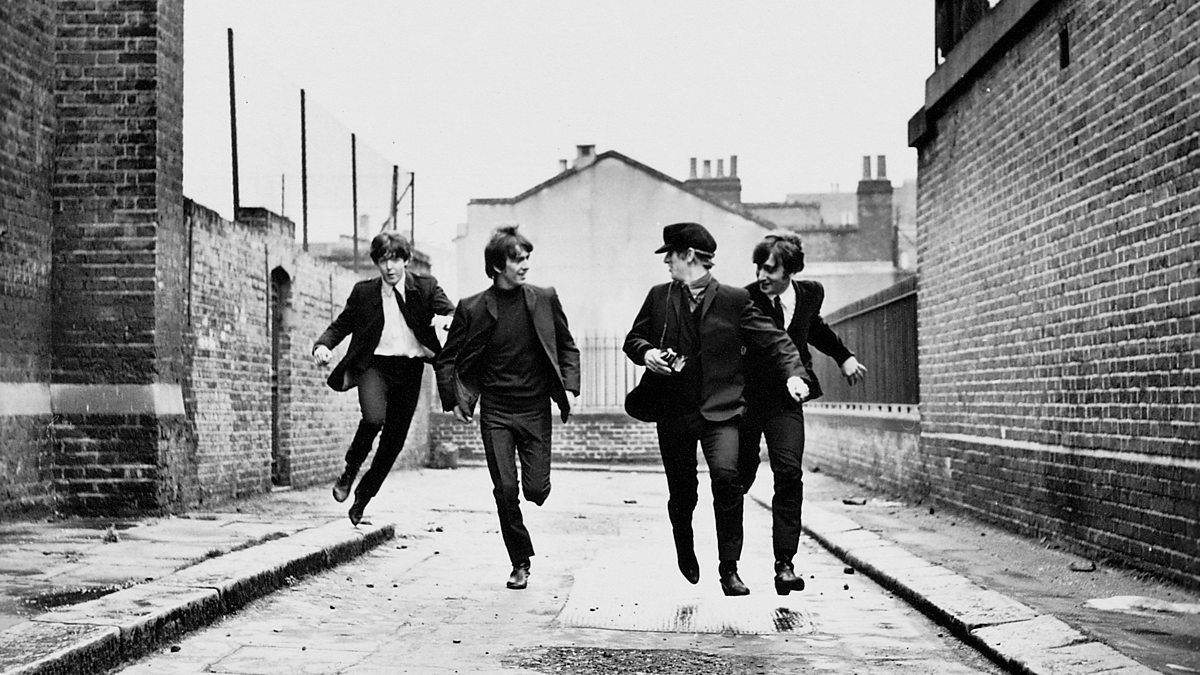
A Hard Day’s Night is often described as a fictionalised thirty-six hours in the life of the Beatles,as they travel down by train from Liverpool to London for a live TV show, but really, it is several films in one: a current affairs documentary about a new pop phenomenon, but shot like a wildlife documentary – these four playful, long-legged creatures with their irresistibly watchable antics.
It’s a surreal TV sitcom with no laughter track. It’s a war film of a commando unit heading from mission to mission, diving in and out of trains and helicopters as they go – all captured by a cinematographer who shot aerial combat footage as an RAF cameraman in World War II. Two-thirds of the way through it becomes, for a while, a social realist drama, with two troubled working-class boys meeting on a towpath. And it is also what it is not – a classic ‘let’s put on the show right here!’ pop musical, as pioneered in 1930s Hollywood, with a grumpy old curmudgeon threatening to ruin everything.
But, above all, it is a French nouvelle vague-style frolic in the spirit of Truffaut or Godard. This is no country for old men, is the first thought that hits you as the film opens on a crashing discordant chord and shortly after, the first of a spate of casualties.
There is a quick introduction for new users as we appear to be in the middle of a chase down an alleyway: the confident one (John) running first; another, slimmer and darker (George), hand in pocket, is grinning as he looks over his shoulder at the laughing crowd of youngsters racing after them; and a third (Ringo), shorter, close behind – all with dark jackets and thick mops of hair.
Suddenly, George trips – as he falls, his right hand emerges from his pocket just in time stop his face hitting the pavement. Ringo crashes heavily on top of him, but they’re soon up and racing onwards. Even through the adrenalin rush, George can’t help but look down and rub his wrist a little. That must have hurt.
We cut to a wide shot of a grand Edwardian station glass canopy and the main entrance to Marylebone railway station, where these young men are heading, all L. S. Lowry stick men legs, followed close behind by that cartoon cloud of children.
Into the concourse now and our first hint of the surreal: the three are suddenly in phone booths watching the blur rush by. Communications in the form of phone and photo booths, newspapers, ad hoardings and magazines – all surround every shot of the Beatles as they rush through the station, with (later on) press and television cameras zooming in, following their moves in much of the film.
We are caught up in the hunt in closer confines; the boys are the prey. John looks out of a café window warily and we cut away to the face of a screaming girl – she’s spotted them. A tally ho! in this new urban world of girls as hunters and young men as foxes.
In a dead-end alley lined with newspaper hoardings they are trapped and left to improvise a way out, watched by a bemused waiter. There is a sense of the boys’ self-awareness in this version of their daily reality semi-staged for the camera; placed in scenarios with the camera watching how they’ll find their way out. They hoist themselves up and over the hoardings, offering a glimpse of their lithe bums in those tight trousers. Landing on a moving newspaper cart, as if in a James Bond film escape sequence, John leaps off it and they are next seen bounding over metal barriers – the first of many running, jumping and (fewer) standing-still moments.
John, George and Ringo are suddenly relegated to background characters running past, while our attention is drawn to a bench. Behind a large newspaper the camera zooms in to find Paul, with a trad jazz beard, sitting next to Wilfrid Brambell’s Grandfather, looking at a copy of the pin-up magazine Men Only. He is that ‘dirty old man’ in the catchphrase used by his on-screen sitcom son in Steptoe and Son (1962–74). The show was the biggest thing on British TV at the time, drawing audiences of more than twenty million.
The boys take refuge in a photo booth, and we see the madness from their point of view, with the crowds of pursuing fans reflected in the mirror outside the booth. John and Ringo watching them go by and deciding to make a run for it. We, like the camera, are trapped on the wrong side of the booth and cannot follow. Instead, the camera captures the geometric field of the station canopy and concrete floor, with these three angular figures moving through it like points on a radar screen.
By one minute fifty-nine seconds we are building to a climax. At the far end of the platform with Grandfather and Paul, we watch the approaching tsunami – a dark, boiling, duffel-coated, cardiganed cloud of waving arms and legs and heads, emitting screams and cheers that we cannot yet hear above the engine of that pounding song. A group of girls are elbowing each other for room – on the edge of a fall themselves – trying to avoid tripping over a camera operator’s dolly being pulled just ahead of their feet.
Two minutes thirty seconds in and the departing whistle blows and we hear the real sound of the crowd screaming – a high-pitched wave of noise that we will repeatedly encounter from now on. In the sea of faces that has suddenly gathered, we can make out elderly ladies, newspaper men with giant camera flashbulbs, uniformed railway staff, including a white woman and a Black man. It is a snapshot of modern, fast-changing Britain, glimpsed through the eyes of the Beatles.
But hang on, where did the little old ladies and snappers appear from? The shot was captured by director Richard Lester, instinctively driven to seize the opportunity, without regard for continuity. And with it the viewer has experienced their first orgasmic Beatles encounter through a catchy new song, turned into a visual adventure. The comforting chug chug of the wheels of the train in motion has us in post-coital calm, ready to get better acquainted with the four young men who inspired such frenzy. We haven’t even been told their names.
There is no sense of the Beatles checking each other out or laughing about their escape or catching their breath. No concession is made for what we’ve just been through as the viewer. We are already fully with the Beatles inside their bubble – the reserved sticker on the window of the first-class compartment the only sign that they might have special status.
Sitting down inside, George is reading the paper, but otherwise the band confront each other in the moment, like actors in a play performed in the round. The windows, the mirrors on each wall, Ringo fiddling with a camera continue the idea that they are constantly seen through a set of glass viewfinders, establishing a quasi-proscenium arch of performance.
The idea of the band as a kind of single entity with a hive mind begins with the Mexican wave-style wordless communication as, nudged and nodded, they assess the little old man in their midst and we can assess them – their individual suits and especially their fabulous hair, nothing like the ludicrous identical black floppy pudding-bowl mops with which they are usually impersonated.
Paul and Grandfather eye each other coolly, as if aware of each other’s celebrity status. One from TV, the other from the new world of youth culture. Paul offers a half-wink of acknowledgment. Brambell sits stiff and erect like an intruder in their world, which he is. It’s an image that will repeat often through the film.
Grandfather, we are told, is ‘nursing a broken heart’. ‘He’ll cost you a fortune in breach of promise cases,’ says Paul. Throughout the film non-Scousers may not quite get the exact words, but we get the tone, and they cast an incantatory effect.
Combing his hair while he explains Grandfather’s presence (Mother ‘thought a change would do him good’), Paul is clearly established as the matriarch in a classic sitcom formula, explained by comedy writer Joel Morris as Matriarch, Patriarch (John), Craftsman (George) and Clown (Ringo). As Morris points out, the band often spoke of how they only truly became the Beatles once Ringo joined; once they had their clown.
Each new member of the team is introduced to the compartment, setting up the dynamics of the Beatles’ wider sitcom family. John Junkin as Shake – their dogsbody assistant – was modelled on their real-life assistant Mal Evans. Junkin was a veteran of Joan Littlewood’s Theatre Workshop and went on to be a foil for Tony Hancock. His genial comic presence helps ameliorate any appearance of nerves among the Beatles on screen. They trust Shake.
‘Got on all right?’ he asks, as he hands out snacks and drinks. ‘No,’ says John solemnly. Shake is relaxed – like an experienced mum, he knows how to handle them. Together with road manager Norm (Norman Rossington), they are an older generational layer of sitcom matriarch and patriarch.
Norm warns against trouble, while the four each start playing, displaying their own tics: George diving into the crusty roll in the paper bag, Paul nodding responsibly as if listening, John playing with the bag straps and sniffing the Pepsi bottle. The ‘veiled cocaine reference!’ gets a mention in the 1984 BBFC (British Board of Film Classification) viewing notes for VHS release, but ‘should probably go safely over the heads of the very young’, thereby protecting the film’s U certificate.
The presence of Grandfather is questioned again and again, drawing a collective response about him being very ‘clean’. In a real sitcom this point would have added or been expected to generate (canned) audience laughter. Instead, we get silence and the continuing rattle of the train on its tracks. The impact is a feeling of weirdness to proceedings. This is not a sitcom, or a documentary. Quite what, we don’t know.
The arrival of a bowler-hatted, suited older gent with a briefcase and newspaper changes the atmosphere. It’s an encounter so many of us have had as teenagers or children. The boys, helpful and smiling, wish him a good morning. He gives a look of haughty horror, complete with eye roll, and then hides in his broadsheet newspaper, finding himself surrounded by a manifestation of a social menace he’s read about in its pages.
But equally, there’s a sense of them all eyeing each other up, like cartoon characters getting ready for a fight. John looks cool but calculating. Underrate him at your peril. He is, we can tell, the most unpredictable and dangerous of the four.
The gent takes a second to clock the small open window and rises to close it, as if to establish ownership of the compartment. Ringo gasps ‘woah!’, looking at George, both recognising a perfect moment of passive aggression on public transport. It is so English and so class-infused. They aren’t going to pretend they didn’t notice.
Paul very politely points at it and asks, ‘do you mind if we have it open?’ ‘Yes, I do,’ comes the strong reply. City Gent is ready for this, his sense of entitlement in no doubt. The group goes into action – all for one. John’s tone hints at menace – ‘There’s four of us’ – but then he suddenly bats his eyelashes, girlishly, to wind him up. The gent’s response – ‘I travel on this train regularly twice a week’ – feels real because it is. ‘The thing on the train really happened to us when the man came in and closed the window and put the radio off,’ Ringo Starr later recounted. ‘And we told Alun … and he put it in.’
As in the real encounter, Ringo turns on a portable radio, only to have the gent turn it off and double down on his moral superiority, citing his knowledge of the Railways Act. Paul cosies up, listening, as if to humour him; Ringo looks stunned, while George scowls darkly. And then Paul reveals the left-leaning politics of the Beatles: ‘We’re a community. Majority vote. Up the workers and all that stuff.’
John, silent till now, moves his face in close like Rod Hull’s unpredictable creature Emu. Will he attack? But he says only, ‘give us a kiss.’ The psychology of the scene rings true. After John points out the older man’s childishness, saying to Paul that ‘you can’t win with his sort. After all it’s his train,’ City Gent, warming to his sense of victory, turns to John and hectors him: ‘And don’t take that tone with me, young man. I fought the war for your sort.’
Ringo leans forward to deliver the sassiest line in the film: ‘I bet you’re sorry you won.’ It has the extra joy of gifting the Beatles a kind of resolution they never had in real life. But it’s a takedown of an attitude that was constantly being deployed at the time, especially as the Beatles represented the first age group to narrowly miss compulsory National Service.
The Beatles underscore their moral victory by leaving, in Paul’s words, ‘the kennel to Lassie’. They pull childlike faces at the compartment door, asking for their ball back, as if schoolboys with a mean old neighbour. And then we are presented with the film’s first fully surreal episode, when the four somehow suddenly appear outside the window, running alongside the train, on foot or bicycle, banging at the window and repeating their plea. It’s followed by Ringo being carried sideways through the corridor like a parody of a wipe sequence into the next scene. From here on, we know for sure whose side we’re on, and we know we can’t be sure what will happen next.
This is an edited extract from Samira Ahmed’s book A Hard Day’s Night which published in the BFI Film Classics series.