
Lava La Rue: “I’ve always been quite vocal about things”
Lava La Rue on returning to their punk roots, being spotted by a Guns N’ Roses legend and making political music.
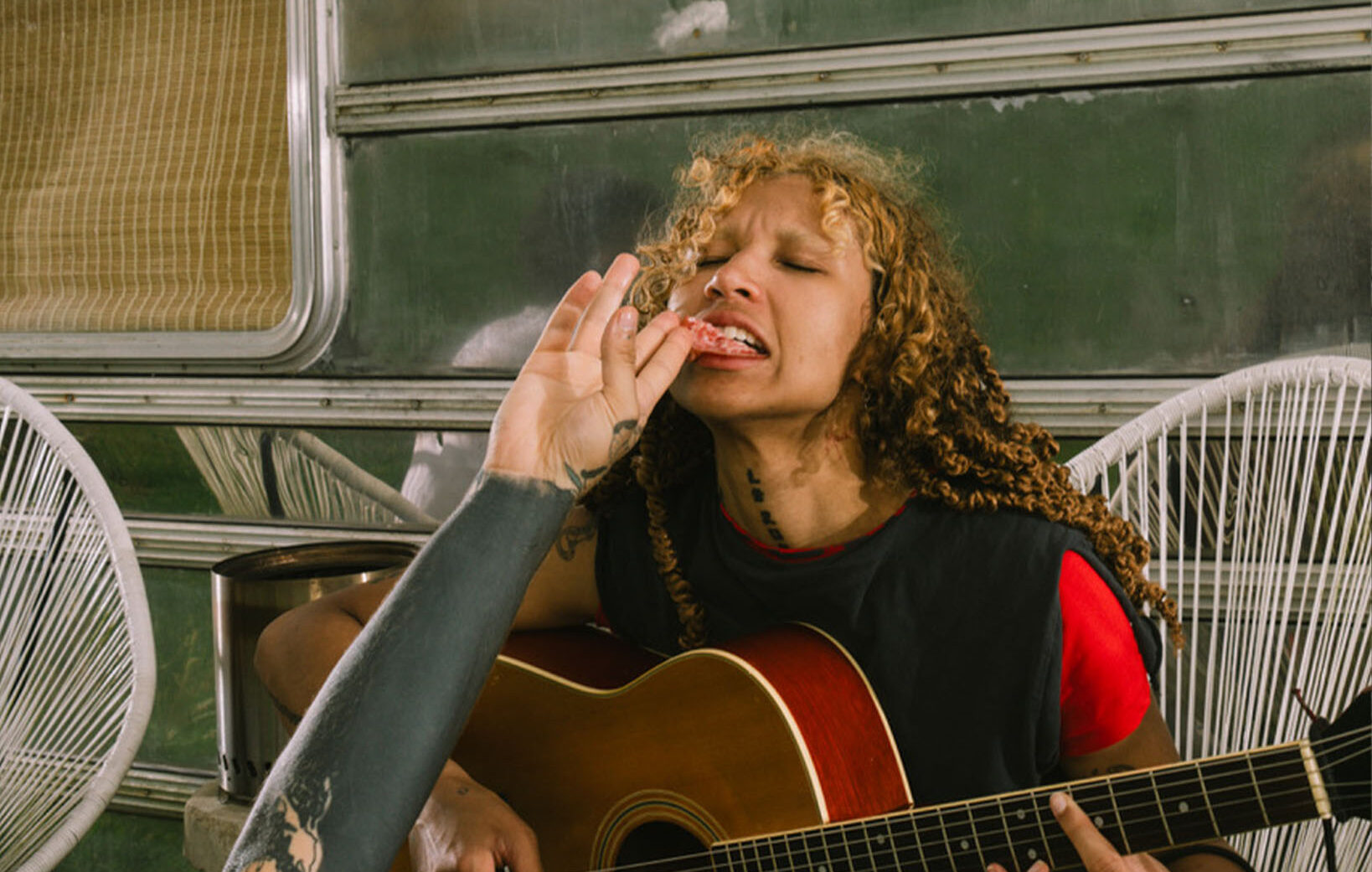
Lava La Rue was just 11 years old when they had their first taste of stardom. The west London-based musician and visual artist was performing on stage with their first punk band, The West Borns, when they were spotted by a famous face. “We were the only kids on the line-up and then fucking Duff McKagan from Guns N’ Roses, who was randomly passing through Notting Hill that day, watched us,” they laugh, before proudly showing us a picture of the moment on their phone. “It was like an episode of fucking School of Rock or something! He came up to me afterwards and said, ‘You’re going to be a star, kid!’”
With 500 million streams and counting of La Rue’s music to date, McKagan certainly wasn’t wrong. Two breakout EPs, Butterfly (2021) and Hi-Fidelity (2022), saw La Rue, 27, fusing elements of funk, alternative and psychedelia into a signature sound they developed primarily as an underground DIY artist. While still at college, they formed an influential collective, NiNE8, made up of artists, rappers and creatives like Mac Wetha and Biig Piig. La Rue’s work later caught the attention of Jamie Oborne’s Dirty Hit label, who released La Rue’s debut album, STARFACE, in 2024. A Bowie-esque concept album, it saw La Rue explore themes of identity, queerness and cultural belonging (they are queer, non-binary and mixed-race as the child of a Black British mother and Latvian father) to a soundtrack of psychedelic, shapeshifting soundscapes.
“It was a fun but risky thing doing a concept album because essentially for my whole debut, I was playing a character,” says La Rue. “It was a version of myself, but it wasn’t me.” They say they lost themselves a bit, especially as they’d been dressing up as a character night after night on tour. “By the end, I couldn’t wait to dress down and just wear, like, a fucking checked shirt and a jacket,” they laugh, pointing to the clothes they’re wearing today as we eat breakfast near La Rue’s west London home. “After the last album, I think I needed just to be still somewhere for a while. I think I needed to work out what my sound was again,” they say, admitting they felt lost.
La Rue flew out to Japan after an old school friend recommended a place to get away that her grandad – who just so happened to be John Mayall, acclaimed blues guitarist and punk fan, who hung out with The Clash in the 70s – always loved. La Rue went to Niigata Prefecture in Japan, home of Fuji Rock Festival, where they accidentally found themselves among a group of like-minded punks: together they would spend their days snowboarding and their nights jamming.
The trip led La Rue to declare that “it was really important” for them “to reintroduce myself on this next project, and for the follow-up to be me”. Indeed, they do just that on new EP, Do You Know Everything?, an emotive, confessional record that’s a throwback to 11-year-old La Rue’s love of punk. “It really is me returning to my roots,” they laugh of the EP. Opener ‘easy come, easy go’ is a breezy alternative bop made with acclaimed producer Fraser T Smith (who has worked with the likes of Adele, Stormzy and Dave) and also sees La Rue experiment more with their vocals.
“I wanted to push myself to unlock elements of my voice where it could be something weird and off-key but still interesting,” they explain, listing The Cure as an influence. “I’ve always been really inspired by how Robert Smith sings and approaches melody and timing in music. He really pushes his voice into places that are also a bit weird, and I love that.”
The EP is a more textured-sounding record in places on account of the fact that La Rue is no longer a singular artist: they’ve formed a band. La Rue say they were “longing to be back in a band” and had the time of their lives when the group were all together at Smith’s impressive studio. “We were trying to play it cool when we arrived,” they say, but failed miserably when seeing “the swimming pool, crazy [gold] plaques on the wall and the fucking caterer”, they laugh. “It was insane!” Even more impressive is the fact Smith asked for La Rue’s help on a visual project (they’re also the creative director for Wet Leg) and offered his services for free in return. “He could’ve charged me whatever, but he did it for a trade, for my creativity. It was mental.”
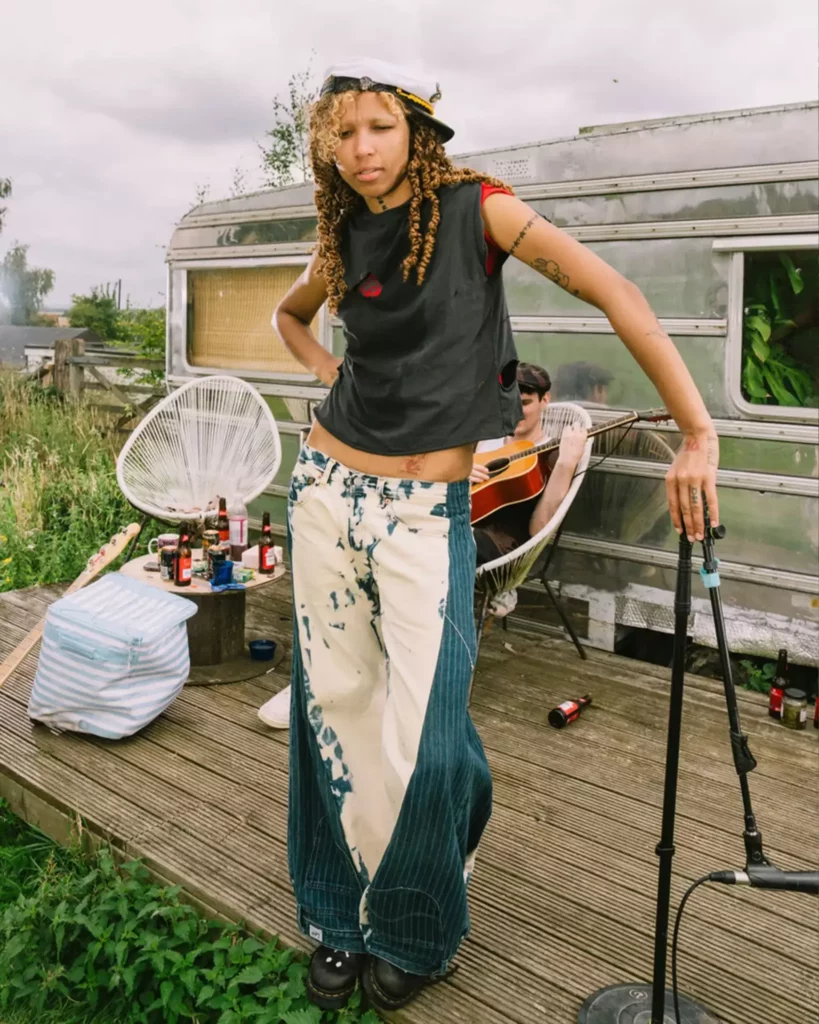
Being back on the alternative scene where they first made their name has been an eye-opener for La Rue, who remembers when it was dominated by white, cis men. “There’s always been a strong presence of Black people within alternative music… It’s not like suddenly we’re like, ‘Oh, we want to make alternative music,’ but it’s taken a while for the industry and people in those spaces to not just hire, work with or manage other bands that look like them, that remind them of themselves, that are educated at the same schools.”
They say while there’s been some positive change, there’s still much stereotyping to contend with in the industry when it comes to artists and the music they make. “I remember when someone called Arlo Parks a rapper. I mean, Pitchfork labelled my last record as R&B. I don’t think STARFACE had any R&B elements at all. No shade to them, but it’s hard,” they say, frustrated at the challenges that still endure. They say the alternative category at the MOBO awards, which arrived in 2022 after campaigning from bands like Nova Twins, was long overdue. “It’s like we’ve been here, always, but the recognition has not been.”
La Rue has also started to reconnect with the grassroots scene where they began. In the past few years, they’ve played Coachella, supported Remi Wolf, had a standout slot on Later… with Jools Holland, and recently attended the Grammys. But they were instead drawn back to where it all began. “There was so much cool stuff coming out of the underground scene that I just wanted to go back there,” they explain. However, what they found shocked them. “Things were in a really dire state. A lot of grassroots venues were closing; a lot of friends I know doing music had to get regular jobs just to survive.”
Music Venue Trust, which has been tirelessly campaigning to help save grassroots venues since 2014, revealed in January that 30 more venues were lost between 2024–2025 and over half those remaining made zero profit. “The middle ground is also being dissolved now,” La Rue says, of the venues that are “a step up from grassroots venues but not part of the big conglomerate. Now these have either dissolved or shut down too, or they’re being bought by the big boys.”
They continue: “The whole thing just needs a huge revolution. Ticket scalping has just sucked the life [out] of it too. Even for a band playing those middle venues, they’re barely breaking even. The venues have to charge a certain amount for artists selling merch to survive… it’s a mess.” La Rue says it made them want to connect with the scene now more than ever. “It was amazing for me to have some of the accolades I had on tour, but I was like, ‘Am I still in touch with the scene where I came from?’ I feel deeply that I still have much to give [to] where I started and it did so much to elevate my career. So now, of all times, is not the time to ditch that.”
La Rue noticed that musicians here were getting more vocal too, both about the state of the industry and about increasing censorship artists are facing around the globe. “Bands are political again,” La Rue says. “Things have a purpose, and there is a need for a subculture and collectivism again. I also think it feels less performative now [than previously] because it is a real dire situation. In the past, artists maybe [toyed with] the idea of being political but now it’s like, ‘How can you not be?’”
As a Black, queer, non-binary artist, they are aware that voices like theirs are being silenced in a world where minorities are facing increasing discrimination. They say they’ve had conversations with other musicians about the moral dilemma they have, like playing places where such animosity is overtly felt and whether they should “boycott them” on principle.
“But you can’t desert the people who are in the thick of it right now,” they reason. “There are so many people in my community who are being demonised for being queer, or a lesbian… I think now, you’ve got to be fearless. It’s a no-brainer that I’m going to care about this, and it’s actually about pushing where our compassions are because compassion can get confused for being radical. This isn’t a radical concept: it’s not radical that we all deserve equal resources, that you don’t have to demonise one group of people in order to support another group of people.”
In places where artists fear for their safety, La Rue says they are supporting one another. “There’s a great support network of artists that I talk to where we talk about how to get around this stuff,” they explain. “Lambrini Girls have given me really good advice.” They say they won’t remain silent on the issues that matter most. “It’s also about real-life action, being actually out there and doing stuff – it’s handing out zines at gigs; it’s being vocal.”
They continue: “It’s important to be upset, angry and frustrated at everything we’re seeing, but we must have hope too… the forces at hand, the ruling classes, want you to feel really frustrated but also hopeless. I think where there is that spark of hope where we all agree [on something], and when there’s more of us than them… this is winnable.”
They return to the photograph of themselves, aged 11, a kid on stage blasting out punk songs fearlessly. “I guess I’ve always been quite vocal about things,” they say with a smile. “And because of the political state of things, music is getting really fucking good again,” they laugh, clearly a true punk at heart.