
Meet Pollyfromthedirt, the masked Darlington artist writing hallucinations of English identity
As he releases new EP ‘The dirt pt. 2’, we get to know a special new songwriter existing on the frayed edges of singer-songwriter music, ambient, hip-hop and beyond
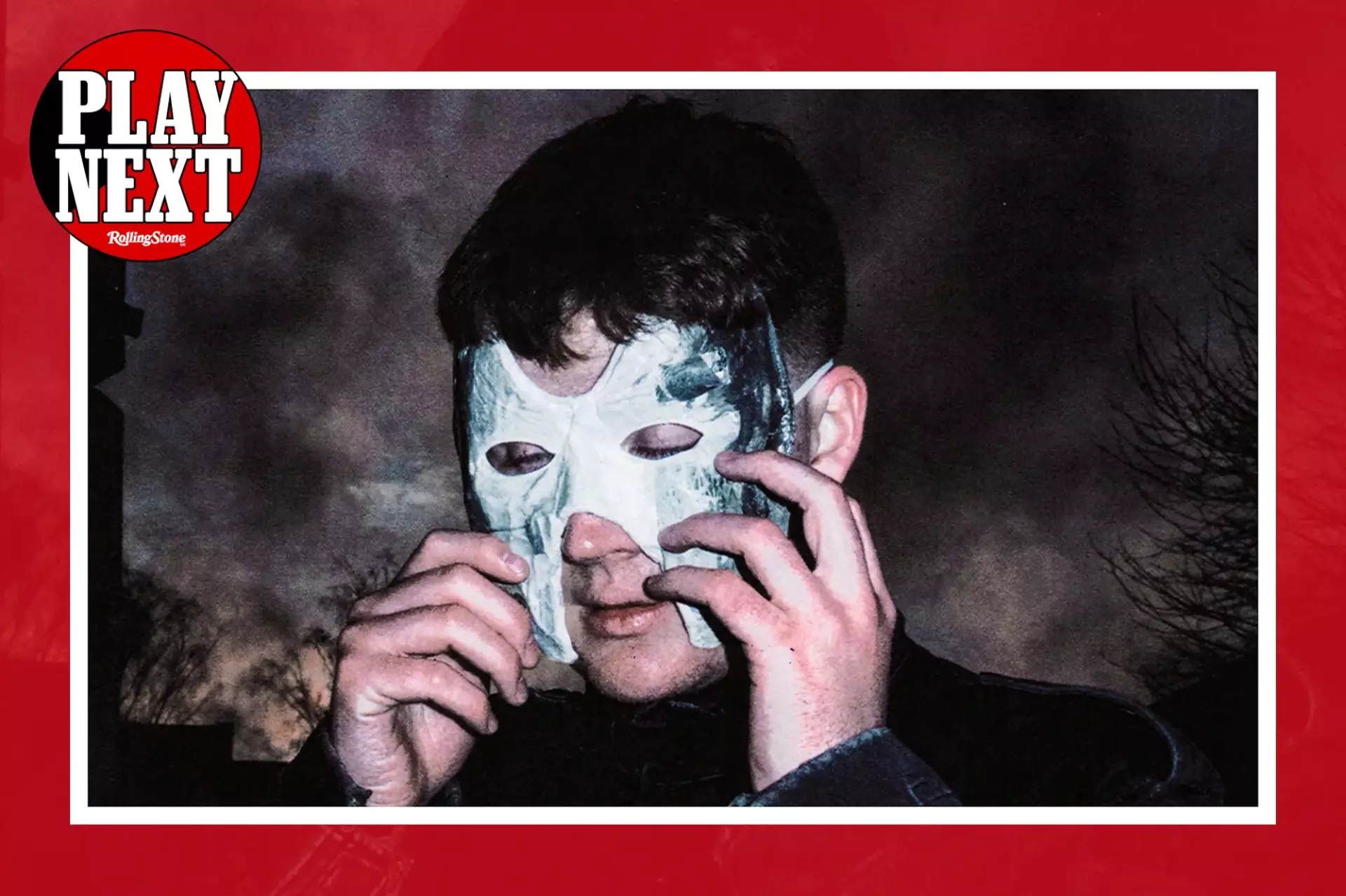
The world of Pollyfromthedirt is presented with only half a face, but ideas and specifics around place are front and centre. ‘The dirt’ was a name first given to this songwriter’s home of Darlington by King James I on a tour of the UK in the 1600s. Upon arriving, the king described the place as “a mucky, mucky town”. He named it ‘Darnton’ in Old English, translating to “dirty town,” and now Darlington. “From the day they were born, these towns were called shitholes,” the songwriter laughs.
The dirt (Polly comes from his mother’s name) is a constant character in this special new artist’s music, which could be described as singer-songwriter music at its core, but expands outwards to incorporate ambient, hip-hop and beyond.
“I was never allowed to create or to be creative when I was growing up,” he says. “It wasn’t my parents, just with that school environment. In that sense, I sort of hate and despise [Darlington] because I found it really hard to be myself when I was a kid. But at the same time, I love so many things about it, and actually have a lot of appreciation for the person that it made me in another way.”
Without wanting to be a tourist brochure for Darlington, the singer does say that it’s “eye-opening how deluded Londoners can be about the rest of the country. I’m thinking about having kids one day, and I’d actually rather they were brought up in Darlington, because they would learn more about real people and real life.”
New EP The dirt pt. 2, the second in a series, arrives today (March 25) and fleshes out the world of this intriguing new songwriter, featuring strange hallucinations of musings on national identity and a curious and experimental take on songwriting.
As the EP is released, we speak to Pollyfromthedirt about too much ambition stifling creativity, the role of his masked presentation, an ongoing collaboration with Irish songwriter Dove Ellis and more.
Read our Play Next interview with Pollyfromthedirt and listen to music from The dirt pt. 2 via our Play Next playlist on Spotify below.
You’ve been making music in various guises for a decade – how and why did Pollyfromthedirt come into focus as an idea and a project?
I was just in shite indie bands and it never really felt serious. Not that this feels serious, but it really didn’t feel serious then. It was more just having fun and not really knowing what my musical identity was, or even worrying about that, which is kind of a good thing. I learned how to do shit gigs and make really shit music, just to find out that you need to be a little bit more self-assured before you actually start making good music.
When I sent these new songs to some people I know, it was a different reaction to what I would usually get when I would send them music. I’ve never had a eureka moment, thinking, ‘I really want to do music’. It’s been a really slow, gradual journey. It was never my dream to be a musician or an artist or anything.
So many musicians talk about doing anything to make music or be successful – do you think your relative ambivalence in that area has aided you?
I think it works both ways with the way the industry is. You need a little bit of that borderline delusion or an insane drive to want to do something. I feel like having that relaxed attitude just takes the pressure off and that’s so important. I’ve got so many friends who are the other way, who are really desperate in it, and it just never seems to quite work. It never seems to quite make sense, because the intentions are needing success or needing fame. I’d say I’m somewhere in the middle really. I feel lucky and privileged to be having the opportunity to even just make music a few times a week. But at the same time, if two or three things in my life had gone differently, I’d be doing something completely different. I never felt like I was born to make music.
Does this relate to your decision to wear a mask for your promotional photos and live performances?
It was about learning from past projects and crossing paths with people in the industry with certain intentions. There are two sides to the mask. There’s the side where I don’t want it to be about me or about how I look. Then there’s the completely opposite side, and sometimes when I do interviews, that’s when the truth hits me. I knew that if I had a mask, I could get away with doing so much stuff that perhaps I wouldn’t have done otherwise. It’s a metaphorical mask in a way – if I was doing this music in Darlington as a kid, I would have been bullied and absolutely ridiculed, even for just making a TikTok or talking about how I feel on a song. I’ve got this mask on, no-one needs to know who I am. I’ve got complete freedom to create whatever sort of music I want, because it’s not about me, it’s just about the music.
Can you explain the dichotomy between the mask as a source of anonymity, yet your hometown and ideas of place featuring so prominently in the music and story?
I’ve got a very strange relationship with Darlington. I’m just trying to be real about where I come from. I’m not trying to promote it or say, ‘This is the greatest place in the world and everyone needs to hear about it’. It’s more just saying, ‘This is where I’m from, and this is the thing that probably makes me unique to a lot of other artists in a similar position to me.’
Your music is rooted in rock, indie and folk, but can you talk a bit about your influences outside of that and how they affect how your music sounds and is created?
When I was 21, I went to Manchester to do music at University. A lot of my friends were rappers and hip-hop artists. They happened to be the first group of people I fell into, and I knew nothing about hip-hop. When I started to write songs, I was doing Oasis rip-offs with three chords, but at Uni the cool thing was to be making very soft trap music. I’d write choruses and hooks for their songs. I learned how to write on the day and write really fast. That’s filtered through even to now. I’ve got a song called ‘A Weekend In Majorca’, which was written in that same way of making the beat and then the chords. I wrote the full thing in one, and there’s the singer-songwriter thing still in there, but the style of it is a bit less thought out and less pristine. It’s always pushing away from the classic sound.
Are you concerned with how your music is described, or the groups you’re associated with?
I’d rather be in a UK underground conversation than a Brixton Windmill conversation. I just think that’s a more interesting world.
Can you tell us about your ongoing collaborative project with Dove Ellis? What can we expect?
He’s a little bit similar to me. I don’t want to reveal his influences, because he’s the most secretive guy in the world, but they’re a little bit more on that [hip-hop] side as well. The music we’re working on, although a lot of it will be piano, it’s more experimental. It’s pushing the boundaries and it’s not classic songs. I think that’s why it works quite well, because he’s obviously doing that with his own project, writing like songs that could have been written in the 60s or 70s or whatever. I don’t know if it’ll ever come out though!
Why did you want to expand The dirt project to incorporate a second EP?
I had ten songs ready but I didn’t want to do an album straight away, because I don’t feel like I’ve 100 per cent found where I want to be yet musically. It was more like a mixtape, but if you release it and call it a mixtape, what does that mean? If you release ten songs, people call it an album.
I’m not really planning ahead. I could write a song tomorrow, and it could come out in two weeks, and that’s the best thing I’ve probably got going for me at the moment. Though I was watching an interview last night with James Blake, and he’s talking about how, if everything was released on vinyl now and we got rid of streaming, the quality would probably be a lot higher. If there’s a physical thing out there, you’re going to think about it a bit more. There’s a lot of shit music out there for that reason.
England is mentioned in a number of your song titles (‘There’s No Such Thing as England’, ‘When England Comes’) – what is your relationship to national identity?
Those two songs were born out of a bit of a mental breakdown of identity. I didn’t have a full-on mental breakdown, but I basically went a bit mad and I had not to go too deep into that. I had OCD about how we all say we’re proud to be English, or proud to be from Darlington, and it’s actually just a concept. There’s no such thing, literally.
I found Buddhism and non-duality and the idea that the world is one, but not in a bodily relief sense, more just being like, ‘Fucking hell, in the whole universe nothing is real’. It was very existential. OCD is horrible, and it was the worst two or three years of my life. I couldn’t think about anything other than existential thoughts. I was thinking about whether the world is a simulation for five months straight. A lot of this project came out of that time.