
Greg Deda Heads to Lyon & Turnbull as Collector Interest Builds
In Partnership With Aurum Fox
By Wyles Daniel
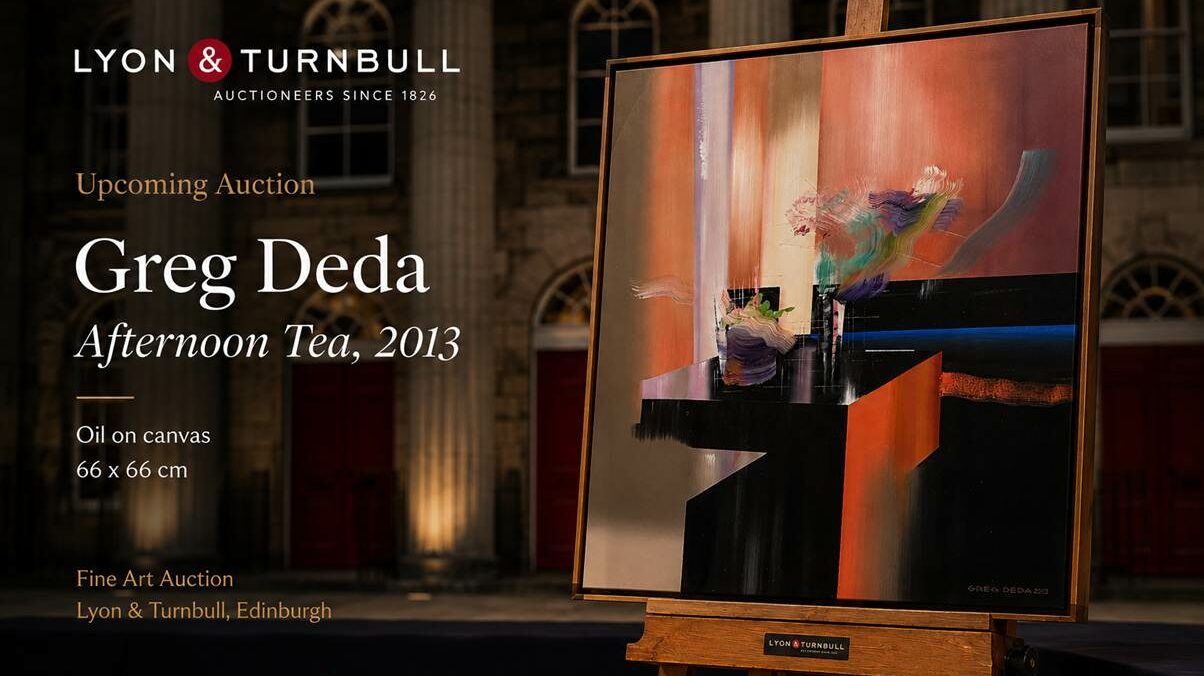
Scotland’s oldest auction house marks 200 years this year. The arrival of the Canadian-born painter on its rostrum suggests that some observers of emerging art markets are beginning to pay closer attention.
A Public Auction Moment
There is a particular kind of moment in an artist’s career that rarely announces itself loudly. It happens not in a gallery opening or a glossy profile, but on the floor of an auction house, where a price is set in public and a reputation is, briefly, out of everyone’s hands. Greg Deda is about to have one of those moments.
The contemporary artist is set to feature in an upcoming sale at Lyon & Turnbull, one of the oldest and most respected auction houses in the United Kingdom. For a painter whose market has been building steadily rather than spectacularly, it is a notable step, and the timing adds further context.
Lyon & Turnbull’s Bicentenary Year
Lyon & Turnbull is not a name that trades on hype. Founded in Edinburgh in 1826 by Jonathan Lyon, it is Scotland’s oldest firm of auctioneers and one of the longest-established fine art houses in the country. This year it reaches its bicentenary, two full centuries of selling paintings, rare objects and museum-quality collections from a converted nineteenth-century church on Broughton Place. Today the firm runs more than forty specialist auctions a year, keeps a permanent base in London, and operates internationally through its long-standing alliance with the American house Freeman’s. When a contemporary artist appears in that kind of environment, it can mark a meaningful point in their market development.
Testing Market Interest
For Deda, it means his work is being measured against an entirely different yardstick. Some collectors and market observers have shown growing interest in the Canadian-born painter, whose abstract and semi-abstract canvases have drawn attention from private buyers looking for contemporary art with potential for continued market development. A primary-market following is one thing. An auction result is another. It is independent, public and unsentimental, and it can provide a useful benchmark for collectors weighing their interest.
That is the real function of a house like Lyon & Turnbull in an emerging artist’s story. Galleries can talk up demand all they like, but the rostrum is where it gets tested. An auction offers something a private sale never can: a live, visible read on appetite, liquidity and confidence, with several bidders in a room and many more on a screen, all helping establish a public indication of demand. For existing collectors, it may support a thesis. For prospective ones, it may provide another point of reference.
Supply, Demand and Collector Attention
And there is plenty to watch. Interest in Deda’s work has been described as strong, and there are suggestions that demand for some paintings could begin to outpace the limited availability of works over time. It is a familiar pattern in markets that are tightening. Buyers may begin to think beyond individual canvases and focus more closely on access to future work.
Whether that scarcity holds is precisely the question an auction answers. Hammer prices have a way of separating momentum from marketing. If the appetite is as real as the artist’s camp suggests, the room will say so.
A Measured Step Onto a Larger Stage
What is not in doubt is the company Deda is keeping. To sell through a house that has handled record-breaking results, advised national institutions and shaped the Scottish art market for two hundred years is to be placed, however provisionally, within a serious lineage. The art world spends a great deal of energy hunting for the next internationally recognised name, and most of that hunting is guesswork. Auctions are where the guessing gets a number attached.
Deda has not arrived yet. But he is about to step onto a stage where arrival is no longer something an artist can claim for themselves. The market decides. This summer, in Edinburgh, it gets the chance to.
Investing involves risk and your investment may lose value. Past performance gives no indication of future results. These statements do not constitute and cannot replace investment advice.