
iAsk.ai Brings AI Search and Tutoring Into One Study Hub
In partnership with iAsk AI
By Kyle Russell
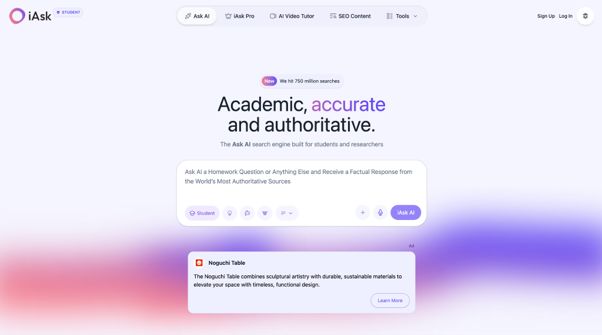
Students can ask AI a question, examine the source material and work through homework with guided help in the same service.
Finding an explanation of photosynthesis takes seconds. Working out why a plant experiment produced an unexpected result requires the student to interpret the evidence and decide whether the explanation fits.
iAsk.ai is bringing those tasks together through AI search, document tools and tutoring. Students can ask AI an initial question, then examine a source or work through a calculation that needs more attention.
The need for academic support is visible in national data. The 2024 Nation’s Report Card results, released in September 2025, showed that 22% of U.S. twelfth-graders performed at or above NAEP Proficient in mathematics and 35% did so in reading. Those results describe an educational challenge; they do not establish the effectiveness of an AI product.
For iAsk, the practical question is how much of a study session it can support while keeping the student involved in the work.
Working through the next question
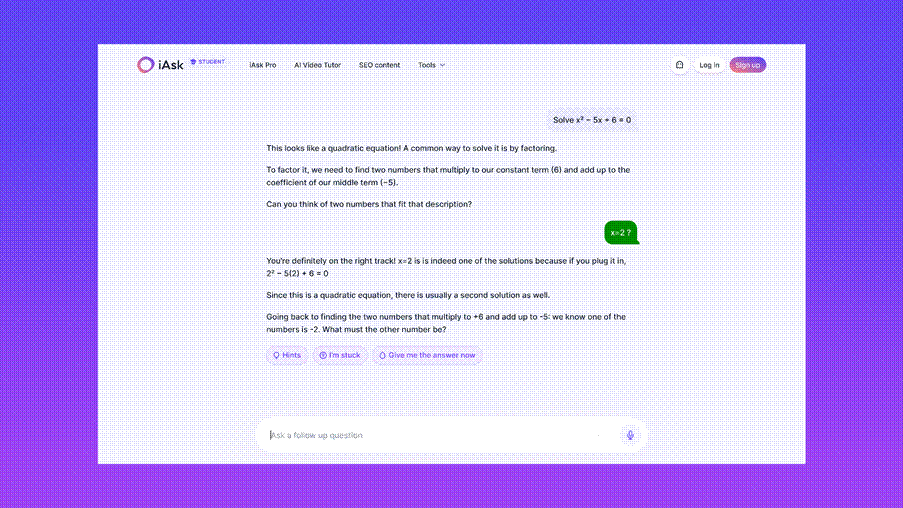
iAsk’s Guide Me mode offers an AI homework helper that works through problems in stages. In the example above, an exchange about a quadratic equation asks for two numbers whose product is six and whose sum is minus five. When the student suggests x = 2, the response checks that value and returns to a question about the remaining factor.
The sequence gives the student a role in producing the solution and helps locate the point of confusion. Someone who can substitute a value correctly may still need an explanation of how factoring produced it.
Visual Search provides another way to begin. Students can use a photo or uploaded image to bring a worksheet or diagram into a question. Checking that the system has read the labels and instructions correctly provides a starting point for discussing the part they do not understand.
The service also offers AI video tutoring for real-time conversation. A student who finds a written explanation difficult can ask a follow-up in a different format. As with text-based help, the important question is whether the response addresses the actual difficulty.
Connecting research with understanding
The broader toolkit extends to reading and research. Document Analyzer accepts material such as PDFs and research papers for questions about their contents. The summarizer produces a shorter version of longer material that students can compare with the original.
For a student preparing a history essay, a summary might help locate an argument worth examining. Questions about the document can clarify the evidence behind it. Before citing that evidence, the student still needs to read the relevant passage and decide whether it supports their point.
Source links in search provide a route back to the material behind an answer. Students can check its author, date and context, and see whether it supports the claim being made. A citation makes that inspection possible; the reader still has to carry it out.
Bringing these functions together gives iAsk a role across an assignment. A student can move between finding information and asking for an explanation, while remaining responsible for the work they submit and their school’s rules on AI use.
Access and the scale of use
iAsk says its platform has handled hundreds of millions of searches and is used by millions of students and researchers. Those figures describe the company’s reported reach. Search volume does not measure unique learners or what they retained.
The service has a free search tier and a Pro plan that includes additional tools such as video tutoring and document analysis. The company says its student offer provides one year of Pro at no charge for students who sign up with an eligible .edu or .ac email address. The offer is available for a limited time.
Access gives students a chance to try the tools; independent work is a more revealing test of their value. On the next assignment, can the student recognize a familiar method and explain why it applies?
iAsk’s study hub gives students several ways to pursue an explanation. What they can understand and use afterward will determine how much those exchanges help.