

The London singer-songwriter combines operatic vocals, orchestral arrangements and a dance beat while exploring queer love through religious imagery.
According to Julia Zelg, a line roughly halfway through her new single captures one of its central themes. “Is it a sin?” she asks, and then answers herself without waiting: “Maybe it’s a sin, but it’s Holy when you’re touching me.” Sung in a trained operatic voice, over a choir, sweeping strings and a four-to-the-floor beat, it is the sound of someone stepping directly onto contested ground and refusing to apologise for being there.
Classical music meets dark pop
‘Holy’, out on 4 September, is a dark pop record with a classical spine. Zelg holds a master’s degree in songwriting and a classical singing degree from Goldsmiths, University of London, and rather than filing that training away she has built her new era around it. Orchestral instrumentation and choral arrangements sit alongside shimmering synthesizers, the sacred and the secular pushed into the same three and a half minutes until the friction becomes the point. It is the sort of collision that could easily curdle into novelty. Here it reads as argument.
Reclaiming the language of faith

The song explores how the language of faith can intersect with different understandings of love. Written by openly bisexual artist Zelg, ‘Holy’ presents queer love alongside religious themes and considers the tension that can arise when some interpretations of faith conflict with LGBTQ+ identities. Rather than rejecting Christianity, the song draws directly on its teachings, including the lyric: “Love one another, told us, Jesus Christ.”
The provocation is subtler and more difficult to dismiss, because she is not rejecting the tradition so much as asking why compassion, which the text she cites places at the centre of the faith, so rarely survives contact with those who police it. What, the song wants to know, could possibly be more sacred than loving another person?
Tenderness rather than ridicule
The song’s use of religious imagery in the context of queer love may prompt a range of responses. Zelg describes ‘Holy’ as a deliberately expressive release, pairing an operatic voice and choir with an expansive chorus intended to give its themes a prominent musical setting. What separates it from simple provocation is that the record never sneers. It is unmistakably tender, closer to devotion than to protest, and the anger sits underneath rather than on top.
A new creative era
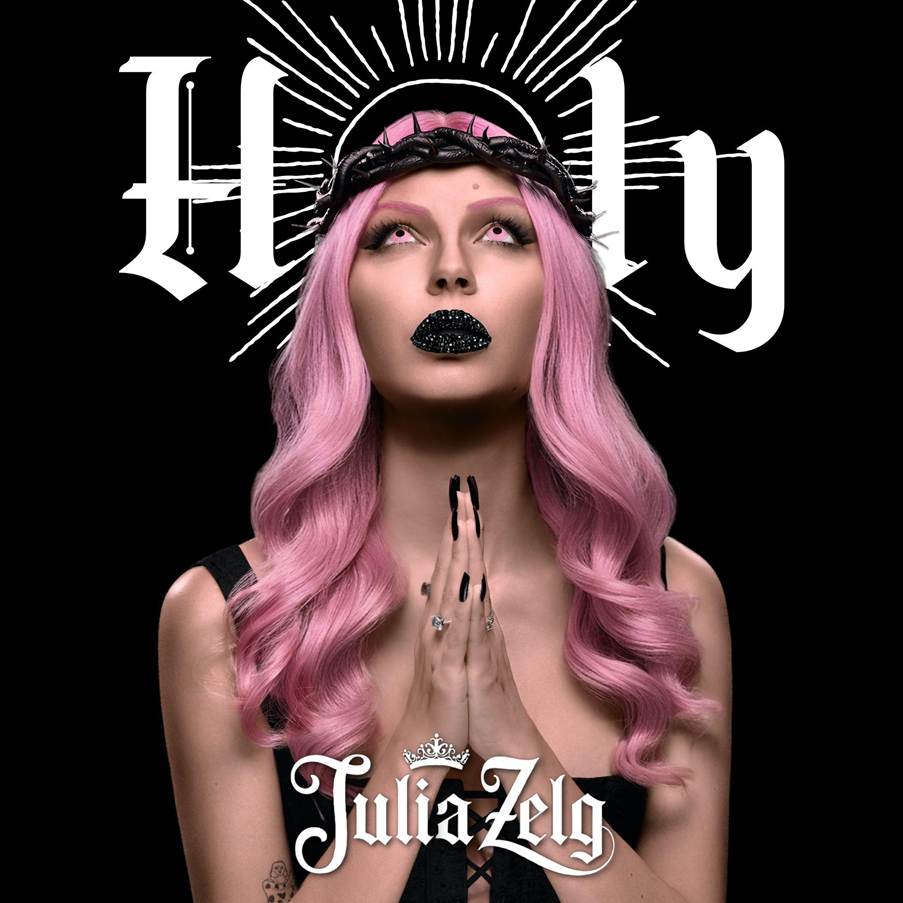
Zelg has been building towards this. Originally from Brazil and now based in London, she has used recent releases to explore themes including LGBTQ+ identity, relocation and personal freedom that lean emotionally raw rather than polished, gathering a global audience along the way. The new direction pairs that candour with a visual world of rococo excess, pink and deliberately whimsical, which functions as its own quiet joke about what serious art is allowed to look like. According to Zelg, the project draws on her classical training while allowing her to use those techniques in a playful and unconventional setting.
‘Holy’ is out 4 September, with the official video following on 11 September. Listen to Julia Zelg on Spotify.