
Gorillaz ‘The Mountain’ review: Death has rarely sounded so joyful
On their ninth album, Damon Albarn and Jamie Hewlett acutely tackle their own experiences of mortality. The result is something unexpectedly beautiful.
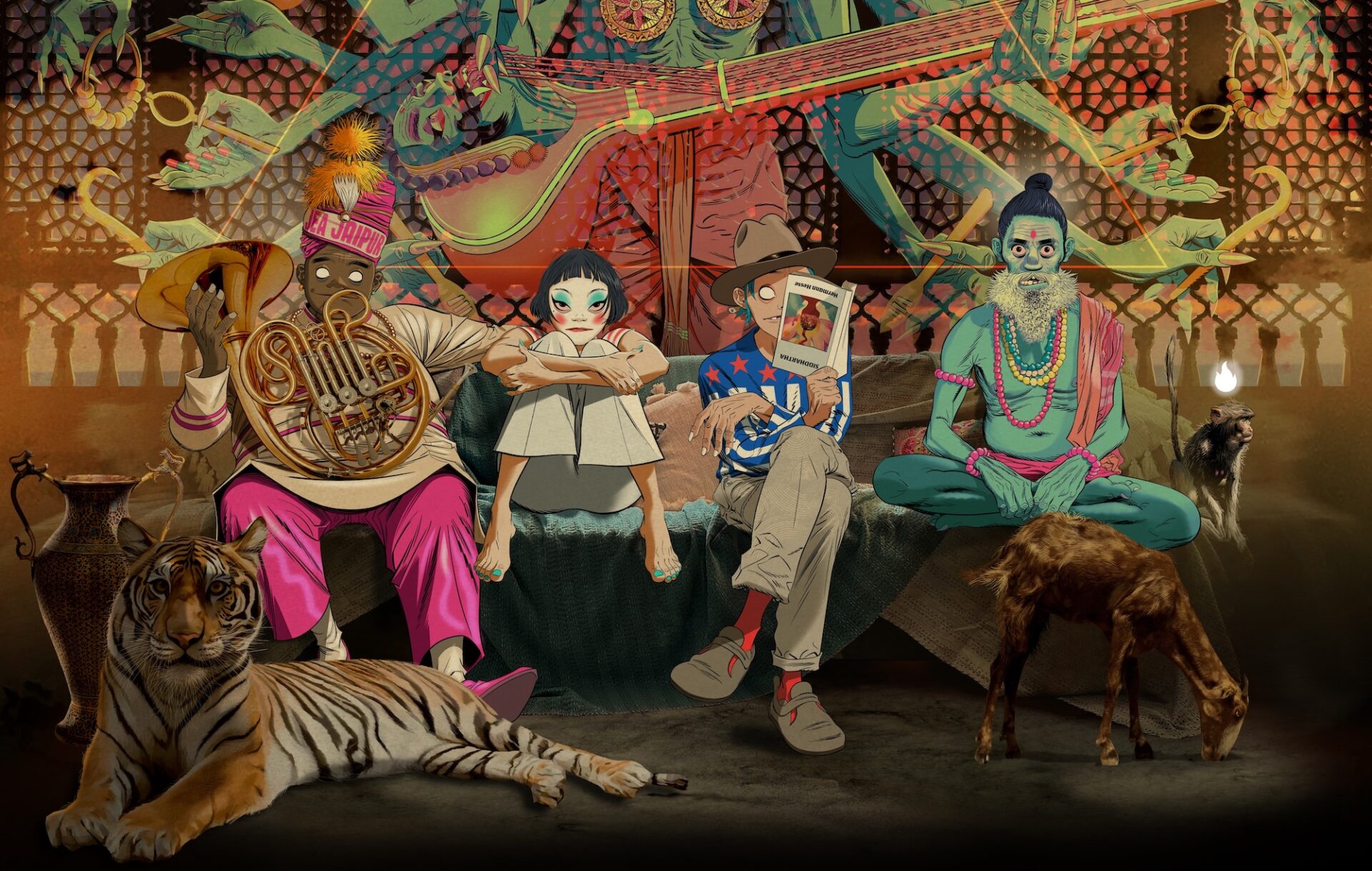
“It was all like, ‘This is fucking weird, there’s a reason why we’re here,’” Gorillaz co-founder Jamie Hewlett explained last year to Rolling Stone UK of his and Damon Albarn’s time in India whilst working through the grief of losing both their fathers and Hewlett’s mother-in-law. “Visually, if you’re an artist and you go to India and it doesn’t blow your mind, then you must be blind, you know? Everything is insane and rich and colourful and mad and tragic and beautiful.”
True to the illustrator’s word, the 15-track album is an expansive sonic and visual odyssey which sends their band of animated misfits out to navigate life, death and transition in the “gloriously technicolour” country. The comfort Hewlett and Albarn each found in the positive attitudes towards death in Hinduism, Buddhism and Sikhism, plays out in a celebratory optimism heard through the album and in its sun-soaked accompanying artwork.
The soaring instrumental title track sets a contemplative tone and introduces the traditional Indian instrumentation which weaves its way throughout its stonking 15 tracks. Award-winning Sitarist, Anoushka Shankar, niece of sitar virtuoso Ravi Shankar, is one of many Indian musicians Albarn worked with and a recurring collaborator throughout the album. Something of a full circle moment for the musician who admits that he probably listened to Shankar before he listened to The Beatles, having been a favourite of his late fathers. As the track fades out, echoes of “The Mountain” from late acting great Dennis Hopper’s 2005 Gorillaz cameo sends listeners on their way.
Hopper’s vocals foreshadow the importance of Gorillaz as a multigenerational prospect to their ninth album. Featuring artists from the likes of Paul Simonon, Johnny Marr and Jalen Ngonda to Ajay Prasanna, Gruff Rhys and Omar Souleyman, it was also “important to include all the people who died that we’ve known,” explains Albarn. As such, voices of departed collaborators from previous sessions have been woven into the narrative, including Bobby Womack, David Jolicoeur and Tony Allen. “I wanted to bring them into the conversation so that the record carries everybody and the whole history of the band,” he continues. It’s almost like they’re “talking from the other side,” Hewlett adds.
But the album isn’t just about navigating death, according to the pair, with underlying conversations centring around what is happening in the world more generally today. Lead single ‘The Happy Dictator’ – featuring art-pop duo, Sparks – is a “staring the beast in the face” example of this, as Albarn explained. The festival-ready singalong is a highlight of the album and a prime example of Albarn’s knack for balancing joy and satire with themes of darker origins, and, more generally, of Gorillaz ability to make saying something more palatable to a wider audience.
Momentum feels somewhat lost in the saccharine ‘Orange County’ featuring Bizarrap and Kara Jackson. Whilst successfully pairing heavy emotional themes with an airiness, the middling track takes on the energy of a drunk ex-boyfriend leaving midnight voice notes. “The hardest thing is to say goodbye to someone you love,” Albarn sings in earnest, punctuated with the peppy whistle of a village postman. It’s welcomingly followed up with the moreish cynicism of ‘The God of Lying’. Laden with doubt and existentialism, IDLES’ Joe Talbot’s distinctive drawl asks ‘Who am I?’ as a captivating beat begins. This tone is continued in ‘Delirium’ as the sardonic salvo of the uncompromising late visionary, Mark E Smith, emerges at the crescendo with a sinister laugh.
True to form, Albarn has worked with a number of rappers for their ninth offering, including The Roots MC, Black Thought, who brings some welcome energy to ‘The Empty Dream Machine’, whilst a jewel of the album (or the peak, so to speak) exists in the form of the sprawling 7-minute ‘The Manifesto’ featuring Argentine rapper, Trueno. A cinematic reveal of a powerful verse from D12 rap legend, Proof – likely taken from their 2001 session recording ‘911’ – is a delicious nod to the band’s early beginnings and a perfect example of Albarn’s ability to effortlessly bring together artists from differing decades, genres and backgrounds, through emotional, intimate connection and collaboration.
Final track, ‘The Sad God’, as the title suggests, is a mournful lament on mortality, grief and the state of the world: “I gave you atoms / you built a bomb,” Albarn croons. It’s not the rousing, overindulgent ending you’d expect from a 15-track album, but perhaps the power lies in the quiet weariness that comes from its long, pensive journey, which plays out with wistful instrumental contributions from Shankar and Prasanna.
Whilst at times meandering, The Mountain is a contemplative and richly textured landscape with moments of greatness. It might not be the sound of Gorillaz albums passed, but it is a successful reconnection between the pair and a triumph in their shared, almost pathological pursuit to move forwards with fresh ideas and to, ultimately, create an album which “makes death cool”.