
Dermot Kennedy is on top of the world
Rolling Stone UK goes backstage with Dermot Kennedy, Ireland’s triple- chart-topping, stadium-packing star.
By Nick Levine
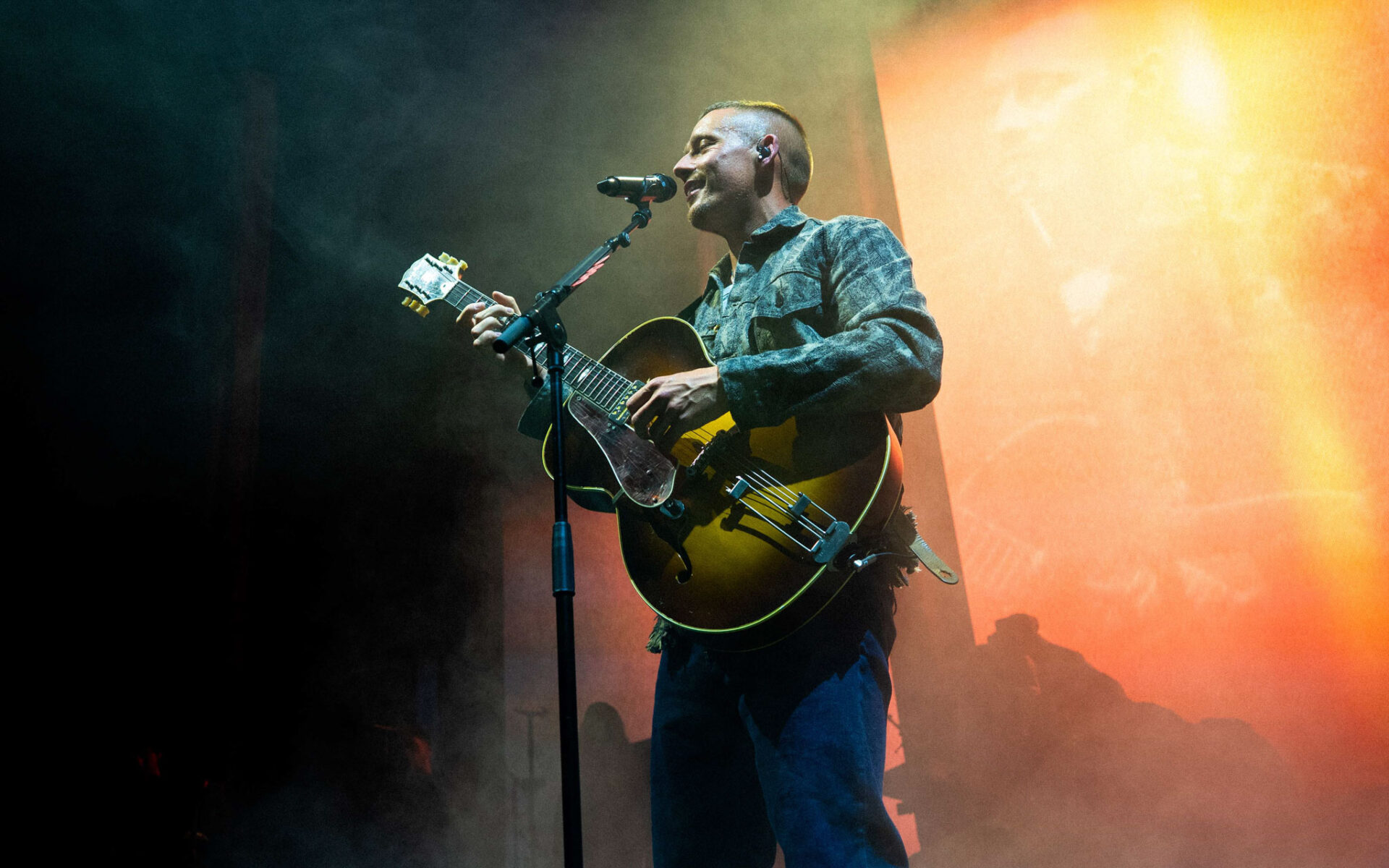
On a temperate May evening in Amsterdam, the AFAS Live concert hall is filled with 6,000 Dermot Kennedy fans: young couples, older couples, gaggles of lads, a few families. On stage, the man himself asks everyone to sing along with his 2019 hit ‘Outnumbered’, a folk-pop showstopper that has now amassed over 370 million Spotify streams. Everyone in the crowd does as they’re told, turning a venue that’s known locally as “the Black Box” into somewhere that feels intimate, even bucolic. The rustic vibe is evoked by stage design that riffs fairly literally on the title of Kennedy’s newly released album The Weight of the Woods, with the mighty voiced Irishman and his band performing on mossy steps as forest-themed visuals fill the screen behind them. But the sense of intimacy comes from 34-year-old Kennedy, a performer of such warmth and intensity that audience members shout, “I love you, Dermo!” as every vein in his neck strains to hit a money note. The devil works hard, but Kennedy’s larynx works harder.
By the night’s end, Kennedy will have delivered emotive and grippingly raspy versions of 20 songs from his three LPs to date: 2019’s Without Fear, 2022’s Sonder and The Weight of the Woods. When the latter topped the UK charts in April, Kennedy became the first Irish solo artist ever to reach number one with their first three studio albums.
“You know, the only thing I know how to do, really, is play to people,” Kennedy tells me in his dressing room at the OVO Hydro in Glasgow, two days later.
Though he ringfences his private life – he discreetly confirmed to an Irish newspaper earlier this year that he has a wife and child, but neither is mentioned today – Kennedy is never less than fully engaged. Throughout our conversation, the early dinner he’s supposed to have digested before he hits the stage goes largely untouched because he’s too polite to chew and chat. In two hours, he’ll turn an even more cavernous venue into an urban forest where you can hear a pin drop. During ‘Lost’, a tender ballad about friendship and resilience from his platinum-selling debut Without Fear, a young guy in front of me is moved to tears. Touchingly, his mate in the next seat puts an arm around him – this is the power of the Irish balladeer in action.
Backstage, Kennedy is bright-eyed and decked out in a natty tracksuit. He’s training for a marathon in early November but says that pounding the pavements on the morning of a show is energising and calms any pre-show anxiety. His comment that playing to people is all he really knows how to do isn’t false modesty but an acknowledgement that performing live has been the bedrock of his success. In profiles, Kennedy is invariably painted as the plucky Dublin busker who became an arena-filling superstar, which is broadly accurate but a little reductive. Though he’s relaxed and unaffected today, he’s not afraid to name-drop his Soccer Aid buddy Tom Hiddleston. And on stage in Amsterdam, he told the crowd he “hated” his days busking on Grafton Street, where he had to compete for attention with iconic Irish cafe Bewley’s and a statue of Molly Malone, who is immortalised in the famous folk song of the same name.
“‘Hate’ is a strong word; I shouldn’t have said that,” he says today, backpedalling a bit. “I just think that sometimes I romanticise it, and it’s mostly not that nice. You know, I’m standing there playing songs that other people wrote; other people who are in a position I want to be in, so that comes with a lot of frustration.” When Kennedy began busking as a teenager, he would play for five or six hours “without even looking up from the ground”. Later, in his early twenties, he streamlined his offering into 40-minute sets with more crowd-pleasing content. For him, busking wasn’t just an “art form” to master, but a formative lesson in the tension between authenticity and popularity. “I remember the song that would always bring in a crowd was ‘All of Me’ by John Legend, and so immediately I became cynical and [thought] ‘I’m not playing that one,’” he says. “But now I can see that’s the beauty of a great song: it can literally pull in a crowd on the street.”
Busking was also a “cheat code” that enabled Kennedy to make a solid living before his career took off, which it did suddenly and spectacularly in 2015, when he uploaded a self-penned song called ‘An Evening I Will Not Forget’. This wracked piano ballad, which is still in his live set 11 years later, was added to Spotify’s Discover Weekly playlist and sent his daily streaming tally from single figures to 50,000. Overnight success secured him a manager, but Kennedy booked gigs in New York, Los Angeles, London and Dublin independently before he finally made a “careful” decision to sign a major label deal with Interscope in the US and Island everywhere else.
Properly tangible success followed before Kennedy exited his twenties. Fuelled by his anthemic 2018 single ‘Power Over Me’ (which now has 540 million Spotify streams), and then ‘Outnumbered’, Without Fear entered at number one in the UK and Ireland in October 2019. Within a year or so, he’d added two more huge hits to his arsenal: ‘Paradise’, a pulsing collaboration with Italian dance trio Meduza, and the perky indie-pop stomper ‘Giants’ – though neither appears in his current live show.
“It doesn’t stress me out,” he says when I ask about skipping ‘Giants’, which topped the singles chart in Ireland. “Like, if I’m not gonna be happy playing it, there’s no way. When I step out there, I see 20 songs on the set list. And if I were to dread a section, that would be crazy to me.”
However, he does allow himself a caveat after making history in July by becoming the first Irish solo artist to play Dublin’s 50,000-seater Aviva Stadium. Kennedy is such a hometown hero now that he actually packed out the stadium twice, on successive nights. “In Ireland, ‘Giants’ is a real thing,” he acknowledges. “It’s funny, I could talk all day about, like, ‘I don’t worry about what people want [to hear],’ but maybe I should bring it out for those shows.”
He’s fully aware that these concerts are a career landmark. “I think if you got me a few years ago, and said how do I play a stadium show, I’d have said, ‘I’m not sure how to do that,’” he admits. “Whereas now, I think it’s enough for me just to do the thing I know how to do.” In fact, Kennedy was so convinced he could fill the stadium two times over that he “pushed” to add the second date. “When the venues become this big and prestigious, there’s always back and forth. They’re like, ‘Well, The Weeknd is doing this…’ so it’s kind of a battle to secure those dates,” he says. “But yeah, we got the two we wanted.”
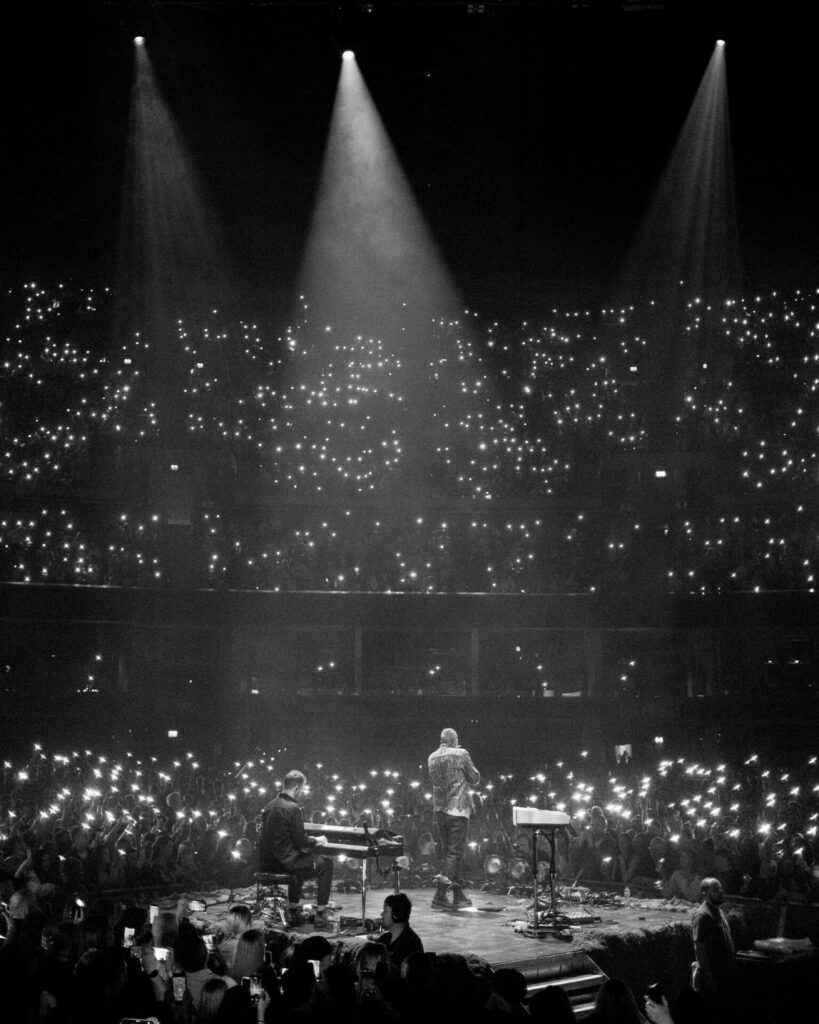
Kennedy was similarly vindicated back in 2023 when he played a pair of outdoor shows at Dublin’s Marlay Park. “The agent or promoter suggested we do one night at reduced capacity, which is, like, 25,000 [people], I think,” he says. “And then we ended up doing two nights at 40,000. So, I’m just… cocky is not the word, but I do feel confident in that support, you know.”
If conjuring intimacy in the vastest of spaces is Kennedy’s superpower, then a certain quiet steeliness might be his secret weapon. Growing up in Rathcoole, 10 miles southwest of Dublin city centre, he taught himself to write songs because he admired his cousin’s guitar-playing skills and loved David Gray’s folktronica opus White Ladder, Ireland’s best-selling album of all time. Though Kennedy says “it took an awful lot of encouragement” from family members to convince him to perform his own songs in public, he steadily progressed from school talent shows to open-mic nights to his lucrative stint as a busker.
A possible life in the spotlight wouldn’t have been an entirely alien concept – his TV presenter aunt, Mary Kennedy, hosted the 1995 Eurovision Song Contest – but Kennedy says he derives his ambition from the sporting world. “Those classic stories like when Kobe Bryant snapped his Achilles tendon [on the basketball court] and still took two free throws, or when Ayrton Senna’s gearbox broke and he had to drive the last few laps in sixth gear [only], stuff like that has always been the most inspiring to me,” he says. Kennedy suggests with a laugh that he’s “not sure whether that aggressive sporting energy really belongs in music”, then adds more seriously: “But it’s definitely foolish to think music isn’t competitive, because of course it is.” After all, only an elite tier of artists will ever get to headline a stadium.
Crucially for his trajectory – and his own self-esteem – Kennedy believes he’s steadily “improved as a songwriter” and sees this year’s The Weight of the Woods as a musical “hybrid” of his two previous albums. Though Without Fear was home to the soaring signature hits ‘Power Over Me’ and ‘Outnumbered’, he points out that other tracks such as ‘An Evening I Will Not Forget’ and the folky lament ‘After Rain’ “almost have no chorus at all”. For a long time, Kennedy was actually pretty wary of writing songs with crowd-pleasing choruses. “Because I love hip-hop and rap music, I’m very envious of how [those artists] can fit so much into one song over the space of three verses,” he says. “So, I could never come to terms with the idea that you might repeat the same idea several times with exactly the same words.” Kennedy was finally converted to chorus-writing when fellow Dublin musician James Vincent McMorrow told him bluntly: “Songs need hooks.”
After Without Fear made him a bona fide star whose music can literally bring grown men to tears, Kennedy used his new, more commercially minded songwriting skills to level up again with album two. “I had so much ambition at that time to be successful and play huge shows and all that kind of stuff, so Sonder had more songs that I thought could reach more people, and they did, I guess,” he says. Kennedy isn’t wrong: the album’s uplifting, R&B-flecked lead single ‘Better Days’ and chugging love song ‘Kiss Me’ both became big hits. “I’m very cautious not to talk about Sonder in a way that [sounds like it] doesn’t make me happy,” he continues carefully, “but I needed to go there, so I could then step back with this album.” For this reason, The Weight of the Woods balances arena-ready anthems like ‘Turnstile’, a rootsy rock stomper with a ringing guitar riff, and more ambiguous moments like the lovely, ambient ballad ‘Sycamore’.
“I won’t go into this too much,” Kennedy begins, ringfencing a personal memory, “but there’s a sycamore tree in front of my house that this electrical company tried to cut down.” The corporation failed mainly because Kennedy was “like Greenpeace” in his determination to save it. “It feels like this talisman in my life, this tree. I can picture it so vividly all the time,” he adds. Knowing his audience will “really listen” to a song like ‘Sycamore’ is a real source of pride and contentment for Kennedy. In the past, he was worried about “a single blowing up” because it might attract gig-goers who only wanted to hear the radio hit. Lest this might sound earnest, Kennedy pivots to the grounding influence of his mother. “When I woke up today, she texted, saying, ‘Geez, you’re a trooper,’” he says with a smile. “And I was like, ‘This is all good stuff. I’m OK, you know.’ When I think about the athletes that have inspired me, it feels quite easy to get on a plane and play a gig.”
Taken from the August/September issue of Rolling Stone UK, out now. Order your copy here.