
Joe Cole on tackling toxic masculinity in bold new drama ‘I Am Helen’: ‘It’s a real strange time’
In Channel 4's I Am Helen, Joe Cole plays a man whose warped ideas about masculinity lead him to abuse the woman he loves. The actor tells Rolling Stone UK about toxic influences, troubled men and what it really means to be a good one.
By Ryan Butcher
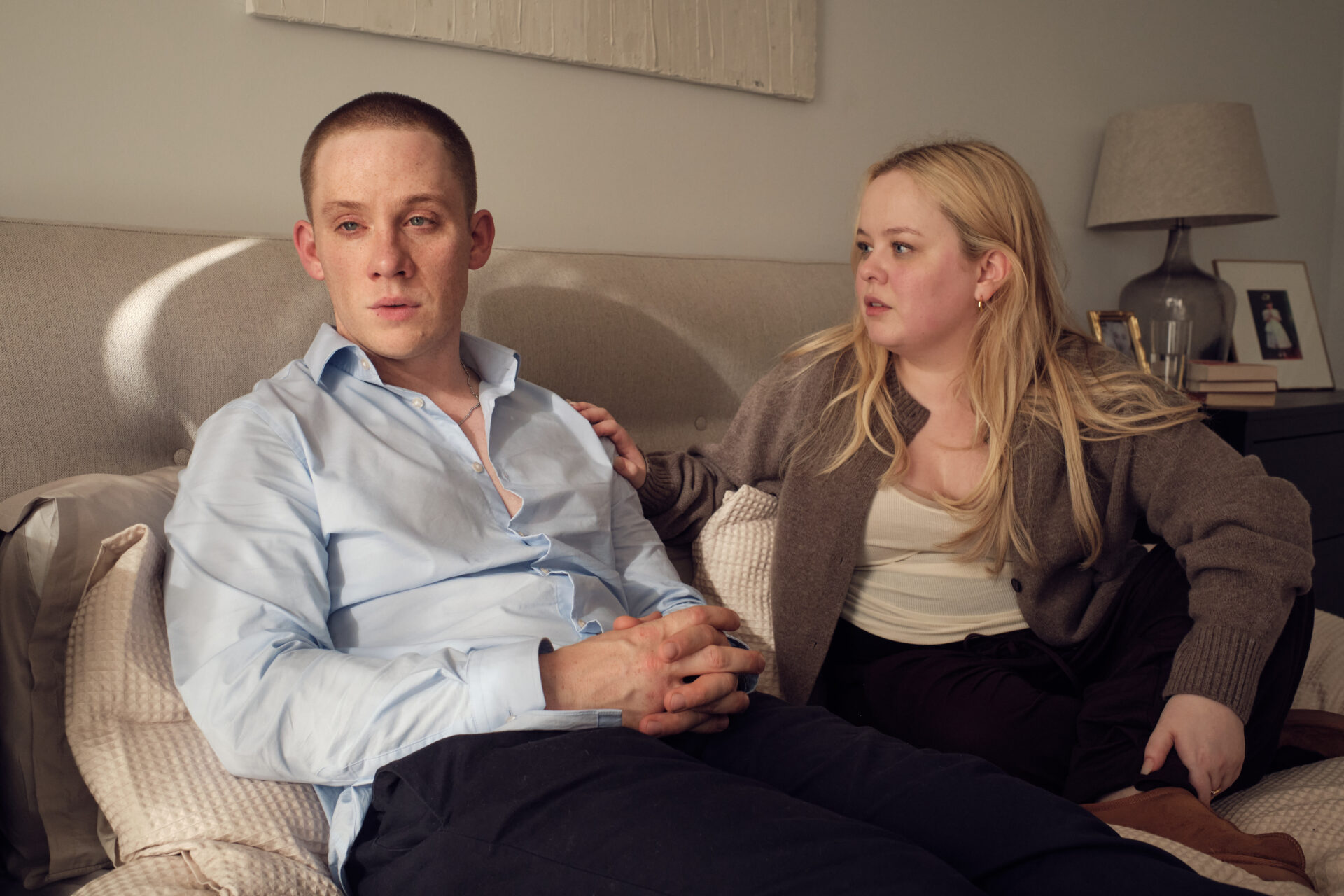
Joe Cole doesn’t want audiences to see his I Am Helen character Steve as simply another monster.
In the latest instalment of Dominic Savage’s Channel 4 anthology, Cole stars opposite Nicola Coughlan as Steve and his girlfriend Helen.
Over two episodes, Steve exhibits increasingly controlling and coercive behaviour, including violent, non-consensual sex acts and explosive fits of rage, leaving Helen frightened in her own home and questioning how well she really knows him.
But Cole, who has played a rogue’s gallery of angry and troubled characters in the likes of Gangs of London, Peaky Blinders and A Prayer Before Dawn, believes there’s something important to be gained from understanding how men like Steve become the people they are. “I think he represents a lot of men,” the actor tells Rolling Stone UK. “I think he represents a lot of men who probably are lonely and are a bit lost and perhaps don’t have a real purpose.
“And I was trying to convey that. I was trying to empathise with this character a little bit. I think, as awful as he is, there were moments when I did feel a bit sorry for him. I was like, ‘This guy probably just needs some proper support and some proper friends.'”
On the surface, Steve’s ambitions are ordinary enough. He wants to provide for his partner, settle down and start a family. But his ideas about being a man are tied to those ambitions, and Helen’s independence leaves him feeling increasingly threatened. “I think deep down, really, he doesn’t know what he wants,” Cole says. “He’s totally lost. He’s trying to hold on to this thing that ultimately is over. It’s done.”
What makes Steve so unsettling, however, is that he isn’t always the man we see in his worst moments. He can be affectionate, attentive and seemingly sincere. There are glimpses of the relationship Helen fell in love with, even as his behaviour becomes increasingly disturbing.
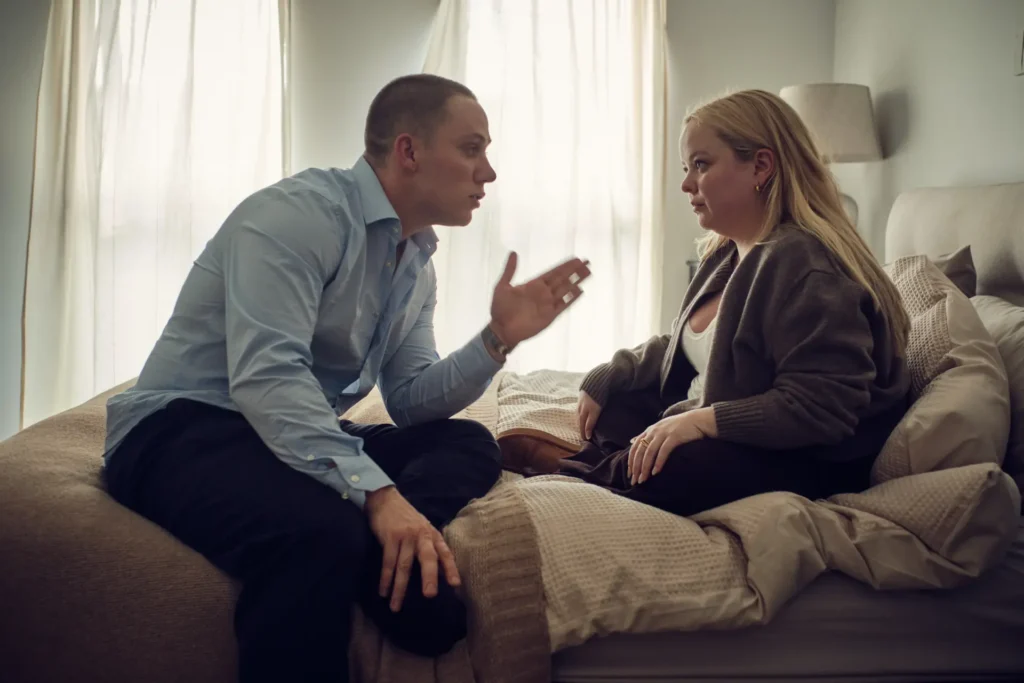
Helen, meanwhile, doesn’t fit the usual clichés about what a domestic abuse victim looks like. She’s successful, independent, ambitious and perfectly capable of standing-up for herself. Yet she begins to question her own judgement and how well she really knows the man she loves.
Cole wanted Steve to feel like someone you might actually know. “It’s not really about trying to make the audience sit in discomfort,” he says. “It was trying to be real and having real conversations and trying to make fully fledged human characters.”
A lot of that rawness comes down to how Savage approaches filmmaking. Rather than working from a conventional script, Cole and Coughlan were given considerable freedom to develop their characters through improvisation, with scenes unfolding in extended takes.
“I loved it as a way of working. I thought it was incredible,” Cole says. “I remember saying to Dominic after the first morning of shooting these hour-long takes, where you can do anything and say anything and go anywhere you want… it’s incredibly liberating.
“I said, ‘I can’t believe more people don’t work like this.’ For me, it was just nice to know that I can do some pretty crazy stuff and he’s not going to cut. He’s not going to turn the camera off and go, ‘Let’s have a rethink.'”
Much of the recent conversation around toxic masculinity has focused on teenage boys, particularly following the success of Adolescence. But I Am Helen shifts the focus to adult men, and the ways misogynistic attitudes can be reinforced and normalised among friends and colleagues.
Steve’s colleague, whom he calls the ‘ginger devil’ on his shoulder, is a particularly disturbing influence. He makes openly misogynistic remarks and even talks about using violence against women, often passing it off as a joke. For Steve, who is already struggling with his own attitudes towards women, it’s precisely the sort of thing he wants to hear.
“He’s lost. He’s lying to his partner. He’s got a porn addiction,” Cole says. “He’s got some real problems in his head that he needs to speak to a therapist about, or a doctor.”
Asked whether the focus on teenage boys risks overlooking misogyny among adult men, Cole is careful not to generalise. “It is a broad conversation, and I can’t really answer the specificities of where it sits in terms of age groups,” he says. “All I can do, and what I’ve tried to do being part of this project, is open up a dialogue and open up a conversation.
“I really hope when this gets into people’s living rooms up and down the country, it’s going to maybe help some people who relate to some of the things in the show. But also educate. I think it’s going to educate both men and women and maybe make people think about some of their behaviours, however big or however small.
“Someone like Steve is immediately painted as the bad guy. It’s like, okay, but how did he get there? Is he inherently bad, or is he just taking a few wrong turns?”
“I never want to vilify people,” he adds. “I just think people need education and help and support. It’s a real strange time.”
But if Steve represents such a distorted understanding of what it means to be a man, what does healthy masculinity actually look like?
For Cole, the answer begins with some fairly simple principles. “I think being kind, being present. You don’t necessarily need to be the provider, but you need to be present. You need to be an ally. You need to be a good human being, for the women in your life and the men in your life.
“There’s a lot to it. I think there’s nothing wrong with going to the gym and being fit and being healthy. But it’s about being kind and being… What’s the word? Just checking in with one another. Communication is a big part of that.
“Having female friends and having women in your life, and accountability and all that sort of stuff, it’s essential.” Without those relationships and that accountability, Cole warns, men can find themselves looking online to people who don’t have the answers themselves. “You can get lost.”
For all his talk of providing for Helen, Steve seems incapable of understanding what she actually needs from him. “He hasn’t got the fundamentals right, which is understanding his partner,” Cole says.
For Helen, some of Steve’s most frightening behaviour comes when he isn’t shouting or losing his temper.
When she attempts to leave him, Steve falls to his knees, apologises and suggests he might hurt himself if she goes. There’s no explosive rage this time, but he’s still trying to control her, and it’s no less troubling. “That’s a common thing that people do when they want to hang on to a relationship,” Cole explains. “I think in that moment, some part of them believes it themselves. They believe that they want to hurt themselves because they can’t see any sort of life without this person.”
Cole says he has friends who have experienced similar relationships and that wanted to portray something recognisable. “I think abuse is broad and it’s not all clear-cut as to what it is,” he says. “It can manifest in a number of different ways, and we’ve covered a lot of them in this.”
One scene that particularly struck Cole sees Helen visiting an abortion clinic, where she’s asked whether she’s experiencing abuse at home. “Dude, that scene for me… I’m 37 and I learned a lot,” he says. “I was like, ‘Oh, so this is what happens at an abortion clinic.’ I had no idea. That scene alone is incredible. It’s incredibly educational, but it’s just wrapped up in the story.”
Despite everything Steve puts Helen through, Cole hasn’t given up hope that men like him can change.
“I think we’re all inherently good deep down. I think we all want to be kind, and I think we all want to be liked, and we all want to be happy,” he says. “Education is the key, and compassion. There’s hope for everyone.”
Even Steve?
“Even Steve. Maybe not Steve.”