

Tara Beier on independence, production, filmmaking, motherhood and evolving from the foundation beneath you
For Tara Beier, the different chapters of her creative life have always been connected.
Long before she became a recording artist and producer, there was music. Born in Vancouver, Beier says she began playing piano at five years old and spent ten years studying classical music through the Royal Conservatory of Music.
She says she later studied criminology, developing a strong interest in human rights and social justice—ideas that would become part of a creative life concerned with truth, humanity and the belief that art can make a difference.
Before music became her professional focus, Beier worked as a filmmaker, writer and producer, creating socially conscious films that screened at international festivals including TIFF and Berlinale. Her films explored human rights and social justice, establishing a belief in art as a vehicle for meaningful change that would later carry into her music.
But music had always been underneath it.
A DECADE OF INDEPENDENCE
In 2016, Beier released her debut album, Hero & the Sage, beginning what has now become a decade-long career as an independent recording artist. Produced by Bret Higgins of Great Lake Swimmers, the record introduced Beier through a more traditional folk and singer-songwriter lens.
She later signed with Los Angeles independent label Manimal Vinyl. Her second album, Super Bloom (2020), produced in Nashville by Ken Coomer of Wilco, marked a significant step outward and helped introduce her to a wider American audience.
The relationship with Manimal placed Beier within the orbit of an adventurous independent label whose catalogue has included releases involving artists such as Yoko Ono and Moby, among a broader roster of alternative and experimental musicians. Beier would go on to release two albums through the label, including her third full-length record, Mourning Doves of Joshua Tree.
Across three albums, Beier has continued to build independently as a songwriter, recording artist and producer, carving out a career on her own terms.
Traditional touring was never the center of that path. Instead, Beier approached live performance selectively, creating shows around particular releases and moments in her career rather than measuring success by months spent on the road.
Those performances have taken her from Berlin and Canada to stages across the United States, with standout appearances at Los Angeles institutions including The Troubadour, Pappy & Harriet’s and the Whisky A Go Go, as well as New York’s Rockwood Music Hall and festivals throughout California. At Ontario’s Riverfest, she appeared on a bill alongside MGMT, while more recently she returned to The Troubadour opening for Liam St. John.
For Beier, the point was never to tour simply for the sake of touring. It was to make the performances she did choose matter—building immersive, memorable live moments that extended the world of each record beyond the recording itself.
Beier notes that her years of building independently have also brought her into rooms traditionally associated with some of the biggest names in popular music.
Attending big musical celebrations alongside major artists became part of those moments. Rather than seeing her independence as a reason she shouldn’t occupy those spaces, it reinforced something Beier had come to believe through a decade spent building outside the traditional major-label system:
“Independent artists deserve to be in these rooms too,” Beier says.
For Beier, independence has never meant thinking smaller.
It has meant learning how to build.
MOURNING DOVES OF JOSHUA TREE
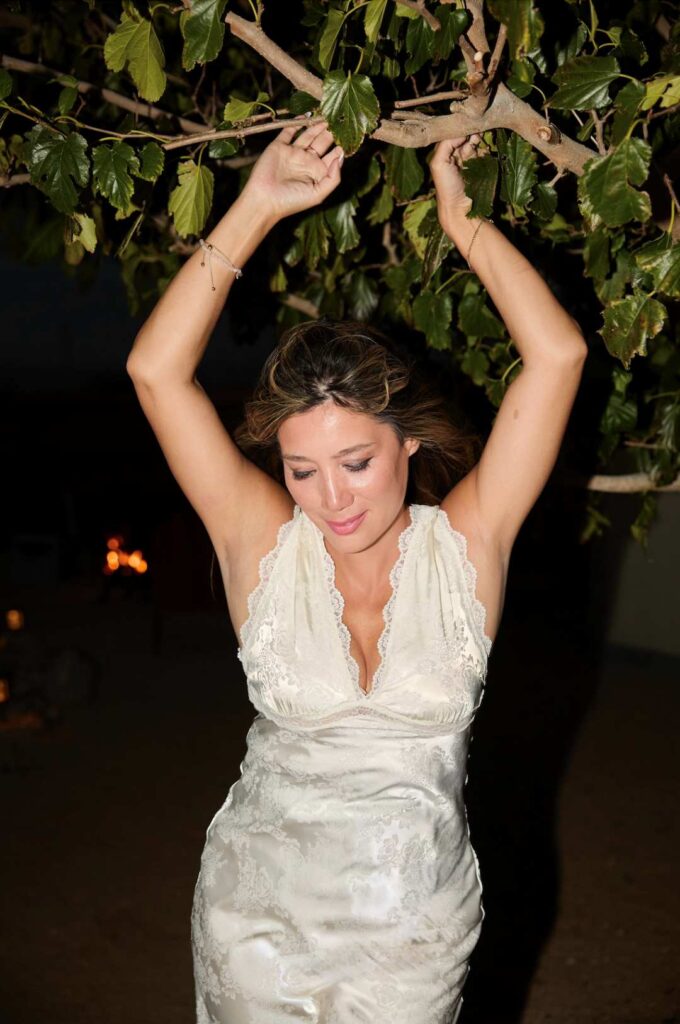
By the time Mourning Doves of Joshua Tree arrived in 2025, Beier’s ambitions had expanded considerably.
After more than a decade living in Los Angeles, Joshua Tree and the surrounding Mojave Desert became an important part of her creative world—a place where nature, stillness, spirituality and music began converging.
Produced with Steve Stout and released through Manimal Vinyl, Mourning Doves of Joshua Tree became perhaps Beier’s most fully realized artistic statement to date: a musical meditation on grief, motherhood, faith, nature and transformation, written in the aftermath of her grandmother’s passing and deeply shaped by the landscape of the California desert.
Rather than treating grief as an endpoint, Mourning Doves of Joshua Tree approaches it almost as a form of alchemy—transforming loss through nature, spirituality and music. Folk and Americana remain part of its foundation, but the record reaches toward a larger sonic world, drawing on full-band arrangements, atmosphere and Beier’s longstanding love of piano, orchestration and instrumental music.
Within that album was “Desert Soul.”
Rather than leaving the song where it was, Beier eventually returned to it as both an artist and producer, using the original recording as the foundation for what would become Desert Soul (REMIX).
Rather than simply releasing another version of the track, Beier returned to its underlying architecture with Stout and began asking a more difficult creative question: how far could a song be transformed while still retaining its soul?
That question became Desert Soul (REMIX).
BUILDING FROM THE ORIGINAL
Rather than approaching Desert Soul (REMIX) as a conventional remix, Beier and her team treated the existing song as a foundation.
They began pulling apart its musical and emotional architecture, asking what was essential to the identity of the song and what could evolve.
One answer emerged from the original chorus.
Rather than writing something completely unrelated, Beier discovered that a single lyrical phrase from the original chorus contained the foundation for an entirely new one. That fragment became the starting point for a newly constructed chorus, allowing the remix to grow directly from the DNA of the original song.
The same philosophy guided the production.
The reconstruction offers perhaps the clearest expression yet of Beier’s instincts as a producer. Guitar swells from the original recording were pitched upward to create an ethereal opening; acoustic guitar was reversed and surrounded with spacious reverb; and a newly composed piano arrangement created an emotional bridge between the two versions. Analog synthesizers, ambient textures and Mellotron strings expanded the track into a cinematic electronic environment, while live bass and acoustic instrumentation preserved a physical connection to the original recording beneath its new sonic architecture.
The result was not an attempt to erase the Americana song that came before it, but to discover another dimension already contained within it.
The original remained present.
They simply kept building.
The process also brought together different parts of Beier’s creative background. Her classical piano training provided one foundation; years spent producing films had taught her to think in terms of atmosphere, pacing, narrative and the construction of an entire world.
Desert Soul (REMIX) became a place where those instincts could meet.
FROM THE DESERT TO THE STARS
The visual and spiritual world of Desert Soul (REMIX) begins firmly on earth: Joshua trees, desert rock, open land and horizon. From there, it reaches upward toward the night sky, the stars and the cosmos.
The journey mirrors the music itself.
The original song remains grounded in the physical and emotional landscape of the desert. The remix takes that foundation and builds upward into a more atmospheric, electronic and otherworldly dimension without losing its connection to where it began.
“You’re not escaping the desert for the stars. The desert is where you’re standing to reach them,” says Beier.
For her, nature and spirituality have long been intertwined.
“Nature has always been my greatest teacher. The desert taught me stillness. The night sky taught me wonder.”
The desert is not something to leave behind. It is the ground beneath you.
The same philosophy extends beyond the recording. People cannot rewrite the path that they followed through life. The experiences, relationships, losses, discoveries and creative risks behind them become part of the foundation beneath them.
Evolution isn’t about erasing what came before.
It is about continuing to build from where you are.
THE MANY WORLDS OF AN INDEPENDENT ARTIST
Behind the records, performances and production is another central part of Beier’s life: she is the mother of twin boys.
Motherhood exists alongside songwriting, producing, filmmaking and the entrepreneurial realities of maintaining an independent creative career. Rather than viewing those identities as competing worlds, Beier sees family as part of the foundation beneath everything else.
Family, spirituality, nature and truth remain central to how she approaches both her life and her work.
THE NEXT DIMENSION

Desert Soul (REMIX) brings together many of the creative languages Beier has developed over the years: the classically trained pianist, songwriter, filmmaker, recording artist and producer.
The songwriter did not disappear as Beier moved further into production. The filmmaker did not disappear when music became her primary medium. Motherhood did not erase the artist. Each experience added another layer to the foundation.
Desert Soul (REMIX) represents the latest evolution of a musical journey Beier began building independently a decade ago.
Not by leaving what came before behind.
By building upon it—and seeing how far it can go.