
Inside Formula One’s Fever Dream at Silverstone
At the British Grand Prix with Philip Morris International, Rolling Stone UK converted to hardcore Formula One fandom
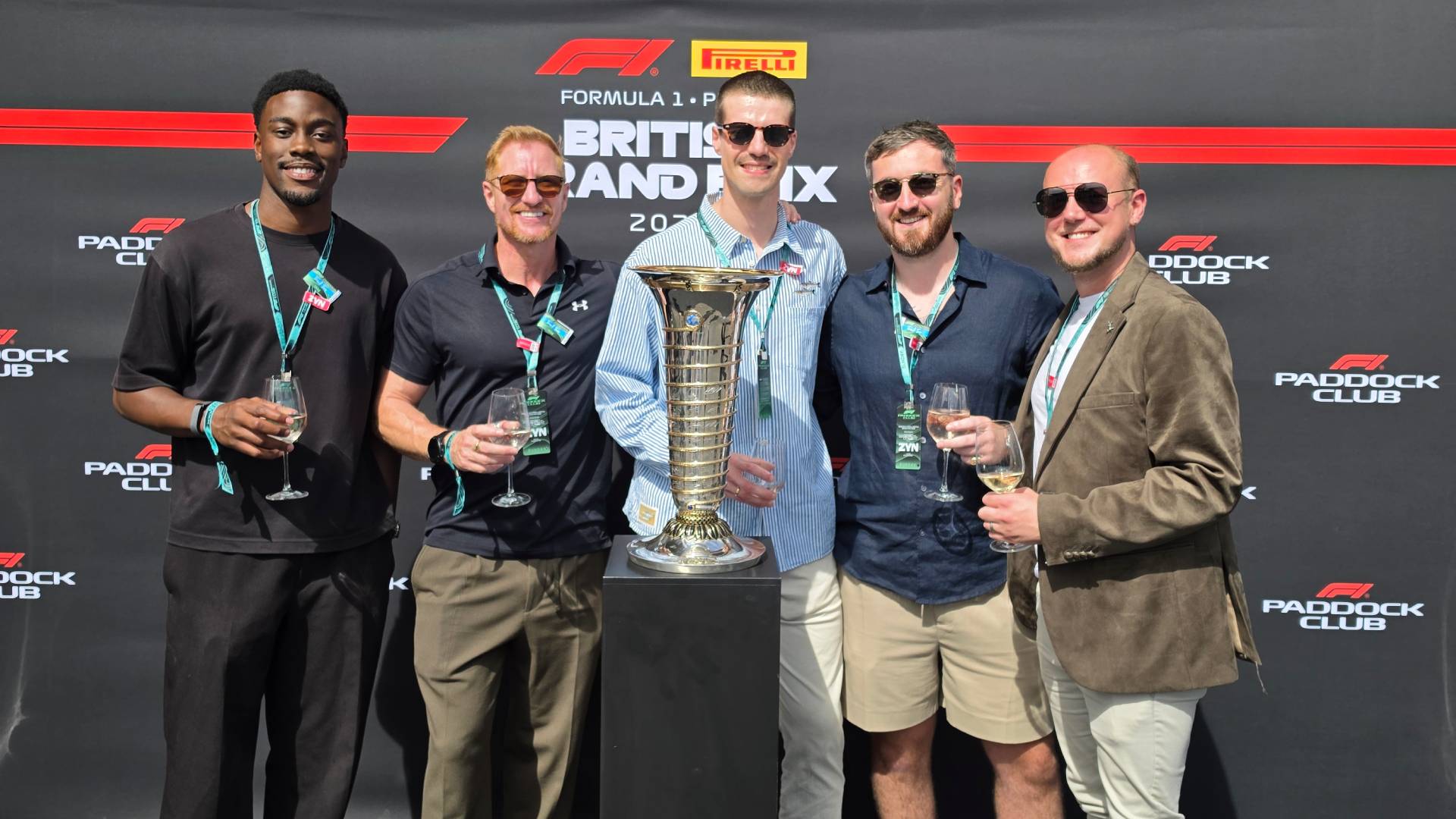
As guests of Philip Morris International at the British Grand Prix, Rolling Stone UK entered Formula One’s most dazzling world – where Ferrari made history, Silverstone shimmered in the heat and the cars screamed past like bullets.
The sound of Formula One, trackside, is almost inexplicable. It is vicious, stinging the eardrums. It is so sharp, so alien and so unlike anything we had ever heard before that the body seemed to react before the brain caught up: a shiver, somehow ironic in the 30-degree Silverstone heat.
Formula One, at close range, does not sound like sport. It begins with the strange, almost theatrical awareness that you are entering a world built around precision, danger and glamour – a place where engineering is treated with the seriousness of religion, and where even hospitality seems to run on its own invisible system of timing, choreography and control.
At Silverstone on Sunday, as guests of Philip Morris International, Rolling Stone UK found itself inside that world at its most heightened: race day at the British Grand Prix, in the F1 Paddock Club, with the Northamptonshire sun climbing over the circuit and turning the whole place into a shimmering, roaring heat trap. For the bald-headed among us, this is also when one begins to pay for insufficient attention to SPF coverage.
The Paddock Club is absurdly sumptuous. It is difficult to pull off that level of luxuriant polish without bordering on vulgarity, but here the detail felt aligned with the sport itself: controlled, choreographed, precise. The champagne was beautifully chilled. The service was calm. The PMI-hosted ZYN lounge offered a sanctuary within the wider theatre: fine dining, excellent company and the faintly surreal sensation of being both cocooned from and suspended directly above one of the loudest spectacles in global sport. Never has a gua bao felt more at home in the high temple of speed.
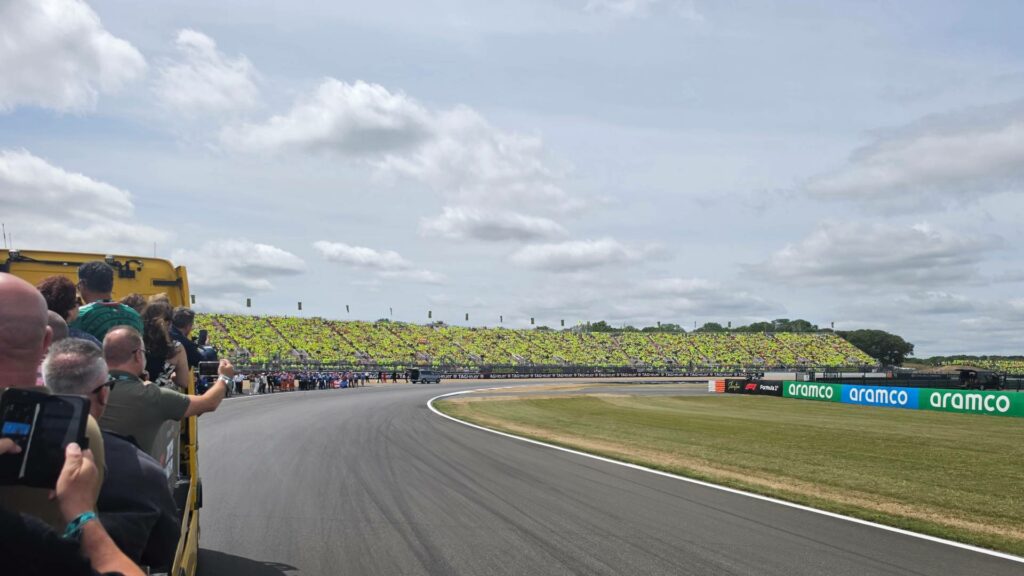
Once the sun had fully committed itself, Rolling Stone UK made its way down to exclusive trackside access – the kind of clearance we were told even Lewis Hamilton does not get. Somewhere nearby, Hugh Grant was being hosted by Ferrari. Elsewhere, Tom Doyle from the Rolling Stone UK team was meeting Chelsea’s Estêvão, checking in on the recovery of his hamstrings. PMI’s Jack Blain suggested he ought to transfer to Arsenal; Estêvão’s candid response to the latter will not be published.
These moments did not feel like interruptions to the day so much as part of its peculiar ecosystem. Formula One is sport, yes, but it is also cinema, fashion week, business summit, music festival and royal court, all happening at once. Among others, we spotted Adele, Cat Burns – fresh from the Attitude Pride Awards a couple of nights before – Lewis Capaldi, V&A’s glamorous Aline Santos Farhat and previous Rolling Stone UK Awards host Munya Chawawa.
And then, of course, there were the cars.
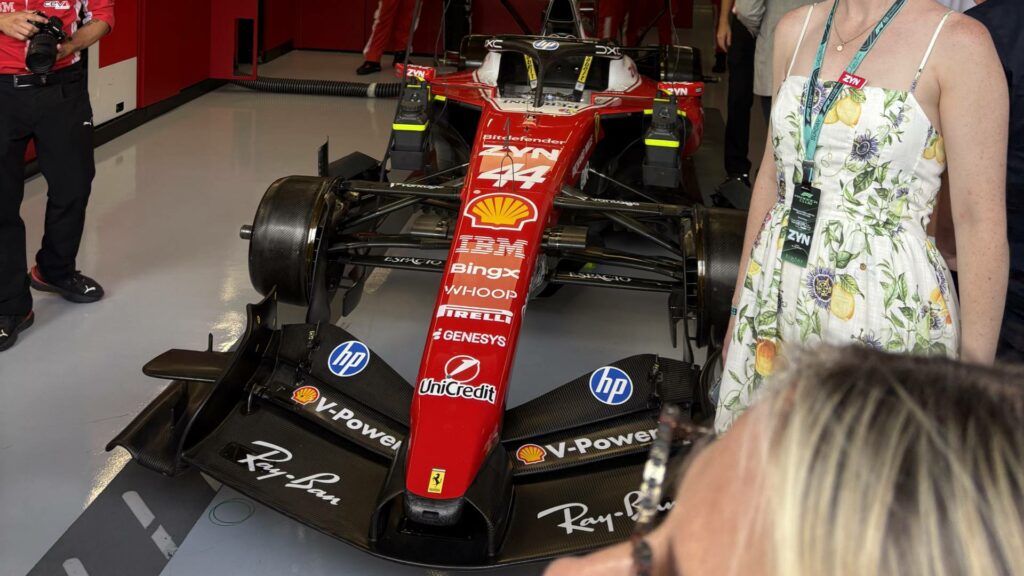
Getting up close and personal with the Ferrari SF-26 was a particular highlight. To stand near it is to see how much beauty exists in function. It is a theme park for branding, yes – all marketers and brand owners worth their weight could salivate at this elevated canvas – but behind the red paint and global iconography is a culture of relentless problem-solving, where tiny adjustments can shape the outcome of an entire afternoon. Having spent time with PMI in Venice for Bocelli’s stage, one begins to understand the desire to align with worlds built so completely around performance, emotion and precision.
Built for Formula One’s new 2026 regulation era, the SF-26 is part of a smaller, lighter, more hybrid-conscious generation shaped by active aerodynamics and a rebalanced turbo-hybrid power unit. Even parked up, it seems to be negotiating with the air: a scarlet object designed around invisible forces, from the viciousness of a 1.6-litre turbocharged V6 to the microscopic aerodynamic decisions that turn airflow into grip. This sport undoubtedly sells perfection, but its drama comes from the fact that perfection is always under threat.
That tension underscored the race itself. What had already been a dramatic British Grand Prix became, in its final laps, a piece of pure Silverstone theatre. Charles Leclerc, driving for Ferrari, took victory ahead of Mercedes’ George Russell and Ferrari team-mate Lewis Hamilton – a podium loaded with both British emotion and Ferrari mythology. It was Leclerc’s first win of the season and Ferrari’s 250th victory in Formula One, a milestone that gave the day the strange charge of history happening in real time.
For PMI, whose relationship with Ferrari stretches back more than five decades, the result could hardly have been more resonant. This was not simply proximity to a team or access to an elite sporting environment. It was the rare kind of hospitality experience where the story outside the window aligns almost too perfectly with the story in the room. Ferrari did not merely host, gleam and pose for photographs. Ferrari won. And amid the post-race hysteria, there too was ZYN, headline sponsor of the Rolling Stone UK Awards, visible in the orbit of a Ferrari victory.
The British Grand Prix carries a particular emotional charge because it belongs so deeply to the mythology of the sport. This is where the Formula One World Championship began in 1950; it remains one of the places where the sport seems to remember itself.
Here was also the exquisite absurdity that only live sport can produce. In a world of sensors, telemetry and aerodynamic genius, the day still found room for confusion, jeopardy and anticlimax. Max Verstappen’s late crash triggered the Safety Car, transforming the final laps into a tactical and emotional guessing game. Then the race finished behind the Safety Car, leaving the crowd with a bit of rose-fuelled frustration: the story had peaked, twisted and then been neutralised. That juxtaposition feels odd on the ground – and odder still when followed by the queue to leave Silverstone, a logistical symphony of moans rippling across the West Northamptonshire region.
What made the experience so powerful was not simply the luxury, though the luxury was incontestable and totally up this writer’s alley. It was the way the day moved between extremes: the polished ease of Paddock Club hospitality and the raw, almost childish thrill of being close enough to feel the race pass through your very organism.
Formula One has always understood the theatre of modern performance: the machine, the driver, the team, the sponsor, the intense crowd. At Silverstone, inside PMI’s world and alongside Ferrari on a day of genuine sporting consequence, we relished the show.
Leclerc won. Ferrari made history. And for one afternoon, from the Paddock Club to the heat and shriek of the trackside, Rolling Stone UK was converted into hardcore Formula One fandom.
Rolling Stone UK attended the British Grand Prix as guests of Philip Morris International.