
Rock in Rio Lisbon should be on every festival fan’s radar
This European extravaganza is a must-visit for festival fans.
By Bea Isaacson
In partnership with Rock in Rio Lisbon
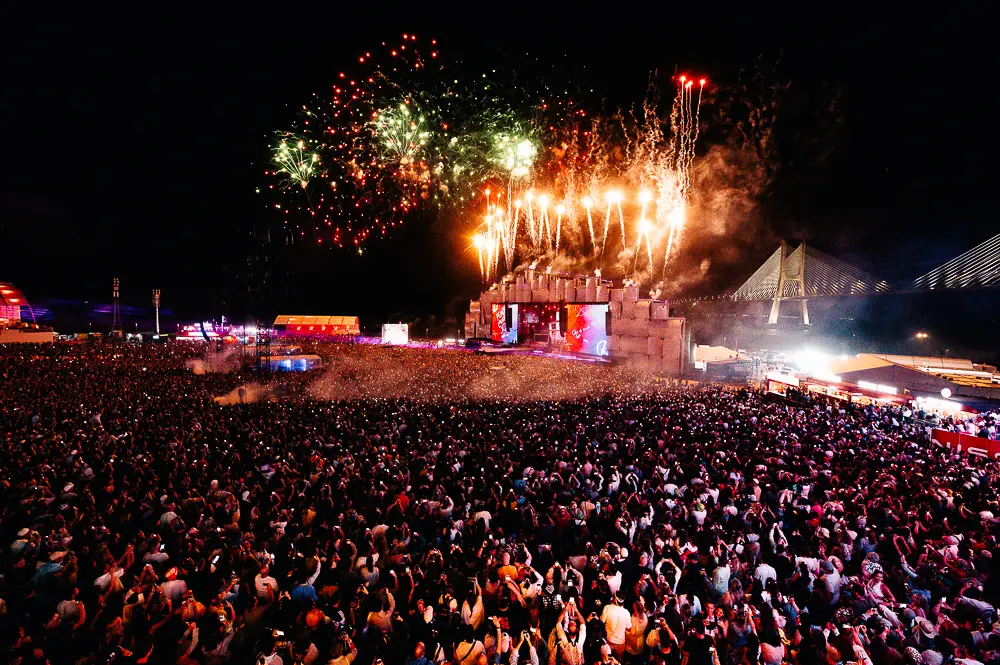
Rock in Rio may not be on the average festival fan’s radar, but it very well should be. Taking place across two June weekends in the Portuguese capital of Lisbon, the beloved festival brings some of the globe’s biggest and most iconic acts to the City of Seven Hills for a series of seriously fun days – and balmy, dancing nights, in which the clear Iberian skies are coloured with vivid fireworks before every headline act.
Located in Parque Tejo Lisboa, the grounds – slightly hilly and pleasantly sprawling – sit on the eastern edge of the city. Both the Vasco da Gama Bridge and the Tagus River gleam behind the festival, outfitting the landscape beyond the main stage, the aptly named World Stage. Positioned at the bottom of a softly sloped hill, there’s Colosseum heritage in watching audiences boogie with delight throughout the weekend, from Saturday’s golden hour Pedro Sampaio set, to Sunday night’s headliner, Linkin Park.
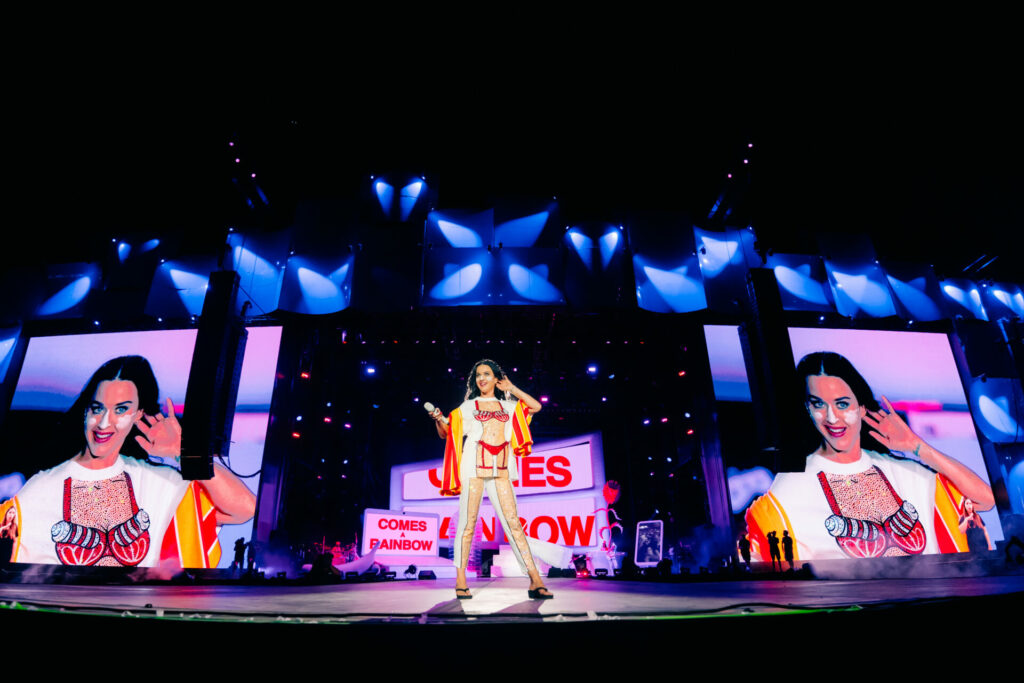
Well, the name may be Rock in Rio – and Sunday most definitely was – but the first day of this year’s festival was pure Pop in Portugal. After a decent performance by Charlie Puth, who went big on platitudes like “this is a song about not being taken seriously, and you’re mad, because you want to be taken seriously,” and “music is amazing,” the headliner of the first night was Katy Perry. Who – it soon transpired, after a rousing medley of California Girls, Teenage Dream, and T.G.I.F. – is actually somewhat local. Somewhere down the line. “How are you my Portuguese friends?” she roared (pardon the chart-topping pun) to her audience, a 90,000-strong coalition of teenage girls and Millennial gays. “I don’t know about you but I spat in a tube and I’m 24% Portuguese!”
The crowds revelled in total pop euphoria. Perry delivered a set as deliciously kitsch – and at times, downright bonkers – as her public persona has been both celebrated and derided for over the past two decades. She was in on the joke, though. After declaring that most people would go to space but are too scared to – “I’m not!” she added brightly – Perry introduced her ‘gayliens’, and also shouted out her astronaut dressed back up dancers, “the first gays in space!” Concluding with – what else – ‘Firework’, the audiences petered out in a collective daze. Perry’s set was maximalist to the point of near manic, utterly unpredictable, all at breath-taking speed. It was the kind of headline performance that one would expect from Coachella or Glastonbury. “That was the best thing I’ve ever seen in my entire life,” an 18-year-old said beside me.
It’s a testament to both Perry’s bona fide showmanship, and a zealous commitment to her rebranding campaign. But it is also, perhaps more strikingly, an indication of how big Rock in Rio is getting.
With an audience expansion of 22% this year, and capability to accommodate a whopping 100,000 people, Rock in Rio really has become one of the largest festivals across the continent. Standing from afar, watching the crowds gather at the World Stage is quite remarkable, if not even overwhelming: this is a colossal audience who – unlike at some other festivals – are predominantly, if not exclusively, here for the headliners. (The giveaway was the sheer quantity of Linkin Park tee shirts on the Sunday. It felt like being in an American mall in 2007.)
And yet Rock in Rio has seriously succeeded in managing size and scale. A boring bit of admin for a festival report, admittedly: but perhaps what I was most impressed by over my weekend was how well equipped the Rock in Rio team were in making the festival feel actually quite intimate, despite the numbers. 100,000 is hefty, if not even daunting – that’s half the size of Glastonbury’s intake, for context – and yet the festival never felt crowded nor congested.
Its strength lies in its subtle, but successful, family friendly ambience. It doesn’t necessarily advertise itself as a family day out, but that is how it’s evidently been interpreted for the weekend, and Rock in Rio are happy to oblige. On Sunday, little boys sit atop their dads’ shoulders for Kaiser Chiefs; at Bebe Rexha’s similarly timed afternoon slot the day before, little girls dance around to her radio-friendly hits. Perhaps matters might be different for 21 Savage headline day this weekend, where Central Cee is also billed to play. But for these consecutive days of pure pop and old school rock, there is no display of drunkenness, no disorderly behaviours. There’s a beer wall – the festival is well stocked with all sorts of vendors, from pad thai to a branded Sephora tent – which allows audiences to purchase a pint of beer through a vending slab of wood. In some British festivals, it would be toppled by 5pm.
For some sets, the noticeable absence of rowdiness only enhanced the live music experience. Linkin Park, still one of the world’s biggest rock bands, kicked things off with a countdown on the stage screen before coming on to applause that lasted into what felt like double digit minutes. The band – with Emily Armstrong, who joined in 2024 to replace Chester Bennington – started with their just as recent track, The Emptiness Machine.
Linkin Park throbbed with vitality for a set that felt tight, and yet never over-rehearsed, despite being on the festival circuit this summer. “Are we going to open the pit up here?” Armstrong asked at some point. The audience was having such a good time, the question should’ve been if they’d be at all interested in closing it.
A detail I haven’t mentioned yet is there is a zip-line at the festival, gliding right across the stage. “Hang on,” said a friend. “Is somebody seriously zip lining above Cypress Hill?” Beer walls, modes of aviation, and even Katy Perry in a water bottle during I Kissed A Girl. If it wasn’t before: Rock in Rio should be on every music lover’s – and, evidently, thrill seeker’s – festival radar.