
Aliens Are Among Us. Just Ask Steven Spielberg
'Disclosure Day' finds the great director once again staging close encounters with interstellar visitors — and crafting a conspiracy thriller that doubles as a career retrospective
By David Fear
We are not alone in the universe — Steven Spielberg has been telling us this for years. Aliens are among us. Sometimes they hide in our closets, looking like adorable geriatrics with glowing fingers (E.T.). Other times, they swoop down to our terra firma on mother ships, inspiring us to contemplate life, the universe, and everything in between playing with our mashed potatoes (Close Encounters of the Third Kind). Spielberg has warned us to watch the skies, lest these visitors try to recruit us for human zoos (Firelight, a sci-fi movie that the 17-year-old Spielberg made in 1964) or eradicate us entirely (War of the Worlds). He’s taught us to look for them in every nook and cranny of modern-day living, even if our memory of them is eventually erased by Will Smith (the Men in Black movies, which Spielberg has been an executive producer on since day one).
Now one of the great American pop moviemakers of the past 50 years has once again returned to the subject of little green men, in a format he virtually pioneered five decades ago: the prestige blockbuster. Disclosure Day takes it for granted that a) extra-terrestrials do exist, and b) the government is lying to you. Each of these concepts are considered a given and carry the same weight here, as well as the notions that whistleblowers are one of the last great defenders of democracy and that the powers of the state will be used to silence those who attempt to speak out. On paper, his latest reads like a 1970s paranoid potboiler. Onscreen, it looks a 1990s summer movie, all big-swing sheen. In reality, this woozy attempt to ride a wave of distrust and lack of faith in our authority figures couldn’t feel more of its moment. This time, the Men in Black are the bad guys. Remember when Spielberg digitally replaced the guns in the hands of government agents for the 20th anniversary of E.T., then expressed regret about the decision? Imagine that he not only restored the weapons but crafted an entire two-and-a-half-hour feature around that one sequence as a mea culpa. That’s Disclosure Day.
Spielberg drops us into this story en media conspiracy thriller, with our protagonist already on the run and the corporate thugs already hot on his trail. Daniel Kellner (Josh O’Connor, once again serving big Seventies antihero vibes) is trying to hide in plain sight at a pro-wrestling match when a goon sticks a gun in his ribs. They escort him to the parking lot, where a dapper villain named Noah Scanlon (Colin Forth, dapper and villainous) awaits. Scanlon was Kellner’s boss at Wardex, a private business contracted to maintain secrecy over the fact yes, Virginia, some “exotic craft” did indeed crash in Roswell, New Mexico, all those years ago. The proof of a cover-up is in Kellner’s backpack. He and some fellow conspirators within the organization want to make the info public. Scanlon wants the company’s intel back, and is willing to put a bullet in Daniel’s girlfriend, Jane (Eve Hewson), if that’s what it takes. Luckily, Kellner has a bargaining chip: a “device,” one of three, that can destroy cities, allow users to “dive” into another person’s consciousness, turn whole groups of people invisible, and essentially do whatever else Disclosure Day‘s complicated plot requires whenever the story needs to get from one point to the next. The close encounter ends in a stalemate and escape.
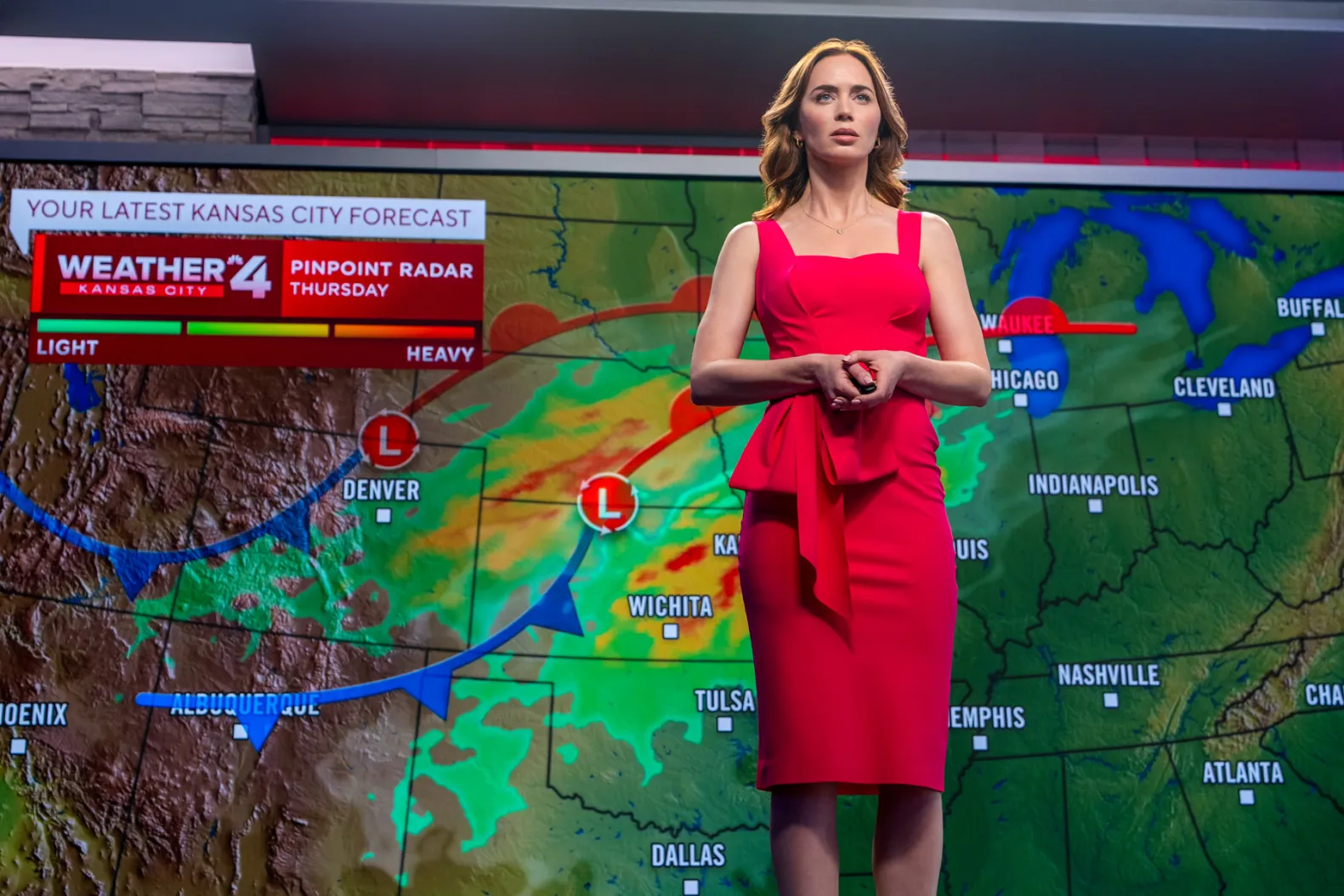
Meanwhile, in Kansas City, Missouri, your friendly neighborhood weather person Margaret Fairchild (Emily Blunt) is having an odd day. It starts with a CGI cardinal flying into her apartment, briefly interrupting an argument between Margaret and her boyfriend (Wyatt Russell). It peaks, weirdness-wise, with her suddenly talking in an otherwordly dialect during a live broadcast, thus attracting the attention of both Scanlon and Hugo (Colman Domingo), the ex-Wardex employee who’s entrusted Daniel with the hard drives containing decades worth of evidence. Somehow, Margaret has been activated by the presence of that bird. Now she can speak any language, read minds, cause people to see their dead loved ones, and receive transmissions of classified information seemingly out of thin air; much like that mystical alien device, her once-latent talents seem to morph and announce themselves according to the narrative whims of David Koepp’s script. Like Daniel, she too is on the run. But they are being pulled toward each other by forces beyond their control, and have a mutual date with destiny that will change everything, etcetera.
We should mention a few other things percolating in and around this duo’s fugitive flights: World War III is on the verge of popping off, thus keeping everybody on edge. Hugo has a team of helpers who appear to building a set — specifically, an old suburban house — in some undisclosed location, with a purpose that will be revealed when the time is right. Scanlon keeps remote-controlling Jane via that alien device. He also has a good-cop-bad-cop set of lackeys, with the good cop played by Hannibal MVP Hetienne Park and the bad cop portrayed by Henry Lloyd-Hughes; were that second character to be blessed with a mustache, he’d spend the entire running time eternally twirling it. The great Elisabeth Marvel shows up as a nun, who once took care of Jane back when she was a novitiate and contemplating a life spent in service to the divine. Religion seems to be the one institution the film still considers untainted and legit, and there’s a strong sense of faith running throughout Disclosure Day in a way that feels unique among Spielberg’s filmography. The Lord works in mysterious ways even while the filmmaker himself works in reliably solid ones, directing everything from extended close-ups to exciting chase scenes with the same chops and sense of awe that we’ve come to expect from him.
There’s also a strong feeling of faith regarding the telling of truths, which shouldn’t make Disclosure Day such a highly charged political film and yet, given the world we currently live in, arguably makes it the most political movie of the summer. That word, “truth,” is uttered more times here than in any previous Spielberg movie, and we’re talking about a guy who made an earnest drama about the publication of the Pentagon Papers (The Post). Conspiracy thrillers run on the thrill of shedding light on things that string-pullers want left languishing in the dark, and next to JFK’s assassination, the Roswell mythology is the Rosetta stone for the tinfoil-hat brigade. Spielberg is having fun by asking: What if all of that isn’t as crackpot as we all thought? But he also knows that the concept of public information as a currency and recognizing the simple fact that 2+2 does not equal 5, regardless of what any Big Brother du jour tells you, should be table stakes for any standard discourse in civil society. Reality has gone from consensus to contentious battleground. The filmmaker may be staging a pulpy campaign with this sci-fi throwback, but he sincerely seems to believe the truth is out there — and will set us free.
There’s a lot to love in Disclosure Day: O’Connor once again proving his leading-man bona fides without stopping to conquer; Blunt’s unique ability to make everything from bewilderment to steeliness to an impromptu rant in Russian seem organic and rooted in reality; the way that Colman Domingo invests the line “It’s always been the two of you” with the same gravitas most actors give to the words of Shakespeare, Pinter, and August Wilson; a shot of a car driving out of a farmhouse — like literally bursting out of its side — that reminds you of how summer movies used to feel on the regular but now rarely do. And there’s so much to roll your eyes at, from the way the movie’s twists and revelations feel frustratingly arbitrary to a climactic act that should feel showstopping and somehow falls flat. The philosophical musings never quite get above late-night dorm-sesh territory, and never quite jibe with the more blockbuster-y elements. David Koepp is, like the guy calling the shots behind the camera, a consummate professional, but it’s tough to shake the sensation that the herky-jerky screenplay needed a few more drafts.
Yet in the end, this is still a Steven Spielberg film. And while the quality of his output can vary wildly when you look at the big picture of his career, there’s still a baseline of love — for filmmaking, for storytelling through images, for giving people an experience that pushes emotional buttons and taps adrenal glands — that gives his work a sense of vitality and displays the sensibility of an artist at work. For those of us who grew up as members of Generation Jaws, the idea of a new Spielberg movie is an event regardless of whether it’s a blockbuster or a big-screen civics lesson. Ditto those who first cut their teeth on his work via his Nineties run, when he was probably the only Hollywood director who could release Jurassic Park and Schindler’s List in the same year (!) and have it somehow make perfect sense.
That cinematic Spielberg DNA is in Disclosure Day, and while this genre exercise may not hit the nosebleed heights of his best 21st century offerings — our picks would include: Catch Me If You Can, The Adventures of Tintin, Lincoln, The Fabelmans, West Side Story — there’s more than enough of his presence to warrant a ticket purchase. There’s also a weird full-circle feel to it, and not just because he’s returning to the fertile ground of Close Encounters and his other science fiction spectacles. You can see traces of everything from Duel to Minority Report show up, to the point where this almost doubles as a career retrospective in miniature. You can hear him cracking his knuckles as he stages both the bigger set pieces and the handful of smaller, more effective and intimate moments that pop through. Yes, Spielberg does believe that we are not the only game running in the cosmos. But he also believes that our better angels have not left the building, and that movies still have the power to communally blow minds and open hearts. That idea may strike some as old-fashioned, but it doesn’t seem alien in the slightest.