
Meet Bleech 9:3, the band channelling recovery into searing rock songs
The dual songwriters of these London-based Dubliners met in Alcoholics Anonymous before fulfilling their musical destiny together
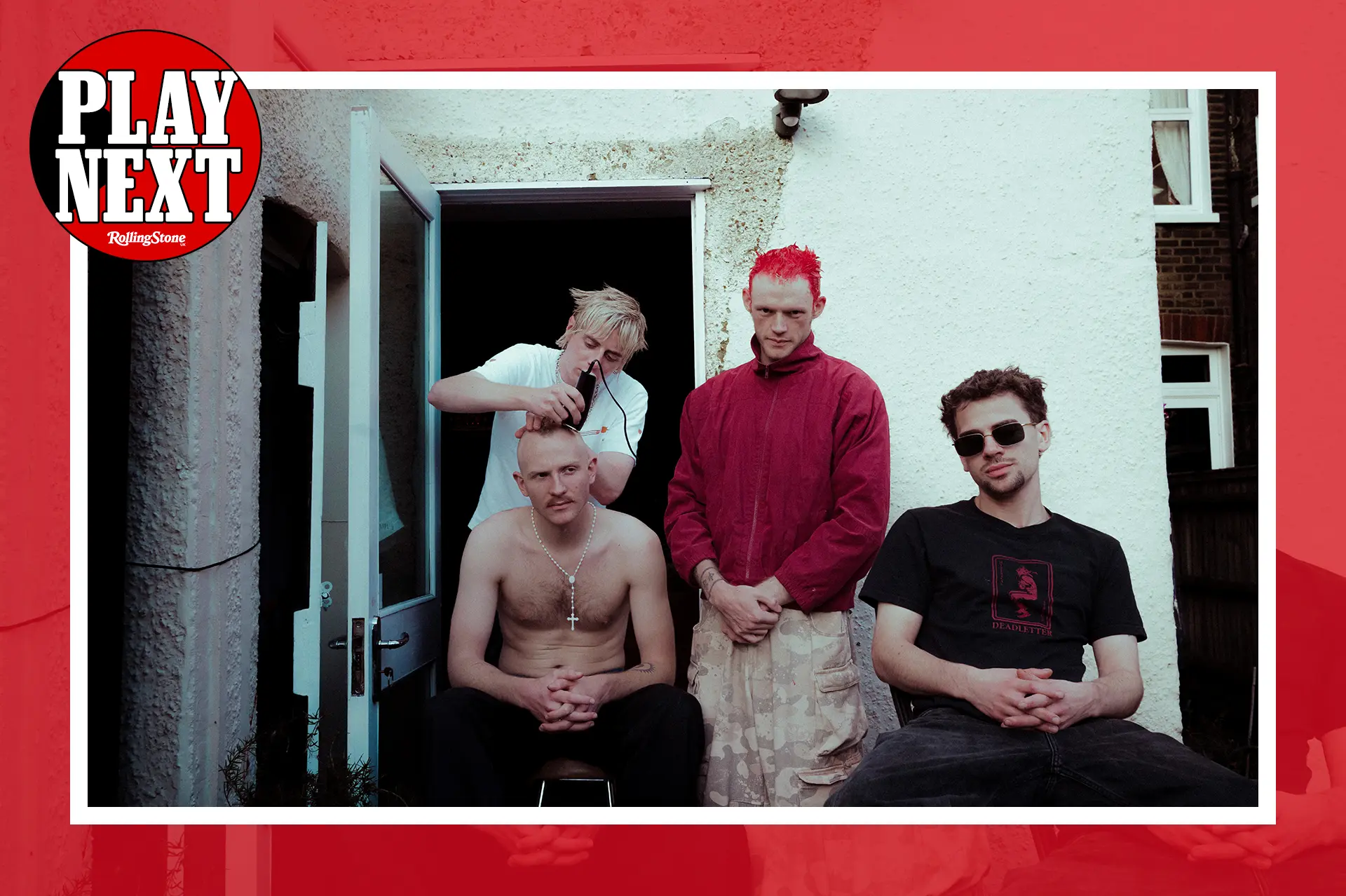
In retrospect, it’s a surprise that Sam Duffy and Barry Quinlan didn’t cross paths earlier than when they finally met. Both fixtures in the emerging and brilliantly exciting Dublin guitar music scene for years, it was only when they were introduced at an Alcoholics Anonymous meeting that the pair finally discovered the yin to their yang.
Previously, Barry had been playing in bands with his younger brother James, while Sam was performing alongside Luke O’Neill in another. Through Barry and Sam’s meeting, the two pairs became a four, with James and Luke joining them as Bleech 9:3, one of the most exciting new bands around.
Reflecting on his meeting with Baz, Sam tells Rolling Stone UK: “In my hippy-dippy way of thinking, I think that for both of our lives, our meeting and our friendship and our musical partnership, it was so important that it didn’t happen until the time was right. We didn’t rub each other up the wrong way,” he adds of meeting when in recovery, rather than when they were “doing things that might have done that”.
After their meeting, Baz – clean for three years at this point – took on Sam as his sponsor, with the pair “pretty much instantly” making music together in their new home of London. “We kept it a secret from the other people we were making music with at the time, because I think we had an inkling that it would actually upset some people,” Sam says.
Three years later, the band have released their self-titled debut EP, a searing collection of impassioned and perfectly crafted rock songs, and developed a reputation as a fearsome live act.
As they continue a 2026 spent almost entirely on the road, Bleech 9:3 discuss their formation, how the band has evolved since then, and the power of music as a vessel through which to channel their continued recovery.
Read our Play Next interview with Bleech 9:3 and listen to their music via our Play Next playlist on Spotify below.
Sam and Baz, can you tell us a bit more about the way you two met and how it impacted your lives?
Sam: We met in February 2022. I was obviously trying to be sober and was in a time where there was a lot of trying and a lot of failing. We tried to do the whole program of recovery, which Barry guided me through, and it actually didn’t work. I had more of a journey to go on with my own alcohol use and drug use. That brings us to December 2022, which is when I eventually got sober. Then we started to do real recovery work, where I took it seriously, in February 2023. Pretty much instantly, we started writing music together.
Does meeting in this very specific way, inextricably tied up with real life and real issues, give a band more of a meaning and a purpose from the off?
Sam: I can only speak for myself, and I’d like to give everyone the benefit of the doubt that anyone who doesn’t suffer from this disease like we do is totally equipped to access all the same sensitivities and about subjects that are equally as important and touching to them. However, going off our own experience when we were going through through all that stuff, putting the [12-step] book down and then picking up the guitars at the end of the day, the air was very rich with a lot of emotion and sensitivity. It was very easy to access much deeper topics and emotions between each other. It was almost like we were picking them out of the air after those days.
It does seem surprising that two kindred spirits like yourselves only met when you did…
Baz: We only grew up ten minutes away from each other, but I think when the time was right, then we met. I had already done my whole big journey – I was three years sober when I met Sam – so I was in a position to help him, which had I not gone on my own path, I wouldn’t have been able to do that and the band probably would never have existed. I think it came at the right time. I don’t believe in fate, and I don’t believe it’s written for you what’s going to happen in your life, but I think you’ve got the free will to set yourself on a path and you’ve got to constantly be trying to straddle the line between chaos and order.
When it did come to writing music, were you instantly aligned on what you wanted the band to sound like? The ‘Bleech’ part of the name refers to wanting to have a completely clean slate from what came before…
Baz: We very naturally were doing a lot of open tunings. It was more major [key] but not glossy. It was more folky and experimental. We did our first bunch of demos in October 2024 and that was a good marker to put in the ground. We said, ‘These are good, but it could honestly just be any other band playing any of those songs’. We decided to be as hard on ourselves as possible when it came to trying to carve out our own sound and go towards stuff that wasn’t as close to what inspired it.
James: It just clicked pretty much immediately. It just felt right. I suppose when you’re having experiences that don’t feel right for such a long time, when you finally get a band of guys together that have that intuition it’s pretty unbeatable. It feels like there’s nothing that you can’t write or you can’t play. It’s a really special thing, and all the more special when you’ve previously been doing something that you don’t love as much.
Was there one song that unlocked this most?
Baz: I think we were all very excited about ‘Jacky’. I had the whole thing [played] on acoustic guitar and I brought it into the rehearsal room. When we played it as a band, it was like a funk song – obviously that was totally wrong! One night in early 2025, we were in Pirate Studios in Croydon. James was trying to get me to listen to this Fugazi song. I wasn’t paying attention, so he threw his phone at me across the room, nearly hit my head, bounced off the wall behind me. James is my brother, so there’s no invitation to violence there; it’s just the way we communicate.
So I picked up the phone, heard what he was trying to get me to listen to, and I passed it over to Luke, and I think James and Luke started playing ‘Jacky’ but in a different way, in a more direct fashion. Then Sam went over and started making this sound, which I had never heard before, and then, a couple of minutes later, we had our first little recording. The way it all happened, the way it came about, totally born out of frustration, that’s the one that we felt very proud of.
What does the self-titled EP represent to you?
Sam: The [songs] represent that first chapter [of the band]. They’re also the highlights of our first set that we played so much around all the clubs and pubs in London.
And what does the next stage of the band look like?
Sam: It looks like the album. The second [the EP] happened, we were all just onto the next thing. We’re finishing writing the album and then going to record it after all this crazy touring over the summer.
Finally, can you tell us about the striking photographs that make up the artwork to your singles and the EP?
Baz: I came across the single artwork for ‘Ceiling’ years ago on Instagram, the boy jumping over the fire. I was just so struck by that image, and there are so many different levels of symbolism. I screenshotted it and Google image searched it to try and find out some more stuff about it. I managed to find the guy who took the picture, he happened to reply to me on Instagram. He’s represented by the British Culture Archive and he’s taken so many amazing pictures. When we came across the broader collection of pictures, which the ‘Ceiling’ artwork was a part of, they just really spoke to us, those kids growing up in Birkenhead, outside Liverpool, in the 80s. Based off the power of that first picture alone, I was just like, ‘If I ever put out a body of work, this is what I want to be on the cover’.
Have you found out anything about the boy on the EP cover?
Sam: All we know is that a girl came up to me in Liverpool earlier this year [at a gig] and she said, ‘The kid in the pictures, that’s my uncle!’ We asked her to put us in touch and she never did, she was quite shy. It’s a real shame, but I do know someday we will meet him. It must be strange for him, and that kid, because there’s now the cover for ‘Ceiling’ and then the cover for the whole EP. He’s made it over the fire and he’s looking into the lens of the camera with a few things to say.