
Family Values: The Cribs
Wakefield’s finest, The Cribs, discuss finally expressing themselves fully on their ninth studio record, Selling a Vibe, how a legal battle almost ended the band, and their enduring brotherly bond
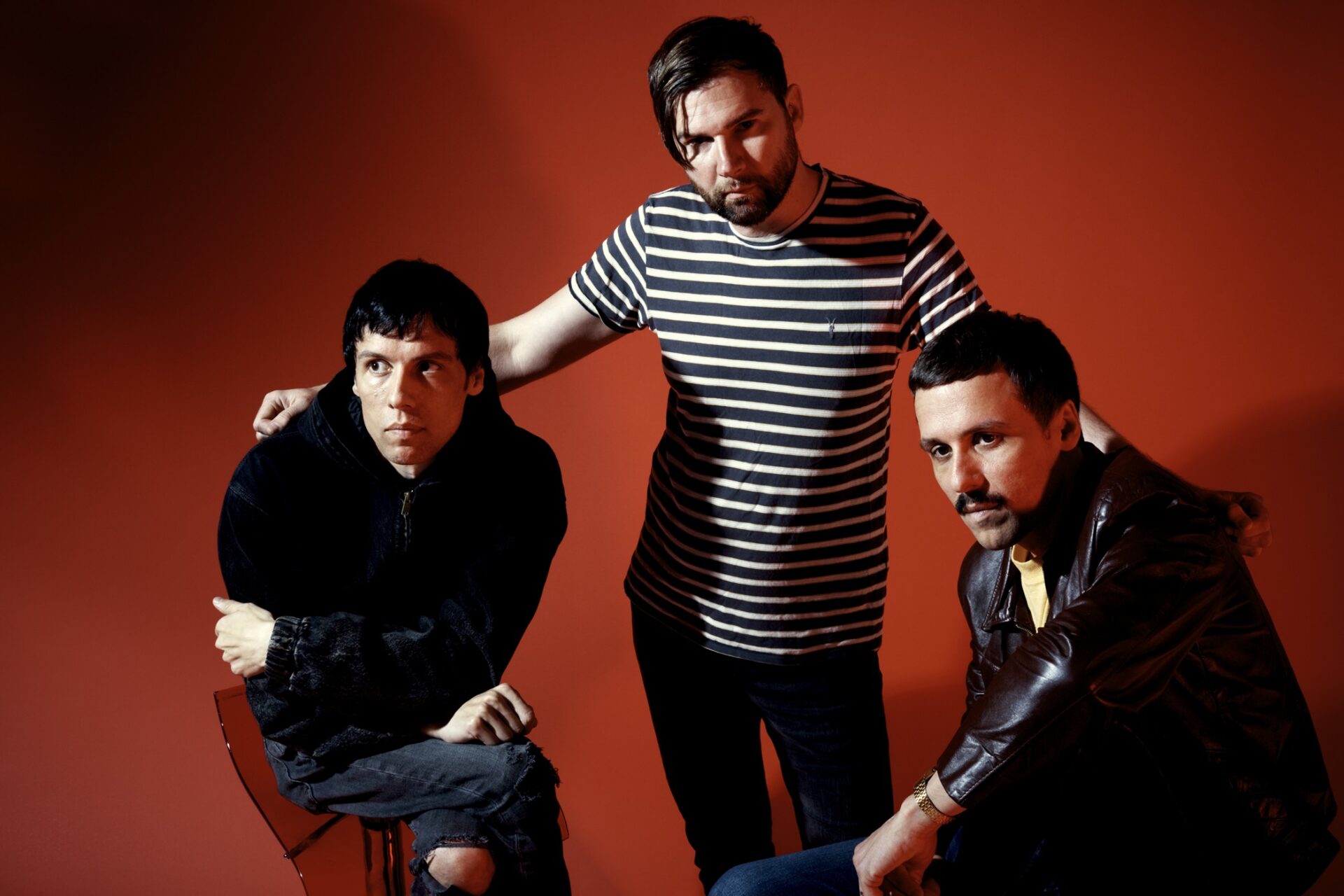
It’s an overcast afternoon in early November 2025 when Rolling Stone UK meets The Cribs at their management office in Shoreditch, a quiet, well-decorated space lined with gold discs and trophies. The band are in high spirits, and it’s easy to see why. Five years since their last record, Night Network, The Cribs are back and feeling reinvigorated. They’re preparing to release their ninth studio album, Selling A Vibe, on 9 January – a record they view as their best yet, as bassist Gary Jarman puts it: “We’re always working harder to beat the prior one.”
This workhorse ethic has allowed the group to quietly become one of the UK’s most beloved cult bands of the past 20 years. They were mainstays during the golden era of 2000s indie sleaze and guitar rock, but the Jarmans – twin brothers Gary and Ryan and younger brother Ross – always served up a more considered and evolved sound that saw them take home awards and cultivate a dedicated legion of fans.
Their 12-track album arrives at a moment when the band have a newfound appreciation for what they do, and in many ways the five-year break helped spur that. Night Network’s release came with “no personal element”, as it dropped during the height of the Covid pandemic and everything was handled online, says Gary.
Ryan, meanwhile, feels he “changed completely as a person” following a serious health issue his girlfriend faced in 2021 and a general period of growth. Ross, the only brother still based in Wakefield while the twins live in the US, has been balancing music with parenthood.
Focusing on life has only helped inspire them further. “We have always really loved doing this,” Gary says. “But having time away from it, the whole process was really enjoyable. It felt really elective to do it; we felt lucky to get to do it. You get to enjoy the elements you take for granted.”
Ryan adds: “Going into this record, I appreciated it. I felt completely refocused on it. Before that, the band had been my sole focus – that’s not really the right relationship to have. It’s good to see it for what it is, as opposed to seeing it as this all-consuming thing.
“It sounds pretentious, but the writing seems more profound as well, because you realise the degree of catharsis that comes from it. You don’t want to waste [time] writing songs for the sake of it. After time away, the writing process feels more significant.”
Ross sums it up simply: “It’s been five years since Night Network came out, but it never really feels like a hiatus, because we’re always working on something.”

Yet only a few years earlier, things didn’t look so promising. The Cribs underwent a tumultuous legal battle after deciding to part ways with their former management following 2017 album 24-7 Rock Star Shit. Whilst there was no “tangible” internal discussion, Ryan says the band might have called it quits if the case “hadn’t managed to work out”. They were emotionally drained and jaded about the music industry from spending two years as “pseudo-lawyers and accountants”.
Still, they found a silver lining. “The irony of the whole legal thing was that as demoralising as it was at the time, once it was sorted, it was really galvanising,” says Gary. “It felt really good and really inspiring. I think Night Network and Selling A Vibe were the two records we enjoyed writing the most, wrote the quickest, and appreciate the most [as a result].”
It would have been a travesty if they’d stopped. The Cribs hold a special place in the UK music landscape. ‘Hey Scenesters’, ‘Men’s Needs’ and ‘We Share the Same Skies’ are just a few Cribs anthems now regarded as indie-rock classics. They’ve always been a band rooted in counterculture, who have never been concerned with being the biggest group in the world. What matters, Gary says, are the “experiences and connections” you make along the way.
“It’s never been about Radio One or Top of the Pops,” he adds. “But we’ve achieved a lot more than we ever thought we would, and we’re really proud of it.”
Ryan admits he’s had a natural aversion to ‘Men’s Needs’ and other big hits over the years, as their success created “a certain degree of resentment”, given the breadth of The Cribs’ catalogue. Now, with distance and perspective, he feels differently. “As I’ve got older, the idea that we wrote even one song – even if it’s just ‘Men’s Needs’ – that became part of British culture, even for a few years, I really get a kick out of it now. I’m a lot more philosophical about it.”
Ross adds: “None of us expected to still be doing this for so long. I was 17 when the band started, and Gary and Ryan were 20 or 21. It’s really nice that we’re still doing it and people are still interested. To still have songs getting playlisted on radio and to be doing big shows or going on tour with dates selling out, no one expected that.”
Collaboration has long been central to The Cribs’ story, from welcoming The Smiths guitar legend Johnny Marr as a full-time member during one era to teaming up with artists like Lee Ranaldo and Franz Ferdinand’s Alex Kapranos. Now producer Patrick Wimberly – known for his work with MGMT and Caroline Polachek – brings a distinct pop sensibility to Selling A Vibe. He never set out to turn The Cribs into a “commercial pop act”; instead, he encouraged them to step away from their usual analogue-heavy process, sitting with the tracks for months after recording to refine and shape them.
“With Patrick, we were excited about working with someone whose ideas were things we’d never think of,” Ryan says. “We’ve consciously made a decision not to overwork songs, to boil them down to their base elements. So we thought if we give someone with a successful track record of making pop records these strong, hooky elements, we can let him do his thing.
“Sometimes our tendency, if we had something strong, was to temper it. But Patrick was like, ‘This is the best bit – go with it.’ He brought a lot of sonic ideas to the table.”
At its core, Selling A Vibe is a celebration of family. Where their early lyrics reacted to the culture swirling around them, this album takes a more introspective turn, drawing on the Jarmans’ shared upbringing, lived experiences, and the bond that has carried them through every era of The Cribs.
“When you write a record, you want to be a little uncomfortable with your lyrics,” says Gary. “It feels uncomfortable when you write things that are very open, because you think you’re giving too much away. But that’s what we enjoy now. Once you get over that, it’s what you’re most proud of. Between the three of us, we were comfortable enough to express that and look inward.
“We’ve turned over all those rocks, and you come out the other side more comfortable and confident in who you are. We’ve got a pretty clear-eyed vision of what The Cribs is now, so there’s no reason not to let it all hang out.”
Ryan agrees: “You don’t want to feel like you’ve left anything on the table – that would be the worst. When I think about our career now, all the stuff we’ve been through, all the ups and downs, all the people we’ve worked with – it’s only us three left. We’re the only ones who have been here from the start. After more than 20 years, there’s a lot of significance in that.”
The Cribs are now a band “with the wisdom to only do what is necessary”, cutting out the “noise” and “bullshit” the music industry can bring, he says.
Nine albums is a milestone not many bands reach, and for the Cribs, the only thing that matters now is legacy. “We try to make the best record we possibly can, but also we leave behind what we want to leave behind,” Gary beams.
“All I care about is looking back and being proud of what we’ve left, because you never know when it’s going to be your last record. That’s why we’re comfortable enough now to express what we want to express, without fear or self-consciousness. All that matters in the future is what’s on the record.”