
Fella Cederbaum’s Expanding Universe of Characters and Short Films Points to a Fearless Creative Future
In partnership with MahniVerse Productions
By Nia Bowers
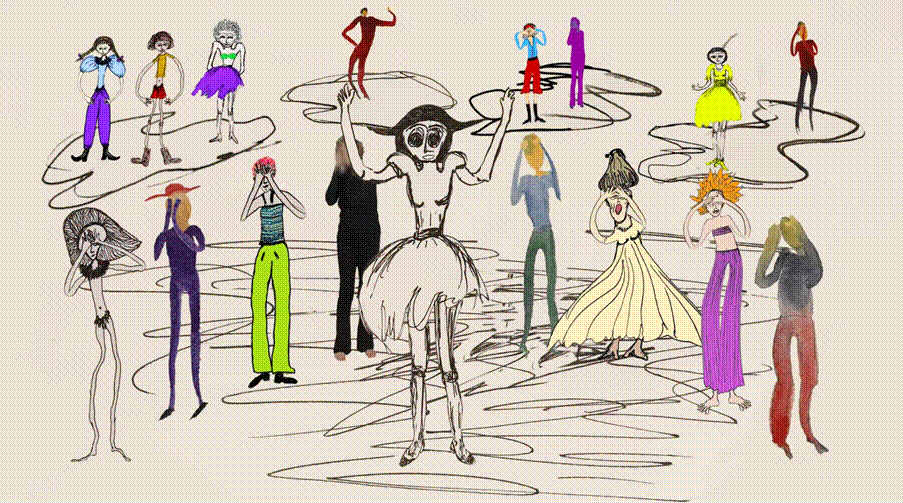
Fella Cederbaum keeps finding new company in her own creative orbit. Her growing cast of MahnoDahnos, MahniDahnies, Bambolinas, and unnamed on-screen figures has turned her short films into a constellation of recurring characters built around a simple idea: art should raise real questions and not settle for easy answers. In a culture that often treats work as content and artists as suppliers, Cederbaum quietly follows a different path, using masks, music, and visual storytelling to keep the focus on ideas rather than personality.
A Studio Full Of Selves
In the studio where MahnoDahno first appeared, the character did not arrive as a marketing tool but as a way to explore thoughts and themes from a fresh angle. MahnoDahno works as an alter ego that separates message from messenger and creates room for reflection without the weight of a visible, named narrator. MahniDahni followed as a related figure, also in disguise, playing with familiar ideas about identity and how people present themselves.
Bambolina joined this small ensemble as an animated character who could easily belong in a children’s program but instead appears in work that deals with deeper questions. Together, these characters act like a gentle chorus, encouraging viewers to reflect on love, truth, control, and the stories they tell themselves about the world. In a time of personal branding and constant self-display, Cederbaum chooses to step back and let these figures take center stage. The result is that the work itself, rather than the artist’s image, stays in clear view.
Poems That Travel Across Mediums
In Cederbaum’s body of work, poetry does not stay confined to the page. It appears as spoken word, combines with music, connects with paintings, and then becomes part of short films. Lines and images move from one medium to another, so that sound, color, and movement all carry parts of the same thought. The collection of short films that emerges from this approach feels like a series of focused reflections rather than a set of unrelated pieces.
This cross-pollination of forms gives the work a steady, contemplative tone. Paintings serve as visual anchors, words guide the narrative, and music shapes mood and tension. Viewers are invited to listen and watch closely rather than rush through. The aim is to look beneath surface opinions and belief systems and to pay attention to what might be shared underneath. The result is art that will stay with the audience and return to mind in quieter moments.
Truth, Comfort, And What Comes Next
Cederbaum’s projects have received humanitarian recognition and attention from festivals, in part because they are willing to address difficult themes in a direct but thoughtful way. Albums such as Truth and Destiny and Speech Acrobats explore language, perception, and the way people speak about events in uncertain times. Her films, including works that focus on fear and control, invite viewers to reflect on their own assumptions and sense of direction. Rather than offering simple reassurance, the work encourages a slower, more careful examination of what feels true.
She holds a distinctive place across poetry, music, and visual art, choosing a path that does not chase trends or quick reactions. While a lot of public conversation focuses on winning arguments, Cederbaum returns to questions about empathy, inner guidance, and what connects people beneath their differences. Her approach favors patience over speed and depth over volume.
Her evolving universe of MahnoDahnos, MahniDahnies, Bambolinas, and other emerging figures feels less like a marketing strategy and more like an ongoing creative language that viewers gradually learn to understand. The characters continue to appear, the films accumulate, and the work grows more layered over time. At its core is a straightforward belief: art can do more than entertain in passing; it can gently unsettle, clear away a little noise, and make space for a more honest look at what people share.
For audiences who are used to quick clips and constant distraction, Cederbaum’s work offers a quieter alternative. It suggests that the creative future may belong to artists who give viewers time to think and feel, and who trust that people are still willing to look inward when the screen stops shouting and simply asks them to see themselves a bit more clearly.