
’28 Years Later: The Bone Temple’ review: An audacious, jaw on the floor masterpiece
This unsettling epic will instantly rank as one of the year's most memorable films.
By Nick Reilly
When last year’s 28 Years Later concluded, we were faced with the unsettling image of young Spike (Alfie Williams) being taken in by a group of acrobatic outcasts all dressed in blonde wigs, shell suits and gold chains which resembled that of Jimmy Savile.
If this was enough to upset your sensibilities, then we subtly suggest that you buckle the fuck up or get out now. Here is a film where unrepentant violence (primarily dispatched by the gang of Jimmies) and a general air of malevolence arrives within minutes, throws your jaw to the floor and ensures that it remains there for the subsequent two hours.
But it’s testament to Alex Garland’s tight script and Nia DaCosta’s intimate direction that it never feels overly gratuitous, nor shocking for shock’s sake. In closely following demented cult leader Sir Lord Jimmy Crystal (Jack O’ Connell) and his gang of brainwashed survivors, we’re cleverly forced to confront the idea that even in the midst of an undead epidemic, man’s inhumanity to man is still perhaps the most terrifying force of all.
That becomes evidently clear as Spike is essentially press-ganged into joining the group and forced to undertake the vicious bidding of Crystal, though he’s keen to escape at every opportunity. It marks O’Connell’s second villainous turn in 12 months after Sinners and he’s utterly chilling here. We previously saw Crystal as a young boy at the start of Years… when his minister father was memorably torn apart by the infected in his own church. Now, he believes that he’s the son of Lucifer, commanding his gang of freaks to dispatch graphic violence whenever he so desires.
This includes the harrowing moment where the demented leader happily sits atop a throne and commands his freaks to dispatch a group of hostages in a barn with worrying glee. In Crystal, a spine-chilling villain for the ages is born. The unsettling catchphrases used by Crystal to command his followers feel fittingly Savile, while the gang’s love of cartoonish violence feels akin to something from A Clockwork Orange.
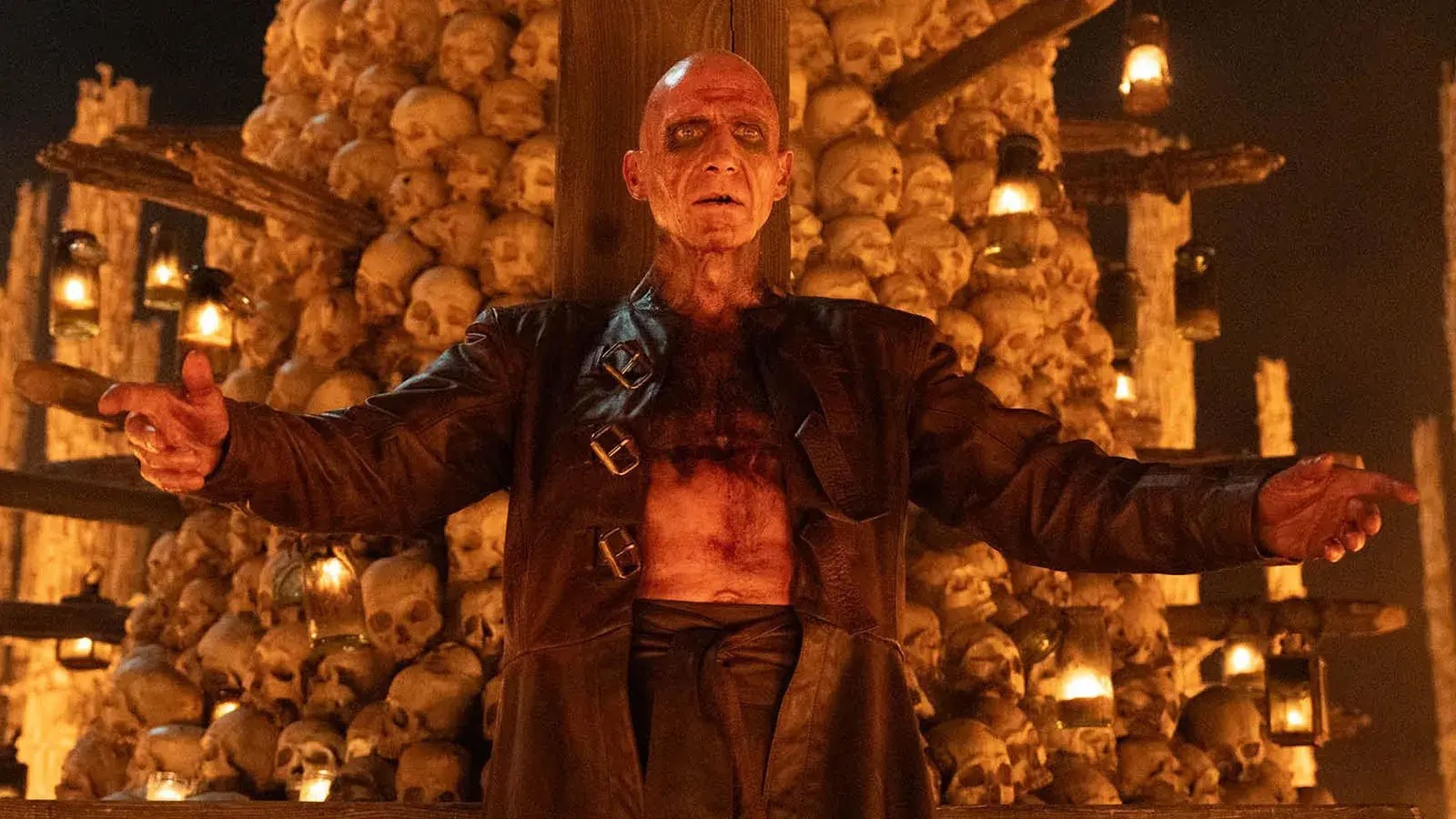
It’s all nicely balanced by the return of Ralph Fiennes as Dr Ian Kelson, the Duran Duran loving doctor who has created the titular monument to the dead and acts as the film’s true moral compass. This time around he’s on the cusp of discovering a major medical breakthrough about the Rage Virus as a result of his unusual relationship with Samson (Chi Lewis-Parry), who you’ll probably remember from the last film as the member of the infected with a particularly prominent appendage.
That’s until he encounters Sir Jimmy, of course. Fiennes’ ability to go from stoic survivor to visibly terrorised only acts to amplify the sheer nastiness of O’Connell’s performance, and eventually lends itself to his key role in one of the film’s most brilliantly demented set pieces. We’ll say little more than the fact that you’ll probably never listen to Iron Maiden in the same way again. It’s a film ultimately defined by the performances of these two men.
We’re loath to say much else, because this is a film that takes an audacious swing for the fences and comes out as one of the most brilliantly unsettling things you’re likely to see all year. Between Alex Garland’s contemplative script and Nia DaCosta’s constant establishment of pressure-cooker dread, we’re faced with a film where the infected take something of a back seat and are instead afforded a look at the reality of what’s happened to those left behind. The result is something magnificent.